Property Taxes in Italy: A Complete Guide to IMU and Real Estate Costs in 2026
Understand Italy's property taxes, including IMU, TARI, and notary fees, essential for homebuyers to avoid unexpected costs in 2026.


Buying a home in Italy is a dream for many: the charm of hilltop villages, the Mediterranean climate, the food culture. But before falling for a beautiful listing, you need to know that the asking price is not the final price. On top of that figure come several property taxes in Italy (IMU, TARI, Canone RAI, notary fees) that vary depending on the nature of the property and how you intend to use it: primary residence, holiday home, or rental investment.
The differences can catch buyers off guard, because the tax advantages are not the same for those who settle permanently in Italy and those who purchase a second home. This article breaks it all down: which taxes apply at the point of purchase, which recur every year, what the difference is between property tax and the waste collection levy, and how much buying a home in Italy really costs.
Primary or secondary residence in Italy

In Italy, the distinction between a primary residence and a secondary residence is fundamental, because it determines the entire tax framework that applies to your property. The Italian state encourages long-term residents to own their homes, while taxing second homes and rental investments more heavily.
To qualify for the bonus prima casa (a reduced registration tax of 2% instead of 9%), you must establish your residence in Italy within 18 months of purchase. This benefit is reserved for people who genuinely live in the property. Falsely declaring a primary residence while actually living abroad constitutes tax fraud.
The Agenzia delle Entrate (Italy’s tax authority) has several tools to verify residency claims, including checks on electricity consumption. In practice, to be considered a tax resident in Italy, you must live there for more than 183 days per year.
What does buying a home in Italy actually cost?
Many buyers are charmed by an Italian property without realising that the listed price is only the beginning. Agency fees, taxes, notary fees and administrative costs mean that the true cost of buying property in Italy is often higher than expected.
Agency fees are typically split between buyer and seller, with each party paying on average 3% to 4% of the property price, plus VAT at 22%. On top of that come:
- Notary fees (roughly 1% to 2% of the property price)
- Registration tax: 2% for a primary residence (bonus prima casa), 9% for a second home, calculated on the cadastral value (which is often 30 to 50% lower than the market value)
- Mortgage and cadastral taxes (€50 each)
- Official translations of documents if you are not an Italian speaker
- Legal or administrative assistance, particularly for foreign buyers
- Surveyor fees, where applicable, to verify cadastral compliance
On average, you should budget between 15% and 20% of the purchase price in additional costs. Building in a financial buffer will help avoid unpleasant surprises.
Summary table of property taxes in Italy
| IMU (property tax) | Owner (second home) | 0.5% to 1.06% of revalued cadastral value | Twice a year (June & December) |
| TARI | Occupant (owner or tenant) | Varies by municipality & property size | Annual (1 to 2 instalments) |
| Canone RAI | Television owner | €90 / year | Annual (via Italian electricity bill) |
| Registration tax | Buyer | 2% (primary residence) / 9% (second home) | At purchase (one-off) |
| Notary fees | Buyer | 1% to 2% of the purchase price | At purchase (one-off) |
IMU: Italy’s property tax
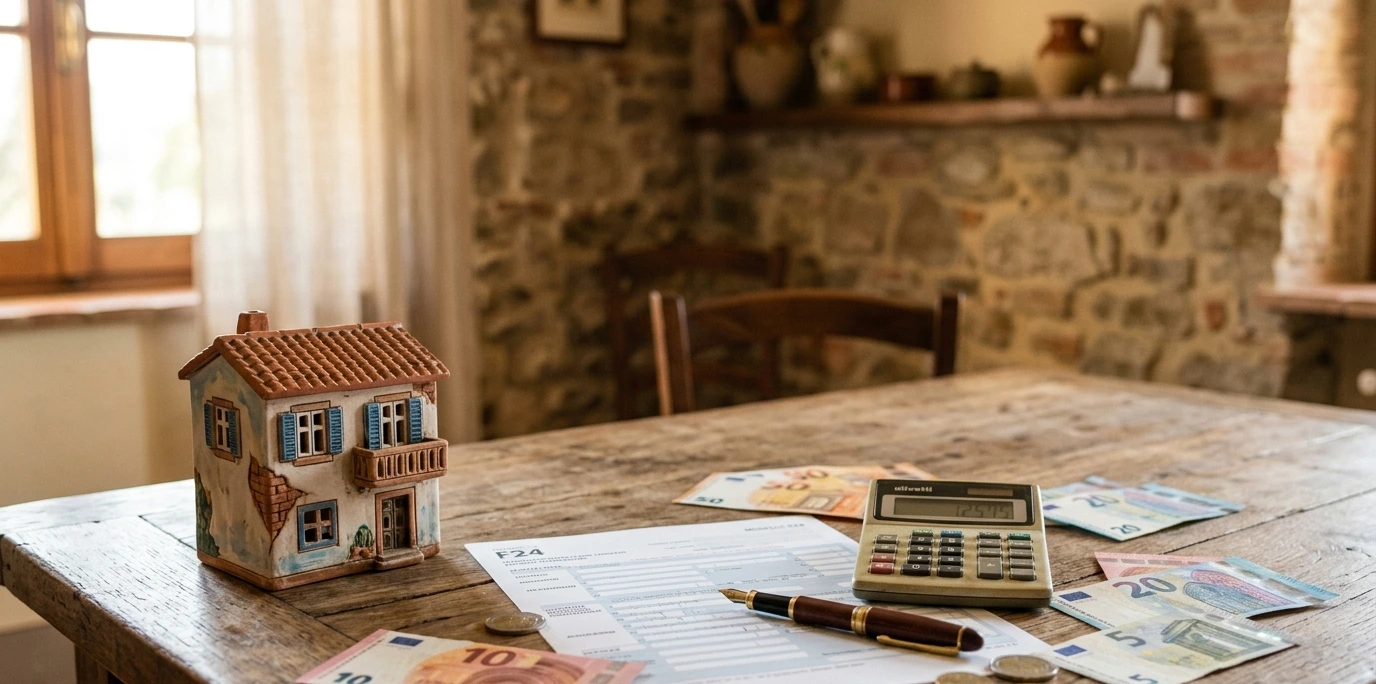
The IMU (Imposta Municipale Unica) is Italy’s annual property tax. It applies only to second homes and luxury properties (cadastral categories A1, A8, A9). If the property is your primary residence, you are generally exempt.
How is IMU calculated?
The calculation is based on three elements:
- The cadastral value of the property (rendita catastale), shown in the notarial deed
- A national multiplier coefficient based on the property category (160 for standard residential properties, category A)
- A municipal rate (aliquota), generally between 0.5% and 1.06%
Formula: IMU = Rendita catastale × 1.05 × Coefficient (160) × Municipal rate
IMU worked example — €200,000 apartment as a second home
Scenario: apartment purchased for €200,000, used as a second home, medium-sized municipality (IMU rate: 0.86%)
- Estimated cadastral value: €800/year (rendita catastale)
- Revaluation: €800 × 1.05 = €840
- Category A coefficient: €840 × 160 = €134,400 (taxable base)
- Municipal rate: €134,400 × 0.86% = approx. €1,155/year
That works out to roughly €578 in June and €577 in December. The amount varies depending on the municipality and the actual rendita catastale of the property.
Payment is made twice a year, in June and December, using the F24 form (available online or through Italian banks). Some municipalities also accept payment through their own online portals.
For non-residents, a tax treaty between Italy and your home country may prevent double taxation on rental income. Consulting a specialist in Italian property taxation is strongly recommended.
TARI: the waste collection levy
The TARI (Tassa sui Rifiuti) is Italy’s waste collection charge. It is paid by whoever occupies the property (whether owner or tenant) and is set by each municipality based on the property’s surface area and the number of occupants.
For a second home, it is often possible to apply for a reduction of up to 30%, on the grounds that the property is not occupied year-round. This application must be made directly to the Comune. Without an explicit request, the full rate applies.
TARI is generally paid directly to the municipality, based on payment notices (bollettini) sent out each year, in two to four instalments depending on the area. Some municipalities accept payment through the PagoPA platform.
Worth noting: if you are buying an unoccupied property or a home in need of renovation, declare your situation as soon as the notarial deed is signed to avoid any backdated charges.
Canone RAI: the Italian television licence
The Canone RAI is the Italian public broadcasting licence fee, set at €90 per year. It is collected automatically through the electricity bill between January and October, at €9 per month.
Despite what you might assume, this charge does not apply to owning an internet connection or a computer. It applies only to owning a television set.
You can be exempt from the Canone RAI in two situations:
- You do not own a television in the property
- The property is a second home not used as a habitual residence
In either case, you simply need to submit a non-ownership declaration (dichiarazione di non detenzione) to the Agenzia delle Entrate by 31 January of the relevant year. The process is entirely online.
Notary fees in Italy

In Italy, the notary plays a central role in every property transaction. Their involvement is mandatory for registering the sale deed (rogito notarile), and they are chosen (and paid) by the buyer. For a full overview of their responsibilities, see our dedicated article on the role of the notary in Italy.
Notary fees in Italy include:
- The notary’s own fees: roughly 1% to 2% of the purchase price (on a sliding scale that decreases as the property value rises)
- Registration tax: 2% (primary residence) or 9% (second home), calculated on the cadastral value
- Mortgage tax: €50 (fixed amount)
- Cadastral tax: €50 (fixed amount)
- VAT on fees: 22%
For a foreign buyer, additional costs may apply:
- Certified translation of identity documents and the sale deed
- Assistance from a bilingual lawyer or legal adviser
- Obtaining a codice fiscale (Italian tax identification number, required for any purchase)
In total, budget between 10% and 15% of the purchase price in notary fees and purchase-related taxes for a second home. If an inheritance involving Italian property is on the horizon, the rules differ — our guide on inheritance in Italy covers everything you need to know.
Good to know: in Italy, notary fees and registration tax are calculated on the cadastral value of the property rather than the market price. Since cadastral values are often 30 to 50% lower than what a property actually sells for, buyers can end up paying significantly less than they would expect.
Italy vs the UK: a quick property tax comparison
For buyers familiar with the UK property market, here is a brief overview of the main differences:
| Annual property tax (second home) | Council tax: typically £1,500–£3,500/year, often with a 50% surcharge for second homes | IMU: generally €800–€1,500/year for a comparable property |
| Purchase costs | SDLT (Stamp Duty) + legal fees: typically 5–8% for a second home (higher rate SDLT applies) | 9–12% for a second home (calculated on cadastral value, not market price) |
| Primary residence exemption | No annual property tax as such; council tax applies to all occupied homes | Primary residence exempt from IMU (except luxury properties) |
Italy is generally more tax-efficient for full-time residents, particularly thanks to the IMU exemption on primary homes. For non-residents or second-home owners, the overall tax burden is broadly comparable to the UK — but Italy’s cadastral values (often well below market prices) reduce the taxable base considerably, which can make the actual bills lower than they first appear.
Conclusion
Buying a home in Italy means understanding the local tax landscape before you sign. Between the IMU (Italy’s annual property tax for second homes), the TARI, the Canone RAI and notary fees, the total budget goes well beyond the asking price.
The good news is that Italy’s property tax system is broadly competitive with other European countries — particularly if you establish your primary residence there. In that case, you benefit from the bonus prima casa and full IMU exemption. If you are also considering buying land, our guide on buying land in Italy is worth a read.
Our advice: before any purchase, have a bilingual professional run through your tax position. A few hundred euros spent on specialist advice can save you thousands down the line.
FAQ — Frequently asked questions about property taxes in Italy
What is the property tax in Italy?
The main annual property tax in Italy is called the IMU (Imposta Municipale Unica). It is paid by owners of second homes and luxury properties (cadastral categories A1, A8, A9). The amount is calculated by multiplying the cadastral value by a national coefficient (160 for standard residential properties) and then applying a municipal rate set between 0.5% and 1.06%. Primary residences are exempt.
What are the notary fees for a foreign buyer in Italy?
Notary fees in Italy typically represent 1% to 2% of the purchase price for the notary’s own services, plus registration tax (2% or 9%), mortgage and cadastral taxes (€50 each) and VAT on fees. Foreign buyers should also budget for document translation and bilingual legal assistance. For a second home, total notary-related costs generally come to between 10% and 15% of the purchase price.
Is IMU compulsory for all properties in Italy?
No. IMU applies only to second homes and luxury properties. If the property is your primary residence, you are exempt — one of the main financial advantages of relocating permanently to Italy.
How do I know if I qualify for the bonus prima casa?
The bonus prima casa applies if you are buying your first home in Italy and register your residency in the municipality where the property is located within 18 months of purchase. You must also live there for at least 183 days per year to retain the tax benefit.
Can I be exempt from the Canone RAI?
Yes. If you do not own a television, or if the property is a second home not used as your habitual residence, you can apply for an exemption by submitting the official form (dichiarazione di non detenzione) to the Agenzia delle Entrate.
Is there a TARI reduction for second homes?
In many municipalities, yes. If your property is only occupied for a few weeks a year, you can apply for a reduced TARI rate. The percentage reduction depends on local rules and must be requested directly from the Comune.