

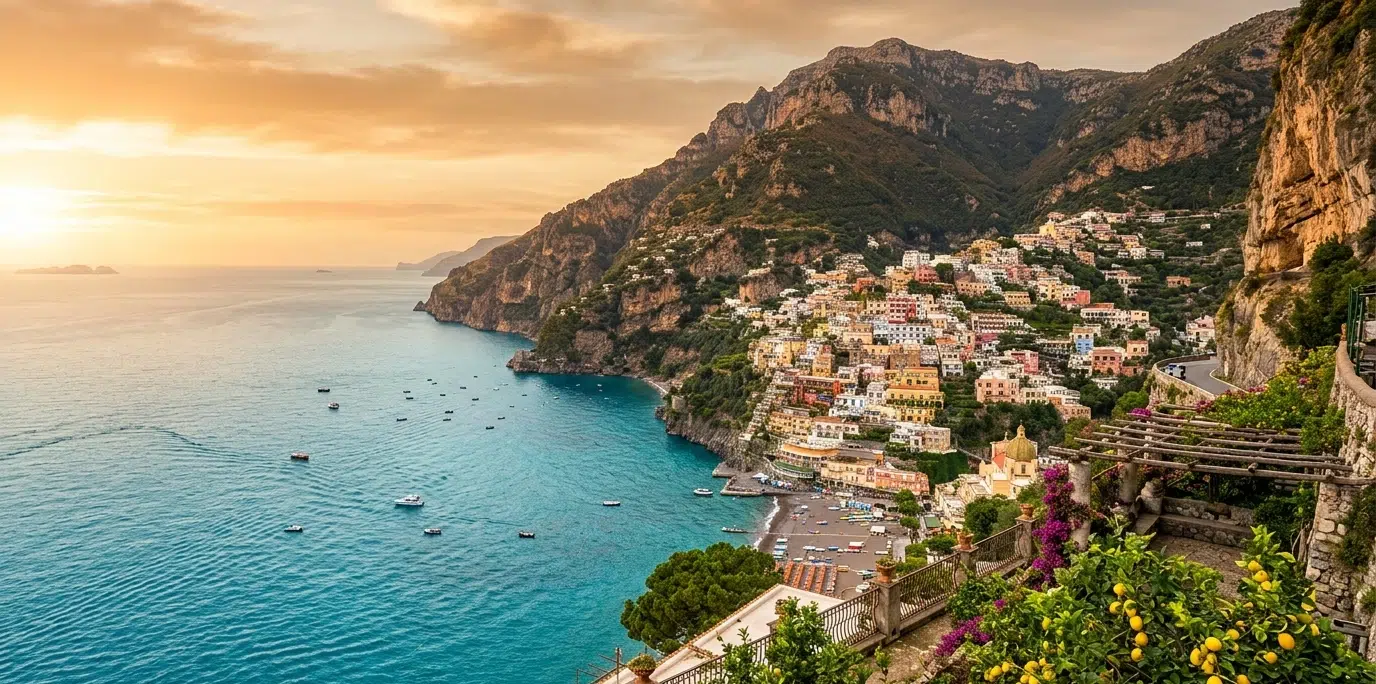
 Imagine throwing open your shutters onto the Gulf of Naples, breathing in the scent of Amalfi Coast lemons, or listening to the silence of a Cilento village perched between sky and sea. Buying a house in Campania is one of the most compelling property projects in Italy, and one of the most affordable, provided you know where to look and how to navigate the Italian administrative process.
Campania packs an extraordinary density of heritage, nature, and gastronomy into a single region. Naples, Pompeii, the Amalfi Coast, the islands of Capri and Ischia, the Cilento… these are places that capture the imagination of travellers and investors from around the world. And beyond tourism, a growing number of foreign buyers are now making the move into property investment in this part of southern Italy.
In this complete, up-to-date guide for 2026, you will find the best areas to invest, market prices zone by zone, everything you need to know about €1 homes in Campania, and the concrete steps to secure your purchase as an overseas buyer.
Contents
- Why buy in Campania in 2026?
- The best areas to invest in Campania
- Property prices in Campania: zone-by-zone table
- €1 homes in Campania: the complete guide
- Steps to buying a house in Campania
- Taxes and purchase costs to budget for
- Practical advice for international buyers
- Conclusion
- FAQ — Your most common questions
Why buy in Campania in 2026?

Campania is one of Italy’s most populous regions, home to more than 5.6 million people. Yet its property market remains significantly undervalued compared to regions of similar appeal such as Tuscany or Liguria. That gap is precisely where the opportunity lies for savvy international buyers.
Several factors explain Campania’s growing attractiveness:
- Prices that are still low: outside the premium tourist zones (Capri, Positano, Ravello), prices per square metre remain accessible, often between €800 and €1,500/m² in rural areas and smaller towns.
- Good air connections: Naples Capodichino Airport is served by direct flights from London, Dublin, Amsterdam, and many other European cities year-round, with numerous low-cost options available.
- Strong rental potential: Campania attracts more than 5 million tourists every year. A well-located property can generate significant seasonal rental income, particularly through platforms like Airbnb.
- Outstanding quality of life: exceptional food, a mild climate, rich culture, and proximity to the sea make Campania a natural choice for a holiday home or a permanent move.
- Tax incentives: Italy offers meaningful tax advantages for foreign retirees settling in southern municipalities, including a flat tax of 7% on foreign-sourced income.
Since 2022, the Campanian property market has seen a modest price recovery in coastal areas and around Naples, while inland zones (Irpinia, Sannio, inner Cilento) have held onto very low prices. Getting in now, before these areas attract wider international attention, makes good sense.
The best areas to invest in Campania
Campania is a diverse region, and property opportunities vary considerably depending on where you look. Here are the main areas worth knowing:
Naples and its metropolitan area
Naples is a complex, fascinating city in the midst of transformation. The UNESCO-listed historic centre and neighbourhoods such as Vomero, Chiaia, and Posillipo concentrate most of the demand. Prices in these areas have risen in recent years but remain well below those of Rome or Milan. For a rental investment, Naples offers excellent returns, particularly around the major universities and tourist districts.
The Amalfi Coast and Sorrento
This is the most sought-after and expensive part of Campania. Positano, Amalfi, Ravello, Sorrento: prices can reach €5,000 to €10,000/m² for properties with sea views. Rental yields are very strong, but the entry point is high. This area suits buyers with comfortable budgets (from €300,000 upwards).
The Cilento
The Cilento is Campania’s hidden gem. A national park, medieval villages, unspoilt beaches, and a cuisine recognised worldwide as the cradle of the Mediterranean diet. Prices remain very accessible, between €500 and €1,200/m². It is also the area with the highest concentration of €1 home programmes.
Irpinia (province of Avellino)
Less known to international buyers, Irpinia is a region of rolling inland hills, celebrated wines (Taurasi, Greco di Tufo, Fiano di Avellino), and authentic villages. Prices are among the lowest in Campania (€400–800/m²), making it ideal for a primary residence or a rural guesthouse project.
Sannio (province of Benevento)
Benevento and its surroundings offer an unusual but very affordable alternative. The city was rebuilt after the Second World War and has a surprising architectural heritage, including Trajan’s Arch and the church of Santa Sofia. Property prices are low, and you can still find homes to renovate for under €50,000.
The Domitian Coast and the coastal Cilento
Between Naples and the Lazio border to the north, the Domitian Coast (Caserta, Mondragone, Sessa Aurunca) is less touristic but benefits from good infrastructure. Further south, the coastal Cilento (Palinuro, Marina di Camerota, Acciaroli) offers some of Italy’s finest beaches at still-reasonable prices.
Property prices in Campania: zone-by-zone table
The Campanian property market is highly varied. The table below summarises average prices per square metre in 2026 by main area, for a property in good condition. For a property needing renovation, subtract 30 to 40%.
| Area / Location | Average price (€/m²) | Low range | High range | Buyer profile |
|---|---|---|---|---|
| Naples centre (Chiaia, Vomero) | €2,800 | €2,000 | €4,500 | Tourist & student rental |
| Naples suburbs / outskirts | €1,400 | €900 | €2,000 | Primary residence, long-term rental |
| Amalfi Coast (Positano, Ravello) | €6,500 | €4,000 | €12,000 | Prestige, premium seasonal rental |
| Sorrento and the Sorrentine Peninsula | €3,500 | €2,500 | €6,000 | Holiday home, seasonal rental |
| Salerno city | €1,800 | €1,200 | €2,800 | Primary residence & rental |
| Coastal Cilento (Palinuro, Camerota) | €1,500 | €1,000 | €2,500 | Seasonal rental, holiday home |
| Inner Cilento (villages) | €650 | €300 | €1,000 | Renovation, rural guesthouse, primary residence |
| Irpinia (province of Avellino) | €600 | €350 | €900 | Relocation, agritourism, primary residence |
| Sannio / Benevento | €550 | €300 | €850 | Entry-level, renovation |
| Caserta and province | €1,100 | €700 | €1,800 | Primary residence, good value for money |
| 🏡 €1 home programmes (Cilento, Irpinia) | €1 symbolic | — | Renovation: €30–80k | Full renovation, residency commitment |
| Source: allerenitalie.com estimates based on data from Immobiliare.it, Idealista and OMI (Osservatorio del Mercato Immobiliare) — 2026. Prices are indicative and vary according to the condition of the property, view, floor, and local specifics. | ||||
€1 homes in Campania: the complete guide
€1 homes in Campania are one of Italy’s most widely covered property stories in recent years, and one of the most misunderstood. Here is the reality behind the headlines, and everything you should know before getting involved.
How do these programmes work?
The €1 home programmes (or case a 1 euro) are municipal initiatives designed to fight rural abandonment. Faced with depopulation, a pronounced issue in inland Campania, certain municipalities put properties up for sale at a symbolic price of one euro. These are typically homes that belonged to owners who died without heirs, or that were voluntarily handed over. The goal is twofold: to revitalise local communities and economies, and to bring back into use buildings that are deteriorating through neglect. In exchange for the symbolic price, buyers commit to a set of strict conditions.
The conditions set by the municipalities
Each municipality sets its own rules, but the conditions most commonly encountered in Campania are as follows:
- Mandatory renovation works within 2 to 3 years of the deed of sale, generally estimated at between €30,000 and €80,000 depending on the condition of the property.
- Security deposit: between €2,000 and €10,000, returned on completion of works or forfeited if works are not carried out.
- Primary residence requirement: some municipalities require the buyer to register the property as their main residence, which can raise questions for non-Italian residents.
- Licensed architect or geometra: works must be supervised by a local professional, which represents an additional cost.
- Planning permission (permesso di costruire or CILA): required for any structural renovation.
Campanian municipalities participating in these programmes
Here are the main Campanian municipalities that have launched or renewed €1 home programmes in recent years:
| Municipality | Province | Area | 2026 Status | Notes |
|---|---|---|---|---|
| Teora | Avellino (AV) | Irpinia | ✅ Active | Village rebuilt after the 1980 earthquake, authentic atmosphere |
| Zungoli | Avellino (AV) | Irpinia | ✅ Active | Listed among the Borghi più belli d’Italia, well-structured programme |
| Bisaccia | Avellino (AV) | Irpinia | ✅ Active | Medieval castle, views over the Apennines |
| Buonabitacolo | Salerno (SA) | Inner Cilento | ✅ Active | Cilento National Park, traditional architecture |
| Felitto | Salerno (SA) | Cilento | ✅ Active | Village known for handmade fusilli, programme open to artisans |
| Rofrano | Salerno (SA) | Inner Cilento | ⏳ Ongoing | Near the Vallo di Diano, very remote but unspoilt nature |
| Sant’Angelo all’Esca | Avellino (AV) | Wine-growing Irpinia | ✅ Active | In the heart of the Fiano di Avellino vineyards |
| ⚠️ Programme statuses change regularly. Always verify with the relevant municipality before making any commitment. Some municipalities have waiting lists. | ||||
The realistic budget for a €1 home
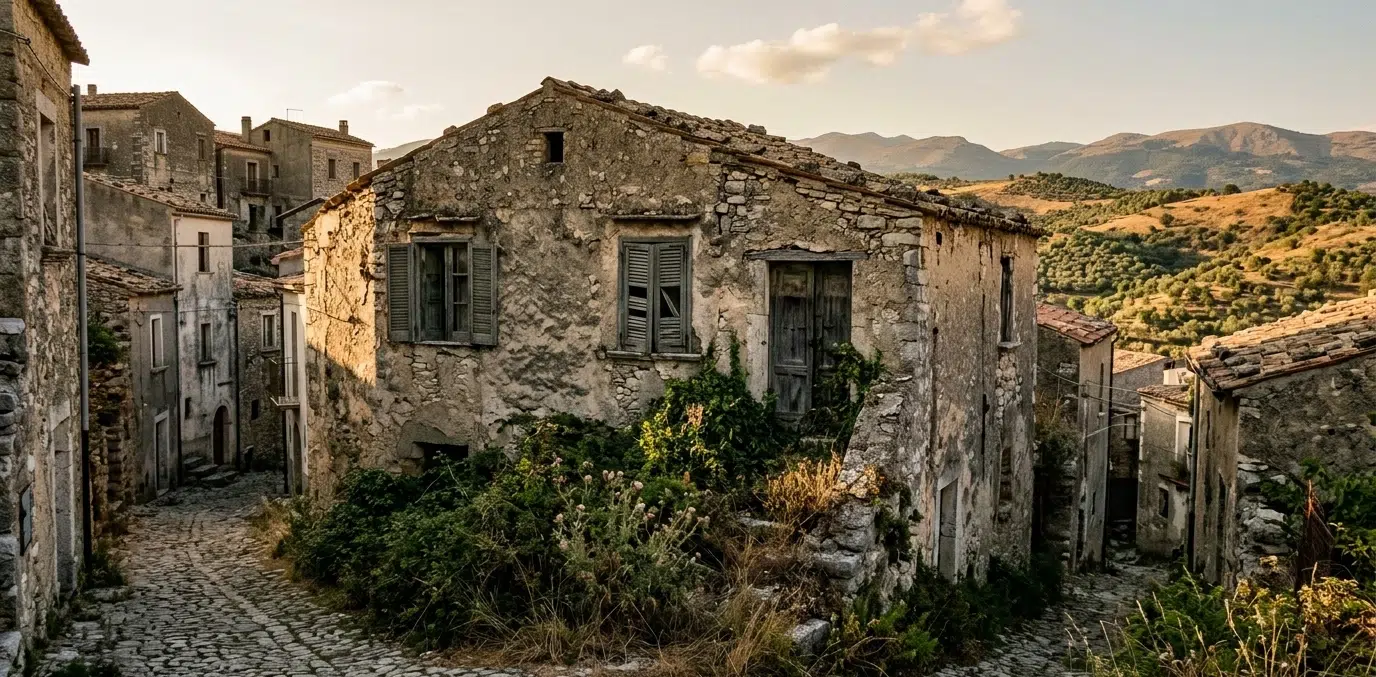
The truth that most media coverage leaves out: a €1 home is not a free home. The symbolic price conceals a real investment, which includes:
- Notarial deed fees: even at €1, the notary charges professional fees (roughly €1,500 to €2,500).
- Renovation works: this is the main expenditure. Budget on average €40,000 to €70,000 for a full renovation of a property between 80 and 120 m². These buildings are typically in advanced disrepair, with roofing, electrics, and plumbing all needing complete replacement.
- Geometra and architect: professional fees for project management and permits generally amount to 8 to 12% of the works cost.
- Translation and legal assistance: if you do not speak Italian, budget €500 to €1,500 for a bilingual lawyer or consultant.
- Travel: site visits, meetings with contractors, and construction oversight will require several trips to Campania.
Realistic all-in budget: between €50,000 and €100,000 to end up with a fully renovated house in a Campanian village. Compared to property prices in most Western countries, the value for money remains very attractive.
How to apply for a €1 home programme
The process varies by municipality but generally follows these steps: identify a property on the municipal website or through the national Borghi più belli d’Italia portal, submit an application file (covering letter, passport, proof of funds), go through selection by the municipal committee, sign a preliminary sale agreement, sign the final deed before a notary, then begin works within the agreed timeframe.
Steps to buying a house in Campania
Buying a property in Italy as a foreign national involves following a precise process. Here are the main stages:
1. Obtain your codice fiscale
The Italian tax identification number is required for any administrative procedure in Italy, including property purchases. You can obtain it at an Italian consulate in your country, or in person at the Agenzia delle Entrate (Italian Revenue Agency). The process is free and fast, typically taking 48 hours to one week.
2. Property search and viewing
The main Italian property portals are Immobiliare.it, Idealista.it, and Casa.it. For rural properties to renovate, local agencies and the municipalities themselves are often the best sources. An in-person visit is indispensable before making any commitment.
3. The proposta d’acquisto (purchase offer)
Once you have found a property, you submit a written offer (proposta irrevocabile d’acquisto). If accepted, it binds both parties for a limited period (generally 15 to 30 days). A deposit cheque is typically handed over at this stage (1 to 5% of the price).
4. The compromesso (preliminary contract)
The contratto preliminare di compravendita, or preliminary contract, is a more formal document that sets the final terms of the sale. A second deposit (caparra confirmatoria) is paid at this stage, generally 10 to 20% of the price. If you withdraw, you forfeit the deposit. If the seller withdraws, they must reimburse you double the amount.
5. Pre-completion checks (due diligence)
Before signing the final deed, your notary or lawyer should verify the property’s cadastral regularity, the absence of mortgages or outstanding debts, the planning compliance of any previous works, and the succession history if the property has changed hands several times.
6. The final deed of sale (rogito notarile)
The rogito is signed at the notary’s office, in the presence of both parties. An interpreter may be required if you do not speak Italian. This is the moment when the balance of the purchase price is transferred (generally by bank transfer) and the keys are handed over.
Taxes and purchase costs to budget for
Italian property taxation can catch foreign buyers off guard if they are not prepared. Here are the main cost items:
Purchase taxes
- Imposta di registro: the main transaction tax. It amounts to 2% of the cadastral value if the property becomes your primary residence (prima casa) within 18 months of purchase, and 9% for a secondary residence. A minimum of €1,000 applies in both cases.
- Imposta ipotecaria e catastale: a flat fee of €50 each for primary residences, or 2% and 1% respectively for secondary residences.
- VAT (IVA): if you buy directly from a developer or construction company, VAT replaces the above taxes (4% for a primary residence, 10% for a secondary one).
Notary fees
In Italy, the notary is chosen and paid by the buyer. Fees are regulated and depend on the purchase price. For a property between €50,000 and €200,000, budget between €1,500 and €3,000 excluding VAT.
Agency fees
In Italy, agency fees are shared between buyer and seller. For the buyer, they typically amount to 3 to 5% of the purchase price, plus VAT at 22%.
The flat tax for retirees
Foreign retirees who settle in an Italian municipality of fewer than 20,000 inhabitants in southern Italy (which covers all of rural Campania) can benefit from a flat tax of 7% on their foreign-sourced income (pension, rental income, etc.) for 10 years. This is a substantial advantage for retirees relocating from abroad.
Practical advice for international buyers
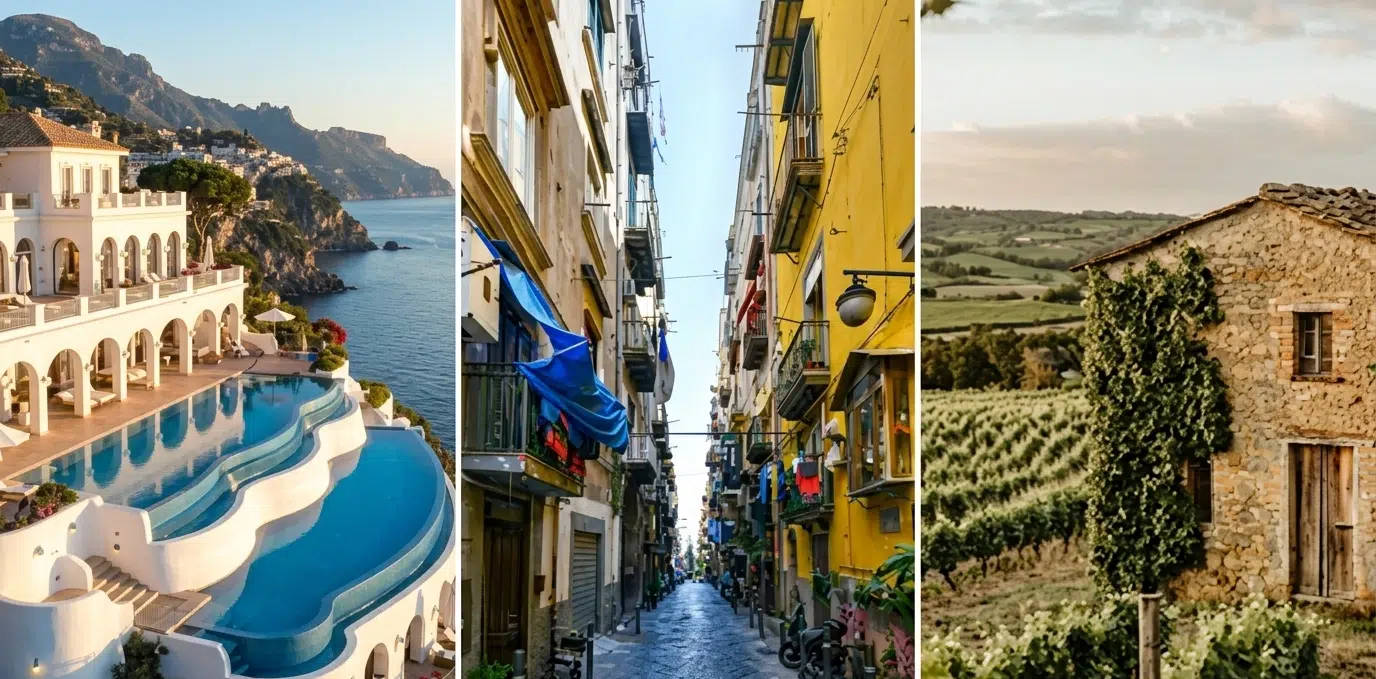
Here is the advice we consistently give to international buyers considering a purchase in Campania:
- Never sign anything without a translation: all official documents (preliminary contract, deed of sale) are written in Italian. Make sure you have an interpreter or a bilingual professional by your side.
- Commission a geometra before buying: this professional (roughly equivalent to a chartered surveyor) can verify the cadastral and planning compliance of a property before you commit.
- Open an Italian bank account: you will need one to pay the notary, local taxes, and contractors.
- Check seismic risk: a large part of Campania, particularly Irpinia and Sannio, is classified as seismic zone 1 or 2. Verify the classification of the property and, where possible, request a structural survey.
- Watch out for undeclared works: renovations carried out without planning permission (abusivismo edilizio) can block a sale or expose you to fines. This is a recurring issue in southern Italy.
- Allow time for the transaction: in Campania, the average time between offer and final rogito is 2 to 4 months. Plan your travel accordingly.
- Negotiate the price: asking prices in Campania are often 10 to 20% above market value. Do not hesitate to negotiate, especially for properties requiring renovation.
Conclusion: Campania, your next property move in Italy
Buying a house in Campania in 2026 means seizing a rare opportunity: acquiring a property in one of Europe’s most culturally rich and naturally beautiful regions, at prices that remain very accessible compared to other Mediterranean destinations.
Whether you are drawn to the energy of Naples, the magic of the Amalfi Coast, the tranquillity of the Cilento, or the authenticity of Irpinia, Campania has something to offer you, provided you go in well prepared. The market is moving quickly in certain areas, and windows of opportunity, particularly on €1 homes, can close faster than expected.
Our recommendation: start by defining your project clearly (primary residence, holiday home, rental investment, or renovation project), set a realistic budget that includes all associated costs, and surround yourself with trusted professionals: a notary, a geometra, and ideally a bilingual consultant with specialist knowledge of the Italian property market.
FAQ — Your most common questions
Can you really buy a home in Campania for €1?
Yes, the programme exists and several Campanian municipalities participate, particularly in the Cilento and Irpinia. But the symbolic price of €1 conceals a real investment: mandatory works (€30,000 to €80,000), notary fees, a geometra, and travel costs all add up to a realistic all-in budget of between €50,000 and €100,000. This is a full renovation project, not a turnkey purchase. Well prepared, however, it represents a genuine opportunity.
Can a foreign national buy a home in Campania without being an Italian resident?
Absolutely. Citizens of European Union member states can purchase property in Italy freely, with no residency requirement. The only mandatory preliminary step is obtaining a codice fiscale (Italian tax identification number), which you can request at an Italian consulate in your country. The process is free and takes a few days.
What are the total costs to budget for when buying property in Campania?
For a secondary residence, plan for between 10 and 15% of the purchase price in additional costs: the registro tax at 9% (applied to the cadastral value, which is often lower than the market price), notary fees (€1,500 to €3,000), agency fees (3 to 5% plus VAT), and potentially the fees of a lawyer or consultant. For a primary residence (prima casa), the registro tax drops to 2%, which significantly reduces the overall bill.