

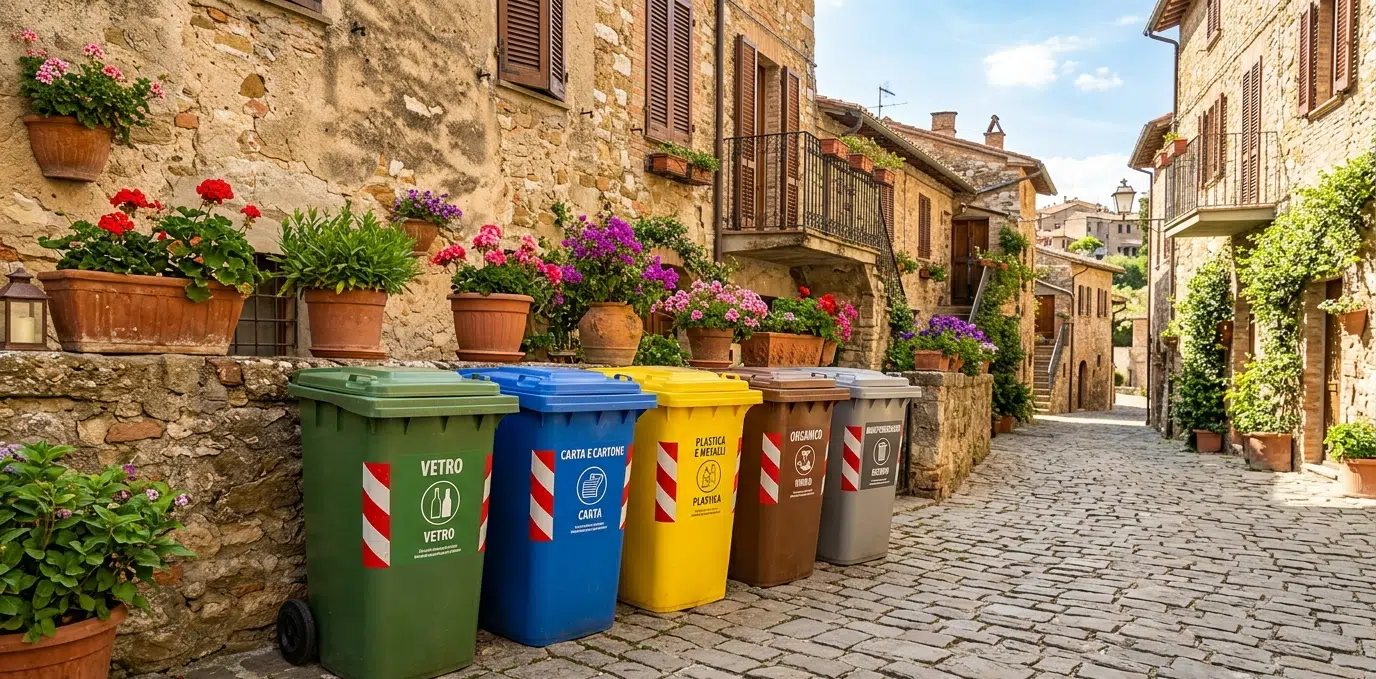
You have just moved to Italy, or you spend several weeks a year there? One of the first surprises of daily life is often the recycling system, known in Italian as raccolta differenziata. Several bins in different colours, collection days that vary from one street to the next, and a mandatory tax you will need to pay whether you are an official resident or simply the owner of an apartment: welcome to the Italian waste management system.
This guide covers everything you need to know to get your bearings without the stress: how to sort your waste, which bins to use, how the TARI (the waste tax) works, and what you risk if you do not follow the local rules.
Contents
- What is raccolta differenziata?
- The Italian bin colour guide
- Collection days and methods: it depends on your municipality
- The TARI: the waste tax everyone pays
- Residents and non-residents: the same obligations?
- Violations and fines: what you risk
- Practical tips for day-to-day life
- Conclusion
- FAQ
What is raccolta differenziata?

Raccolta differenziata — selective waste sorting — has been a legal requirement in Italy since the 1990s, progressively reinforced by European legislation. The national target is to recycle at least 65% of household waste. In 2024, many regions in the North exceed this threshold, while the South still lags behind, sometimes falling below 40%.
In practice, each municipality organises its own collection, with its own rules, its own schedules, and its own types of containers. What applies in Milan does not necessarily apply in Naples or Palermo. This is one of the first things to check when you arrive in a new city.
The system is built on a simple principle: separating waste at the source, at home, to make industrial processing easier. Each stream (glass, plastic, paper, organic, non-recyclable residue) follows a separate channel.
The Italian bin colour guide
Below is the most common colour coding used in Italy, as applied in the majority of large cities. Bear in mind that some municipalities use slightly different shades or distinctive labels. When in doubt, always check your local council’s website or the local app.
| Bin colour | Waste type | Examples |
|---|---|---|
| 🟢 Green / White | Glass | Bottles, jars, flasks (without lids) |
| 🔵 Blue | Paper and cardboard | Newspapers, cereal boxes, cardboard packaging |
| 🟡 Yellow | Plastic and metals | Plastic bottles, trays, cans, aluminium |
| 🟤 Brown | Organic waste | Vegetable peelings, food scraps, coffee grounds |
| ⬛ Grey / Black | Non-recyclable residue | Used tissues, nappies, broken ceramics |
One point that often causes confusion: plastic bottle caps generally go with the plastic (yellow bin), separate from the glass bottle. Soiled packaging (a heavily greasy pizza box, for example) usually goes in the non-recyclable residue, not with the cardboard. These details vary by municipality, so always check the guide distributed by your local council when you move in.
Collection days and methods: it depends on your municipality
In Italy, waste collection is managed locally by municipal companies or regional consortiums. There is no unified national schedule. In Rome, the service is run by AMA; in Milan by AMSA (a subsidiary of A2A); in Naples by Asia Napoli. Each operator sets its own collection days and frequencies.
Two main systems coexist across the country:
- Street container collection (cassonetti): large communal bins placed on public roads, accessible at any time. This system is still dominant in many cities in the South.
- Door-to-door collection (porta a porta): each household puts its sorted waste out on the morning of the scheduled collection day. This system, which is more effective for hitting recycling targets, is widespread in many northern cities and in tourist areas such as Positano or Capri.
When you move into a new home, ask your landlord, the building manager (amministratore di condominio), or the local council directly which system applies to your address. Many municipalities also offer a mobile app (such as JojaCMS, EcoFacile, or the operator’s own app) that sends reminders before each collection.
The TARI: the waste tax everyone pays
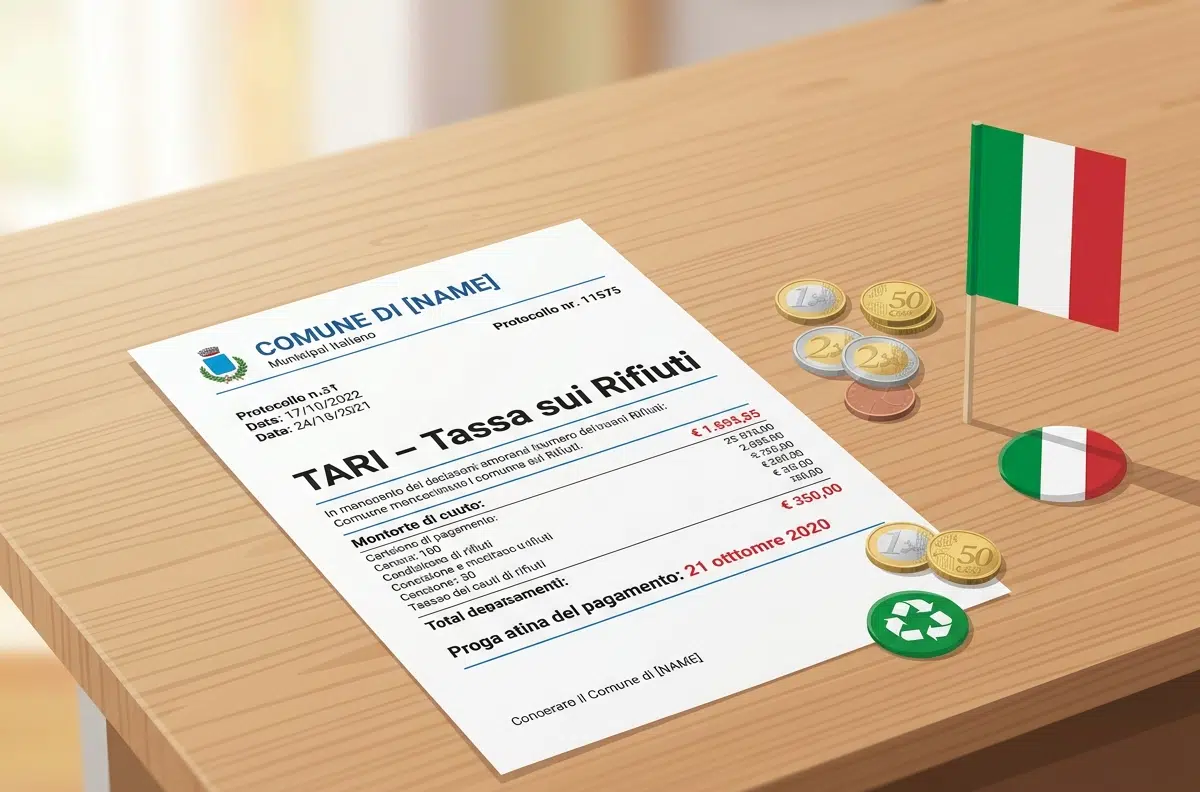
The TARI (Tassa sui Rifiuti) is the Italian household waste tax. It replaced the former TARES and TARSU taxes in 2014 and forms part of the IUC (Imposta Unica Comunale), the unified local tax, alongside the IMU and the TASI.
How it works, in broad terms:
- It is calculated based on the habitable surface area of the property (in square metres) and the number of people occupying the home.
- The rate is set each year by a decision of the municipal council. It therefore varies from one municipality to another, sometimes considerably.
- It is issued by the municipality or its delegated manager in the form of a payment notice (avviso di pagamento), sent by post or notified through your digital account.
- Payment is generally made in two or three annual instalments, via the modello F24 (the standard Italian tax form) or through the newer digital platforms (PagoPA).
Worth noting: some municipalities offer reductions or partial exemptions for households facing financial hardship, secondary residences that are rarely occupied, or owners who can demonstrate very low waste production. These benefits are available on request from the local tax office (ufficio tributi).
Residents and non-residents: the same obligations?
This is one of the most common questions among foreign property owners in Italy: do I have to pay the TARI if I am not an Italian resident? The answer is yes, and many people wrongly assume otherwise.
The TARI is owed by anyone who occupies or holds a property in the municipality, whether that person is:
- An official resident (registered at the anagrafe, with a residence permit or administrative residence)
- A non-resident owner using the property as a second home or holiday home
- A tenant, who then becomes the primary taxpayer (rather than the owner) when the rental contract exceeds 6 months per year
In practice, if you own an apartment in Lecce or Florence and only stay there for a few weeks in summer, you will still receive a TARI notice. The municipality generally bases its calculation on land registry data (the surface area of the property) and the number of people administratively linked to it.
If you have not yet received a notice and have owned the property for several years, it is advisable to proactively regularise your situation with the local tax office: unpaid TARI arrears can be subject to surcharges and interest.
Violations and fines: what you risk
Failing to follow Italy’s recycling rules is not a minor matter. Municipalities have stepped up their controls in recent years, particularly in large cities and tourist areas. Here are the main violations and their consequences:
- Incorrect sorting (waste placed in the wrong bin): a fine of €25 to €500 depending on the municipality and whether it is a repeat offence.
- Fly-tipping (abbandono di rifiuti) outside designated areas: a fine of €300 to €3,000, which can escalate to criminal proceedings for large volumes.
- Failure to register for TARI or submitting an inaccurate declaration: a tax reassessment with a surcharge of 100 to 200% of the amount owed.
- Putting bins out at the wrong time in door-to-door systems: a fine of €50 to €150 in many cities.
In some municipalities that take enforcement particularly seriously (notably in Veneto, Tuscany, and Emilia-Romagna), inspectors regularly search bins to identify households that are not sorting correctly, using named bags or barcodes that some councils distribute. This may come as a surprise to newcomers, but it is a fully established part of the system.
Practical tips for day-to-day life
Here are some concrete pieces of advice for getting to grips with waste sorting in Italy without the headaches:
- Ask for the local guide when you arrive. Known as the guida alla raccolta differenziata, this document (often available at the town hall or downloadable from the municipal website) lists precisely what goes in which bin, with illustrations.
- Download your waste operator’s app. Most large cities have an app with a collection calendar, push reminders, and a search function (“where do I throw away a light bulb?”).
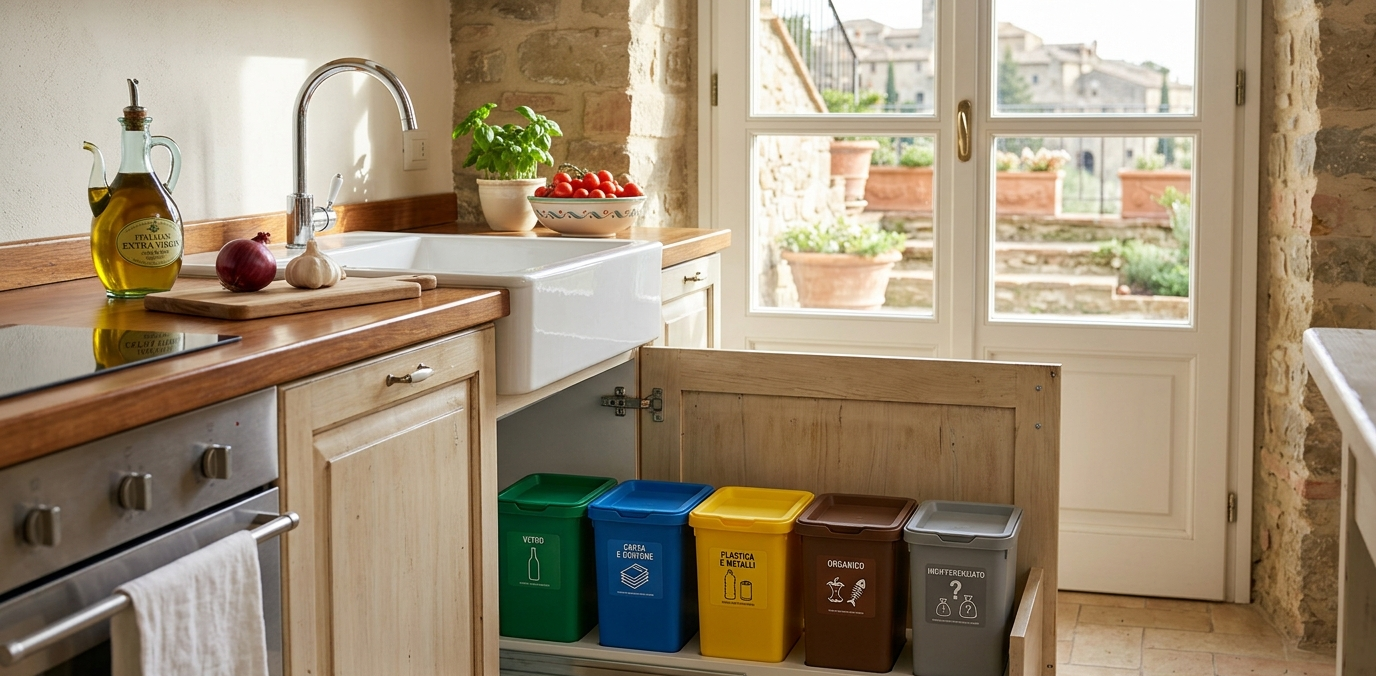
- Set up small bins in your kitchen. In Italy, it is common to have four or five small bins in the kitchen for pre-sorting before taking the bags downstairs. Starter kits are often distributed free of charge by the municipality when you move in.
- Note your collection days in your diary. In door-to-door systems, putting the bins out on the right day (and bringing them back in the same evening) is an important social norm — your neighbours will notice.
- For the TARI, declare your situation promptly. If you have just bought or rented a property, register with the ufficio tributi within 90 days to avoid any subsequent reassessment.
- If you are unsure about a bulky item (an old sofa, a television, a household appliance), do not leave it on the pavement. Contact your collection operator, who generally offers a free home collection by appointment (ritiro gratuito a domicilio).
Conclusion
Italy’s recycling system can seem complicated at first glance, between bin colours that vary from one municipality to the next, collection days to keep track of, and the TARI to deal with. Once you understand how it all fits together, though, it quickly becomes routine.
The main thing to remember is simple: find out how things work in your municipality as soon as you arrive. Pick up the local guide, download the collection app, and sort out your TARI registration without delay. Whether you are a permanent resident, a second-home owner, or a seasonal tenant, these obligations apply to you, and meeting them will save you from some unpleasant surprises.
Italy is making real progress on waste management, and playing your part in that collective effort is also a way of embedding yourself in local life.
FAQ — Frequently asked questions about recycling and the TARI in Italy
❓ Who has to pay the TARI in Italy?
Anyone who occupies or holds a property in Italy is liable for the TARI, whether or not they are an official resident. This includes owners of second homes, even if they only stay there for a few weeks a year. In the case of a long-term rental (more than 6 months), the tenant becomes the primary taxpayer.
❓ Which bin colour is for which waste in Italy?
The most widely used colour code is: green or white for glass, blue for paper and cardboard, yellow for plastic and metals, brown for organic waste, and grey or black for non-recyclable residue. Bear in mind that some municipalities use different shades, so always check the local guide.
❓ Can you be fined for not sorting your waste in Italy?
Yes. Penalties exist and are enforced, particularly in the stricter municipalities. Incorrect sorting can result in a fine of €25 to €500. Fly-tipping waste outside designated areas can lead to fines of up to €3,000, and even criminal proceedings for large volumes. Enforcement has intensified in recent years.