

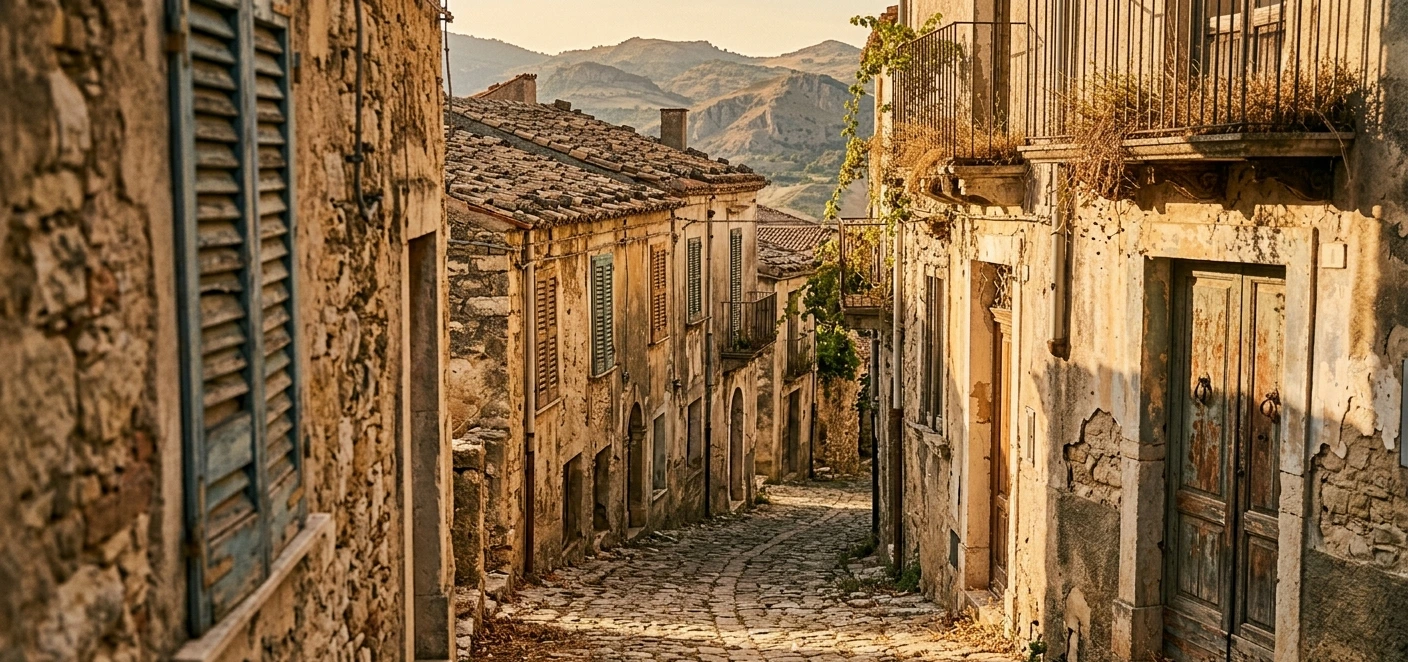
 A character home in a village in Sicily, Sardinia or the Apennines, for 1 euro. The idea is captivating, and it has been circulating across social media for years. But behind that symbolic price lie very specific conditions, real costs, and an administrative process that requires serious preparation. This guide tells you everything the sensationalist articles leave out, so you can make an informed decision.
Contents
- Why does Italy sell houses for 1 euro?
- Where to find these houses in 2026
- The factor nobody talks about: isolation
- Conditions you must meet
- The real budget: what it actually costs
- How to apply, step by step
- Our honest take on this opportunity
- FAQ
Why does Italy sell houses for 1 euro?
 The programme began in 2009 in Gangi, a village in the province of Palermo in Sicily. The municipality was facing two connected problems: a mass exodus of young people towards larger cities, and hundreds of abandoned homes that posed a public safety risk. The then-mayor came up with the idea of transferring these properties at a symbolic price in exchange for a firm commitment to renovate them.
The initiative quickly caught on. Today, more than 40 Italian municipalities have adopted the scheme, from Sardinia to the Abruzzo, taking in Piedmont and Calabria along the way. The logic is straightforward: owners of these derelict homes kept paying property tax (IMU) without receiving any benefit in return. By transferring them for 1 euro, they free themselves from an ongoing financial burden. The municipalities, for their part, hope to attract new residents and breathe life back into the local economy.
It is a genuinely worthwhile idea, and it does work in certain cases. But as with most things in Italy, the reality on the ground is more nuanced than the headlines suggest.
Where to find these houses in 2026
The programme is still active in 2026, though it operates intermittently: some municipalities open new application rounds while others close theirs once properties have been allocated. The most active areas remain Sicily, Sardinia, Campania, Piedmont and Calabria. Among the best-known villages:
- Sambuca di Sicilia (Sicily): a hilltop village with traces of Arab architecture, widely covered in the press, with several successive programme rounds since 2019.
- Mussomeli (Sicily, province of Caltanissetta): one of the most active programmes in Italy, regularly restocked with new properties.
- Ollolai & Nulvi (Sardinia): offering additional incentives, including a monthly allowance of €600 per child born in the village.
- Zungoli (Campania): one of Italy’s “Most Beautiful Villages,” with a well-managed programme run directly by the municipality.
- Carrega Ligure (Piedmont): an alpine village where applications are handled directly at the town hall.
- Biccari (Puglia, province of Foggia): open to retirees as well as those with commercial projects.
To browse active listings, the reference site is casea1euro.it. Offers move quickly and conditions vary considerably from one municipality to the next.
The factor nobody talks about: isolation
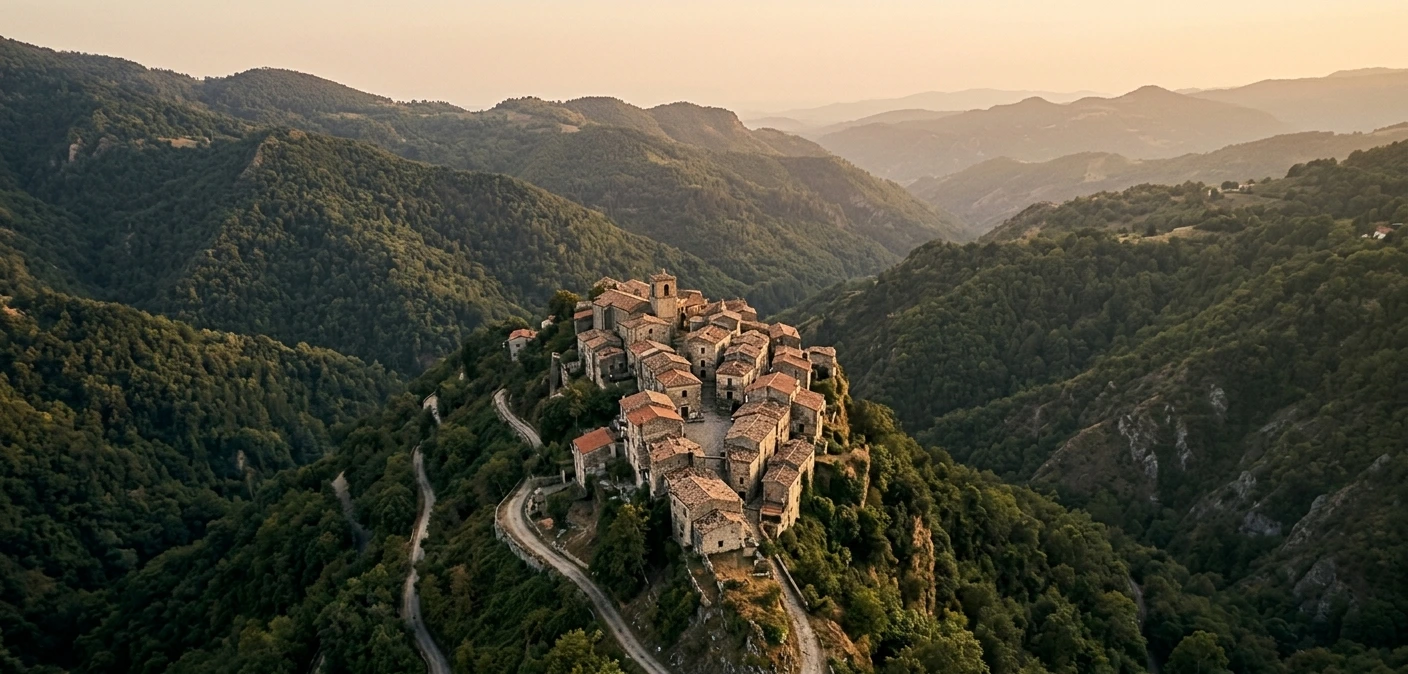
This is the subject that enthusiastic articles carefully sidestep, yet it is one of the first things you should evaluate seriously before committing to anything.
The vast majority of villages offering 1 euro houses are in remote areas, sometimes more than an hour from the nearest sizeable city. These are precisely the communities that have been losing population for decades: young people leave, shops close, schools and medical practices reduce their hours or disappear altogether. That is, in fact, the very reason the programme exists.
In practical terms, this means:
- Limited public transport: in many of these villages, a car is not optional, sometimes even for basic grocery shopping.
- Few local services: no guaranteed doctor, a pharmacy open only a few days a week, the nearest maternity unit 40 to 60 kilometres away.
- Patchy internet connectivity in some hamlets, which makes remote working difficult.
- A social fabric that needs rebuilding: the first months can be quite isolating, especially if your Italian is still limited.
None of this means these villages lack charm; far from it. But you need to go in with your eyes open, and above all visit several times before committing, across different seasons, to understand what daily life there actually looks like outside of summer.
What about a B&B or holiday rental project?
This is often the first idea that comes to mind: renovate the house, open it as a guesthouse or list it on Airbnb, and turn it into a source of income. The appeal is real. The reality is more complex.
A B&B in a highly isolated village, with no established tourist flow or local signposting, will struggle to attract enough guests to be profitable year-round. Summer weeks may go well, but what happens in November or February? Some villages have developed a genuine tourism identity around hiking, local gastronomy or nearby UNESCO heritage sites, and can support this kind of project. Others remain largely unknown and sit well outside the usual tourist circuits.
Before launching a hospitality project, ask yourself: do visitors already come to this village? Are there existing guesthouses or B&Bs that are trading? How far is it from the nearest major attraction? Can you generate bookings year-round, or only in season?
⚠️ Our advice: If your primary goal is a rental or B&B project, study the village’s tourism potential before letting the purchase price win you over. A well-located village 30 minutes from a major draw (the sea, an archaeological site, a city with cultural heritage) will be far more viable than a hamlet tucked deep in the Apennines, however much raw charm it has. We can help you assess the viability of your project.
Conditions you must meet
Acquiring an Italian property through this scheme is nothing like a standard purchase. The symbolic price comes with binding obligations that each municipality sets out freely in its own regulations. The most common clauses are:
- Renovation deadline: work must generally begin within 3 months of signing the deed of sale and be completed within 1 to 3 years, depending on the municipality.
- Minimum investment required: most municipalities require a renovation spend of between €20,000 and €50,000, sometimes more.
- Use of the property: some villages require it to become your primary residence or to be opened as a business. Others accept holiday homes or tourist rentals, but check this point carefully before applying.
- Security deposit: a guarantee (often between €2,000 and €5,000) is sometimes required upfront and returned on completion of works, subject to proof.
- Heritage constraints: stone facades, historic architectural features and traditional materials often have to be preserved. Current thermal insulation standards must also be met, which can add complexity when working with old buildings.
- Language: the contract is written entirely in Italian. Make sure you have a bilingual professional with you before signing anything.
The real budget: what it actually costs
This is the question everyone asks, and the answer is often sobering. Houses offered at 1 euro are generally in an advanced state of disrepair: roofs that need replacing, no functioning electricity, outdated plumbing, structural damp. Here is a realistic budget to plan for:
| Expense | Estimated amount | Notes |
|---|---|---|
| Symbolic purchase price | €1 | Signed before a notary |
| Notary fees and registration | €1,500 – €3,000 | Mandatory, non-negotiable |
| Codice Fiscale and translations | €100 – €300 | Via your country’s consulate or embassy in Italy |
| Renovation works | €20,000 – €80,000 | Varies widely depending on the condition of the property |
| Architect or surveyor (geometra) | €2,000 – €5,000 | Often required for planning permits |
| Bilingual lawyer or adviser | €1,000 – €2,500 | Strongly recommended |
| Realistic total budget | €25,000 – €90,000 | Depending on the municipality and condition of the property |
One buyer’s experience illustrates the reality well: after purchasing a home for 1 euro in a Campanian village, he ended up spending €62,000 on renovation works. He now rents it out as a short-term let and is happy with the outcome, but it took patience, a solid budget and multiple trips to Italy to coordinate the tradespeople on the ground.
How to apply, step by step
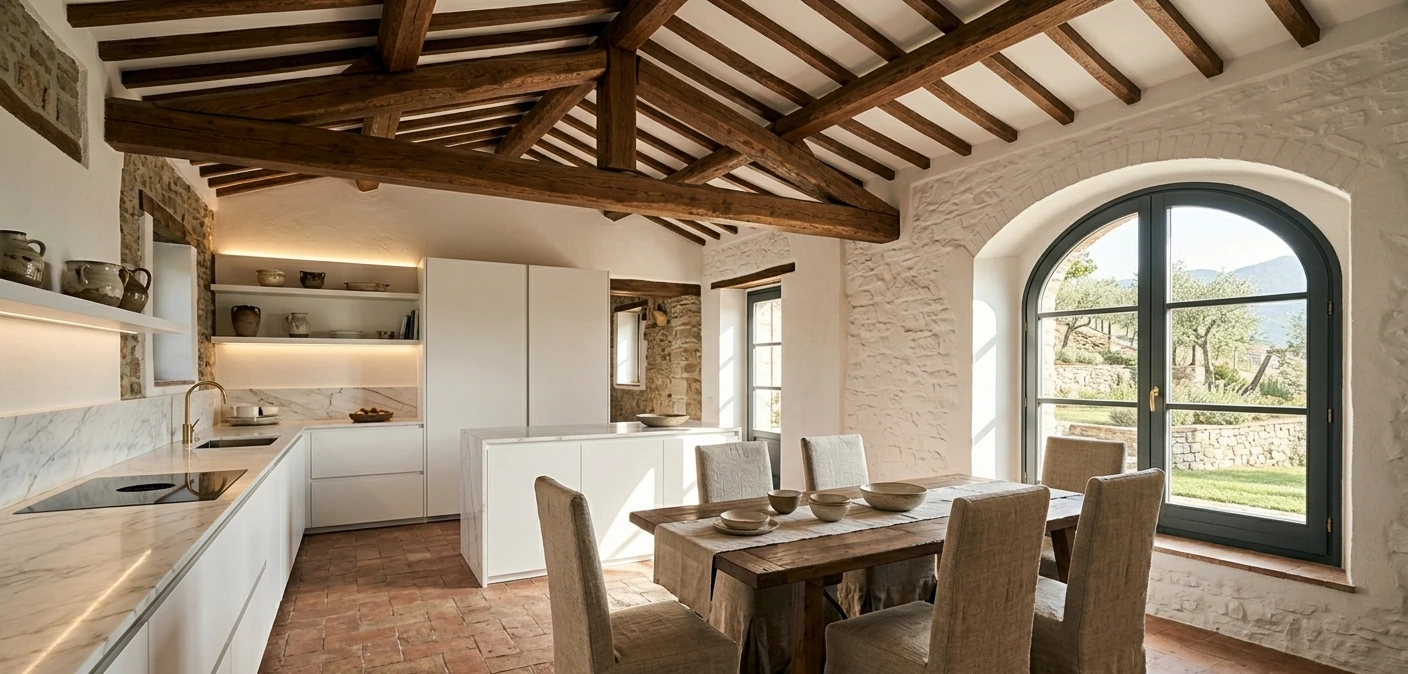
The process is similar to a standard Italian property purchase, with a few steps specific to the 1 euro house programme. Here is what the typical journey looks like:
- Choose your municipality on casea1euro.it or directly on the relevant town hall’s official website. Confirm that the application round is still open.
- Visit the village, ideally more than once. Go at different times of year to get a realistic sense of daily life, accessibility and, if relevant to your plans, tourist potential.
- Obtain your Codice Fiscale (Italian tax identification number). Your country’s consulate or embassy can usually issue this within a few days by appointment. It is required for any notarised transaction in Italy.
- Prepare your application file: a cover letter describing your project, proof of financial means (bank statements from the past three months), and a written commitment to meet the renovation deadlines set by the municipality.
- Get a renovation estimate from a local contractor or architect before you sign anything. This step protects you from unpleasant surprises and allows you to budget accurately.
- Sign the preliminary agreement and then the final deed of sale (rogito notarile) with an Italian notary. All documents are in Italian, so professional bilingual support at this stage is not optional.
- Begin works within the required timeframe and keep every invoice. You will need them to reclaim your security deposit and demonstrate that you have met your commitments.
Allerenitalie can handle all communications with municipalities on your behalf. Our bilingual team knows the local procedures, the right contacts at each town hall, and the administrative pitfalls specific to each programme. Contact us for a free initial conversation.
Note for non-EU nationals: buying a property in Italy does not automatically entitle you to a residence permit. EU citizens simply need to register with their local municipality. If you hold a different passport, look into Italy’s Golden Visa programme to understand your options.
Our honest take on this opportunity
The 1 euro house programme in Italy is real, not an urban myth. It has been running since 2009 and continues to attract buyers from around the world in 2026. Some have gone on to build genuinely rewarding lives or solid investment projects around it. But it is not a gift without strings attached, and it is certainly not a guaranteed rental income stream.
For this project to succeed, several things need to align: a realistic budget of between €25,000 and €90,000 all-in, a tolerance for Italian administrative processes, a clear-eyed assessment of the village’s potential (its appeal, accessibility and available services), and a genuine personal motivation that goes beyond the attraction of the symbolic price.
Our recommendation: visit the village before you commit, preferably outside the summer season. Talk to residents and local officials. Get renovation quotes on the ground. And work with an expert who knows how Italian property and local administrations actually operate. That is, by some distance, the best investment you can make before putting pen to paper.
FAQ
Is the 1 euro house programme still running in 2026?
Yes, several Italian municipalities are still offering properties at this symbolic price in 2026. The programme operates intermittently: application rounds open and close as properties are allocated and as municipalities make new decisions. Check casea1euro.it regularly, or let our team monitor it for you.
Can you buy a 1 euro house in Italy as a foreign national, without living in Italy?
Absolutely. The programme is open to foreigners, including non-residents. You will need a Codice Fiscale (Italian tax number), which you can obtain through an Italian consulate or embassy in your country. Bear in mind, though, that some municipalities require the property to become your primary residence. Always check the local conditions before applying.
Is it actually viable to open a B&B in a 1 euro village?
It depends entirely on the location. In an isolated village with no established tourist traffic, year-round profitability is genuinely difficult to achieve. In a well-positioned village close to the sea, a listed heritage site or a culturally rich town, the project can work. That is precisely why we recommend analysing a village’s tourism potential before being swayed by the purchase price. Our team can carry out that analysis with you.