


The good news is that it is entirely manageable, provided you understand how the Italian system works before you buy. This article covers everything you need to know about owning a second home in Italy: the legal definition, annual taxes, the buying process, remote management, and how to make the most of your investment.
Table of contents
- Prima casa vs seconda casa: what’s the practical difference?
- Annual taxes: what you pay every year
- The key steps of buying property in Italy
- Purchase costs: how much more do you pay for a second home?
- Renting out your second home: rules and taxation
- Practical tips for managing your property remotely
- Conclusion
- FAQ
Prima casa vs seconda casa: what’s the practical difference?

Under Italian law, the distinction between prima casa (primary residence) and seconda casa (second home) is fundamental: it determines almost every tax rule that will apply to your property.
For a property to qualify as a prima casa, you must establish your primary residence there, meaning you must be officially registered (iscritto all’anagrafe) with the municipality where the property is located. For foreign nationals who do not live in Italy, this condition is generally impossible to meet: if you are based abroad, your Italian property will automatically be treated as a seconda casa, regardless of how much time you spend there.
The immediate consequence is that you do not benefit from the tax advantages reserved for prima casa owners, whether at the point of purchase (higher transfer taxes apply) or on an ongoing basis (no IMU exemption). This is the starting point for all your financial planning.
Taxes on a second home in Italy: what you pay every year
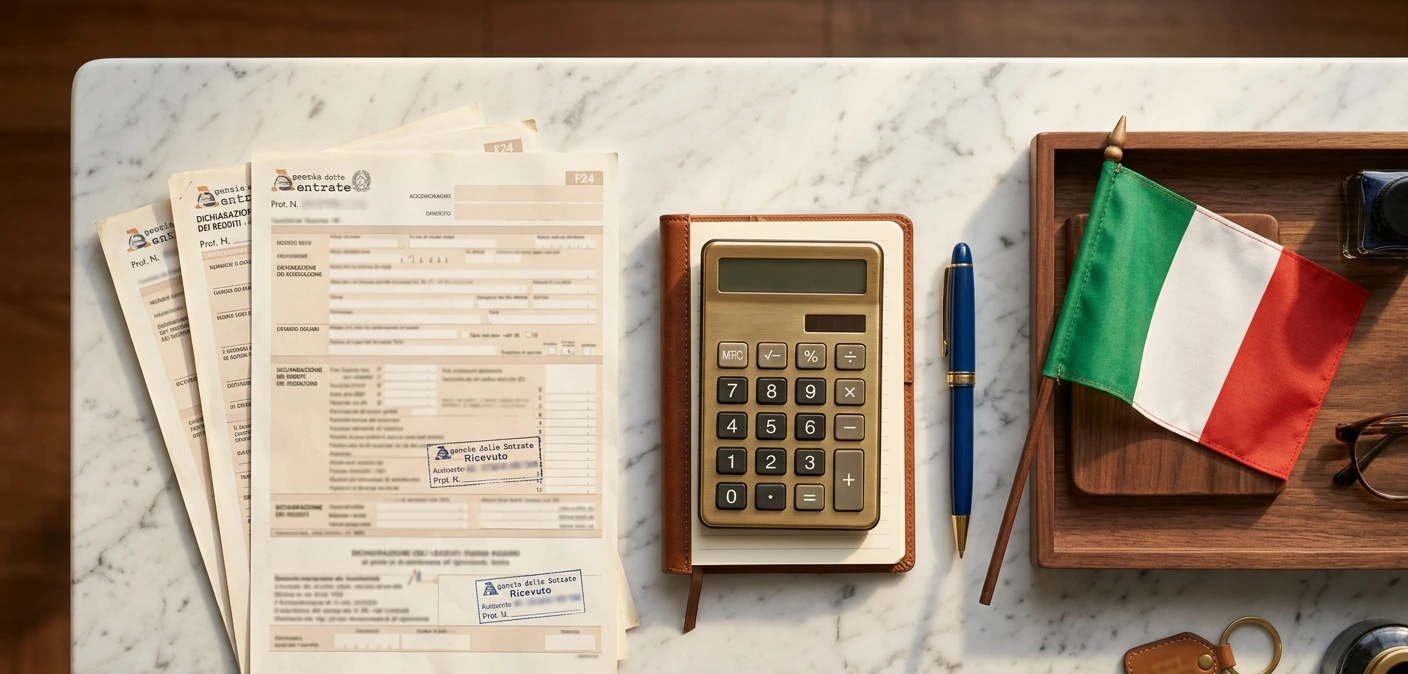
One of the most common surprises for first-time buyers is the recurring tax burden that comes with owning a second home in Italy. Here is a breakdown of what to expect.
IMU: the main tax on seconda casa
IMU (Imposta Municipale Unica) is Italy’s annual property ownership tax. It applies to second homes, whereas prima casa properties have been exempt since 2015 (with the exception of luxury properties).
The calculation is based on the cadastral value of the property (rendita catastale), multiplied by a coefficient specific to the property category, then by a rate set by each municipality. In practice, rates range between 0.86% and 1.06% of the recalculated cadastral value. The good news is that the Italian cadastral value is often well below market value, which makes IMU considerably more affordable than equivalent property taxes in many other countries.
IMU is paid in two instalments: an advance payment in June and the balance in December.
TARI and other local charges
TARI (waste collection tax) is due by every owner or tenant, including second home owners. The amount varies according to the size of the property and the municipality. Additional regional or municipal surcharges (addizionali) may also apply depending on your situation.
Avoiding double taxation: what the tax treaty says
Many countries have signed bilateral tax treaties with Italy to prevent the same income from being taxed twice. For property located in Italy, rental income and capital gains on sale are taxable in Italy first. You will still need to declare this income in your country of residence, but a tax credit equal to the Italian tax already paid will generally be offset against your domestic tax liability. Consult a tax adviser with cross-border expertise to confirm how this applies to your personal situation.
Buying a second home in Italy: the key steps from start to finish
The Italian property buying process follows a specific framework, with several mandatory stages. Here is what to anticipate.
1. Obtain a codice fiscale
Before anything else, you need a codice fiscale, Italy’s tax identification number. It is required for signing any legal document, opening a bank account, or paying taxes in Italy. You can obtain one within a few days through an Italian consulate in your home country, or directly in Italy at the Agenzia delle Entrate.
2. Sign the compromesso
The contratto preliminare di compravendita (preliminary sale agreement) is legally binding on both parties. A deposit (caparra) is paid at this stage, typically 10 to 20% of the purchase price. If you withdraw, you forfeit the deposit; if the seller withdraws, they must return double the amount to you.
3. Sign the rogito before a notary
The rogito is the final deed of sale. It must be signed before an Italian notary (notaio), and this is when transfer taxes and fees are settled. Unlike in many other countries, it is typically the buyer who selects the notary in Italy.
4. Timelines and points to watch
Between the compromesso and the rogito, allow one to three months. Before signing the preliminary agreement, make sure a visura catastale (cadastral check) and a mortgage inspection (ispezione ipotecaria) have been carried out. Hidden defects and irregular cadastral situations are real risks in Italy, particularly for older or rural properties.
Purchase costs: how much more do you pay for a second home?
One of the most common pitfalls for foreign buyers is underestimating the acquisition costs for a seconda casa. They are significantly higher than those that apply to a prima casa.
| Tax | Prima casa | Seconda casa |
|---|---|---|
| Imposta di registro (existing property) | 2% | 9% |
| VAT / IVA (new-build, developer) | 4% | 10% |
| Imposta ipotecaria + catastale | €50 + €50 | €50 + €50 |
| Notary fees | 1 to 2.5% (variable) | |
On a €200,000 purchase of an existing property, the difference in registration tax alone amounts to roughly €14,000 more for a seconda casa compared to a prima casa. Factor this into your budget from the very start of your search.
Renting out your second home: rules, taxation, and returns
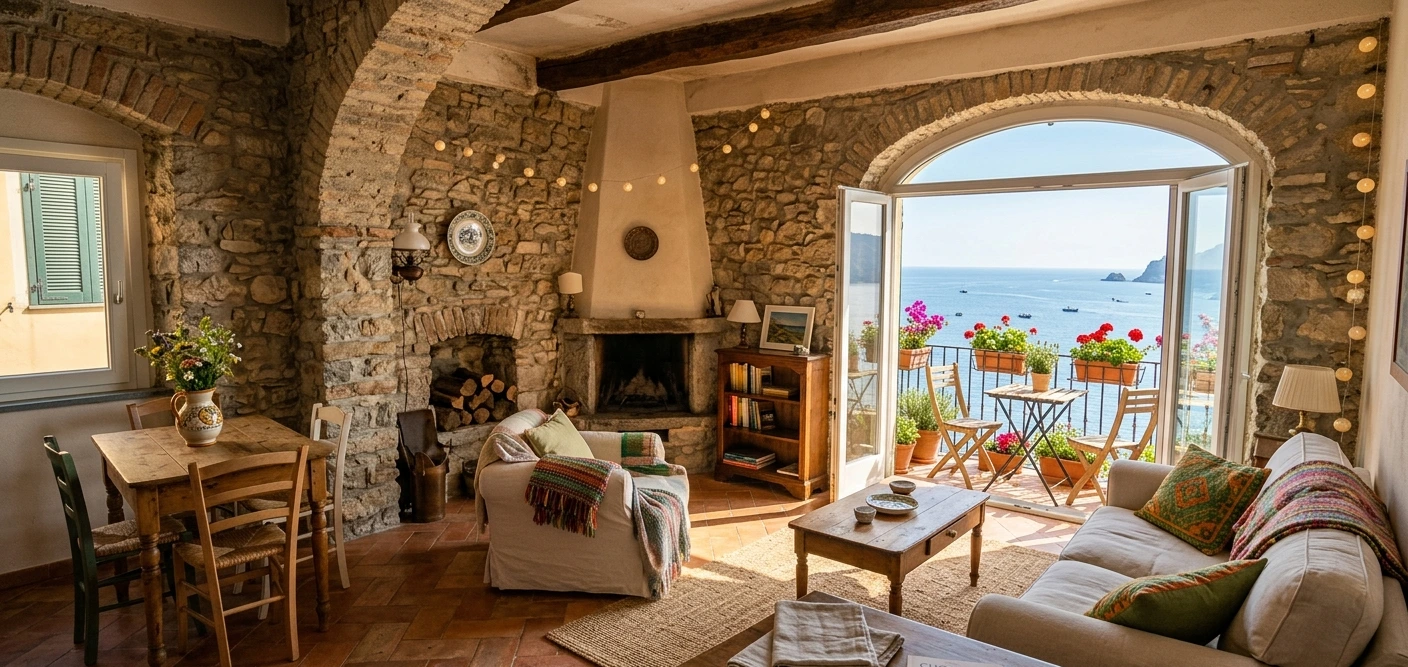
Renting out a second home during periods of absence is very common, especially in tourist areas. Italy has put a specific regulatory framework in place for this.
Short-term rentals: legal obligations
Since 2021, owners who rent their property on a short-term basis (stays of fewer than 30 days) must obtain a CIN (Codice Identificativo Nazionale), which is mandatory for any online listing. This number must appear on all your Airbnb, Booking.com, or other platform listings. Penalties apply for non-compliance.
Cedolare secca: simplified flat-rate taxation
For rental income, you can opt for the cedolare secca, a flat-rate tax that replaces the standard IRPEF income tax. For short-term rentals (affitti brevi), the rate is 21% on the first €2,333 of annual rental income, then 26% beyond that threshold. This is generally more advantageous than the progressive IRPEF scale, particularly for non-resident landlords.
Platforms such as Airbnb automatically withhold 21% at source and remit it directly to the Agenzia delle Entrate on your behalf.
Declaring rental income in your home country
If you are a tax resident outside Italy, you will generally still need to declare your Italian rental income in your country of residence, even if tax has already been withheld in Italy. Bilateral tax treaties typically provide for the elimination of double taxation through a tax credit mechanism. Check the specific rules that apply in your country.
Practical tips for managing your second home remotely

Owning a property hundreds of kilometres away requires some organisation. Here are the habits that make a real difference.
Appoint a local property manager
For minor emergencies, routine maintenance, guest check-ins, or simply keeping on top of paperwork, working with a local management agency (agenzia immobiliare or property manager) is often money well spent. Their fees are generally deductible from declared rental income.
Insurance: don’t skip it
In Italy, home insurance is not legally required for property owners, but it is strongly advisable. At a minimum, take out cover for fire, water damage, and third-party liability. If you rent the property out, a policy specifically designed for short-term rentals (locazione turistica) is recommended.
Planning for resale and capital gains
If you sell the property within 5 years of purchase, any capital gain is taxable in Italy. After that threshold, capital gains are exempt from Italian tax for private individuals. Declaration obligations in your home country remain in place, with the bilateral tax treaty applying to avoid double taxation.
Buying a second home in Italy: are you ready to take the plunge?
Buying a second home in Italy is entirely within reach for international buyers, provided you go into the process with a clear picture of what is involved. The tax treatment is less favourable than for a primary residence, acquisition costs are significant, and managing a property remotely takes organisation. But for those who prepare properly, it is also a genuine opportunity: an exceptional living environment, a property market that remains affordable in many regions, and attractive rental potential in tourist areas.
Our advice: before signing anything, consult a notary and a tax adviser who specialises in cross-border transactions. It is a marginal cost relative to the overall investment, and it can save you from very costly surprises down the line.