

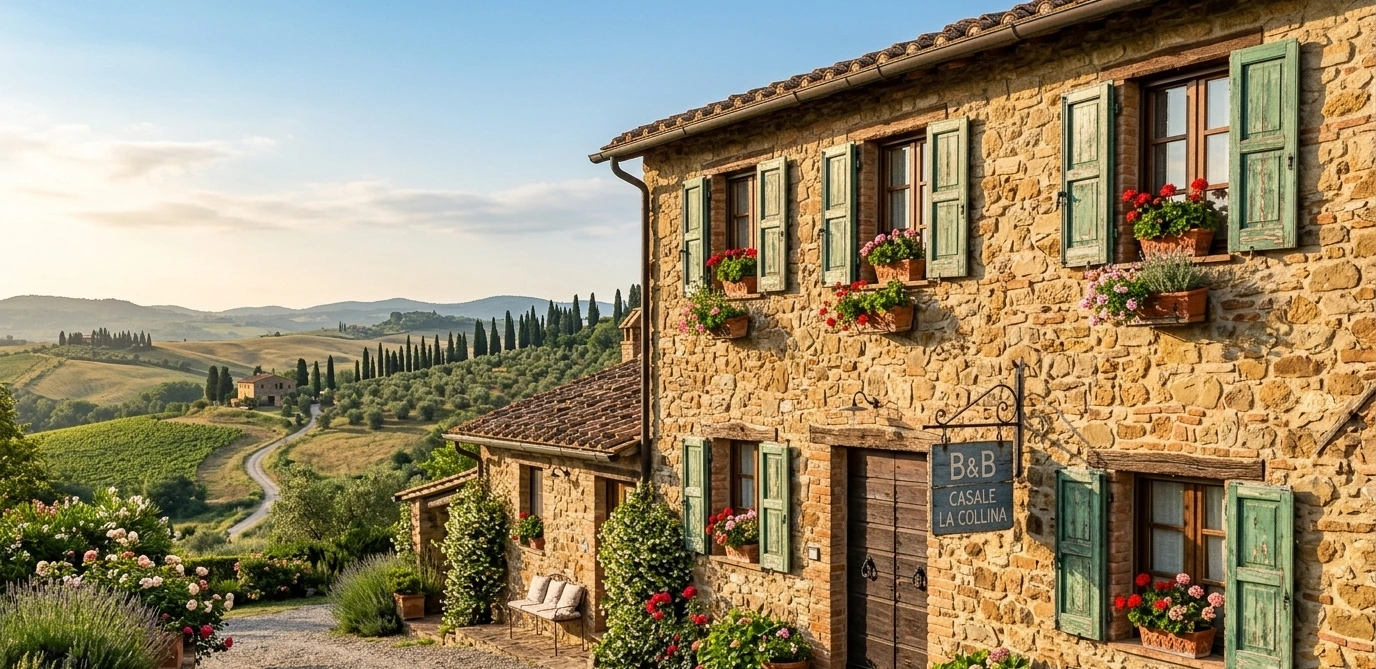
Table of contents
The B&B market in Italy in 2026
Italy is the third most visited destination in the world, welcoming over 57 million international visitors every year. The tourist accommodation market is in constant expansion, driven by strong demand for authentic stays, characterful properties and local experiences — exactly what B&Bs and guesthouses have to offer.
The most sought-after regions remain Tuscany, the Amalfi Coast, Sicily, Puglia and Lake Como, but secondary destinations such as Umbria, the Marche and Calabria are attracting growing interest, with far more accessible purchase prices and limited competition. For an investor or someone looking to relocate, these emerging markets often represent the best opportunities.
International demand for authentic, intimate accommodation in Italy has never been stronger. Travellers are looking for genuine experiences, human connection and local insider knowledge — three advantages that large hotel chains simply cannot offer, and that you, as an owner living on the premises, naturally possess.
B&B, guesthouse, affittacamere: what are the differences?
Before taking any steps, it is essential to understand the legal distinctions between the different forms of tourist accommodation in Italy. These categories are not interchangeable: they carry different obligations, limits and tax regimes.
The B&B (Bed & Breakfast)
Under Italian law, a B&B is defined as a non-professional activity carried out within the owner’s primary residence. It is the simplest status to obtain: it does not require setting up a formal business or registering with the companies register. The owner must live in the property and accommodate guests in rooms within their own home. Regulations generally allow a maximum of 3 rooms and 6 beds, but these limits vary by region — each Italian regione has its own tourism legislation.
The affittacamere
The affittacamere is a professional accommodation activity that can be carried out in a property separate from the owner’s primary residence. Unlike a B&B, it requires opening a business (partita IVA), registering with the companies register and meeting stricter safety and hygiene standards. In return, capacity limits are higher: up to 6 rooms in most regions.
The casa vacanze (holiday rental)
The casa vacanze is a tourist rental with no breakfast service and no requirement for the owner to be present. It is closest to what English speakers would recognise as a furnished holiday let. It can be operated on a non-professional basis (up to 4 apartments in some regions) or professionally.
| Status | Owner residence required | Partita IVA | Breakfast | Max. capacity |
|---|---|---|---|---|
| B&B | Yes | No (non-professional activity) | Included | 3 rooms / 6 beds (variable) |
| Affittacamere | No | Yes | Possible | 6 rooms (variable) |
| Casa vacanze | No | Depends on volume | No | Varies by region |
Administrative steps to open a B&B in Italy
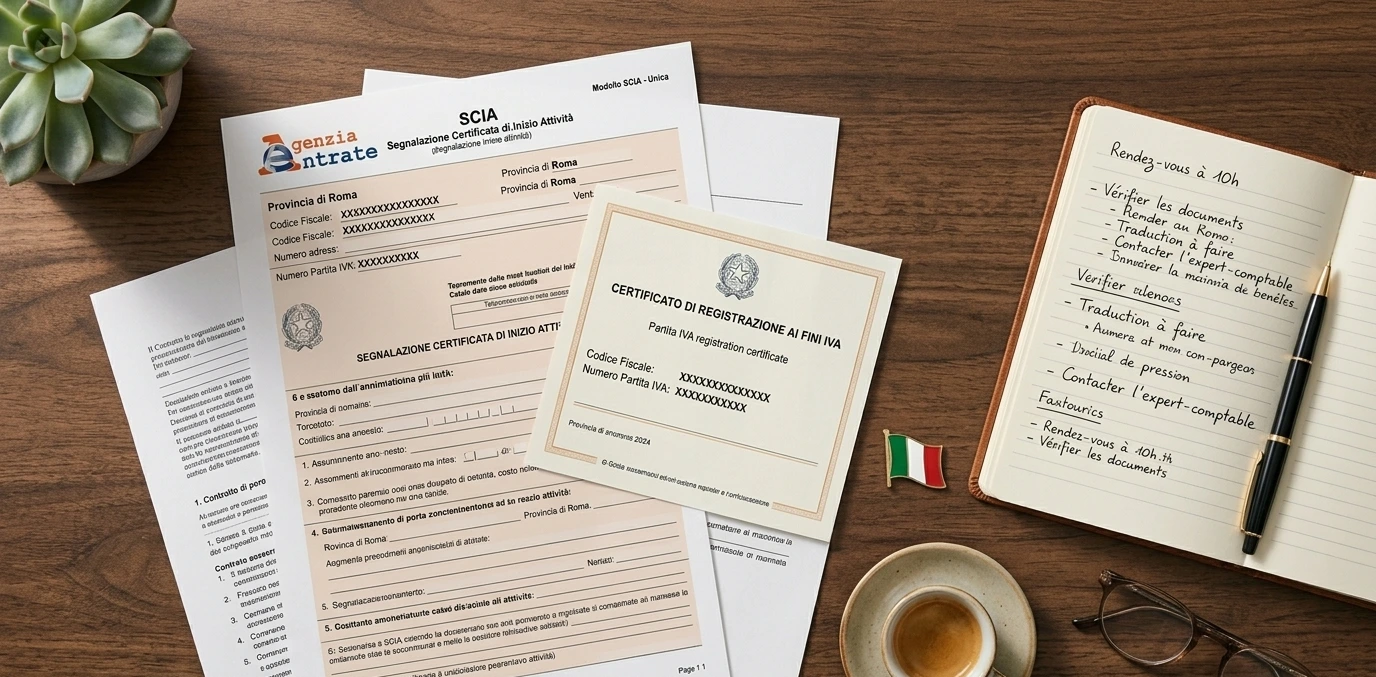
Opening a B&B in Italy involves several administrative procedures to be handled in parallel. Here are the key steps in chronological order.
1. The SCIA — Segnalazione Certificata di Inizio Attività
The SCIA is the business start declaration you must file with your local municipality (Comune) before welcoming your first guests. It replaces the old prior authorisation system and takes effect immediately upon filing. It must be accompanied by several documents: fire safety compliance certificate, floor plan of the property, proof of ownership or a lease authorising commercial use, and in some cases a certificate of habitability (agibilità).
2. Obtaining the CIN — Codice Identificativo Nazionale
Since 1 January 2025, all tourist accommodation in Italy must have a CIN, the national identification code. This code, issued by the Ministry of Tourism via a dedicated online platform, must appear on all your listings (Airbnb, Booking, your own website) and at the entrance to your property. Operating without a CIN exposes you to fines of up to €8,000. This is a priority step that must be completed before you list your property anywhere.
3. Registering with the questura
Italian hosts are required to submit their guests’ identity details to the local police (questura) within 24 hours of arrival. This obligation applies to all types of tourist accommodation, including non-professional B&Bs. It is done through the Alloggiati Web online portal, provided by the Ministry of the Interior. Registering on this portal is one of the very first steps to take.
4. The tourist tax — tassa di soggiorno
The vast majority of Italian municipalities levy a tourist tax payable by guests. As a host, you are responsible for collecting it from your guests and paying it periodically to the municipality. The amount varies by municipality, accommodation category and season — generally between €1 and €5 per person per night. Check with your local municipality for the applicable rate and payment procedure.
5. Safety and hygiene standards
Your property must meet a set of minimum standards: smoke detectors and fire extinguishers, posted evacuation plan, hot running water in each room or adjoining bathroom, good-condition bedding and adequate ventilation. Inspections may be carried out by municipal or regional services at any time. A well-prepared compliance file will save you from unwanted surprises.
Taxation and accounting obligations
Taxation is often the most complex area for a foreign national opening a B&B in Italy. It depends directly on the legal status chosen and the volume of income generated.
The non-professional regime (standard B&B)
If you operate as a non-professional B&B — in your primary residence, without a partita IVA — your income is declared as miscellaneous income (redditi diversi) in your Italian tax return (dichiarazione dei redditi). Since 2024, this income can benefit from the cedolare secca, a flat-rate withholding tax of 26% (21% for the first property rented out). This is a straightforward regime and often advantageous for small operations.
The professional regime (affittacamere, larger structures)
If you operate professionally with a partita IVA, you fall under the business income regime. The regime forfettario (flat-rate scheme) is often the most suitable for small structures: it applies up to €85,000 in annual turnover and provides for a tax rate of 15% (5% for the first five years of new activities) on a flat-rate taxable base. Above this threshold, you move into the standard regime.
VAT
Short-term tourist rentals (under 30 nights) are generally VAT-exempt in Italy. If you offer ancillary services — catering, transfers, activities — VAT may apply to those specific services.
Social contributions
Under the non-professional regime, there are no social contributions linked to B&B income. Under the professional regime with a partita IVA, you are subject to contributions to the Gestione Separata INPS (approximately 26.23% of net income) or, if you fall under the craft or commerce categories, fixed INPS contributions.
Choosing and fitting out the right property
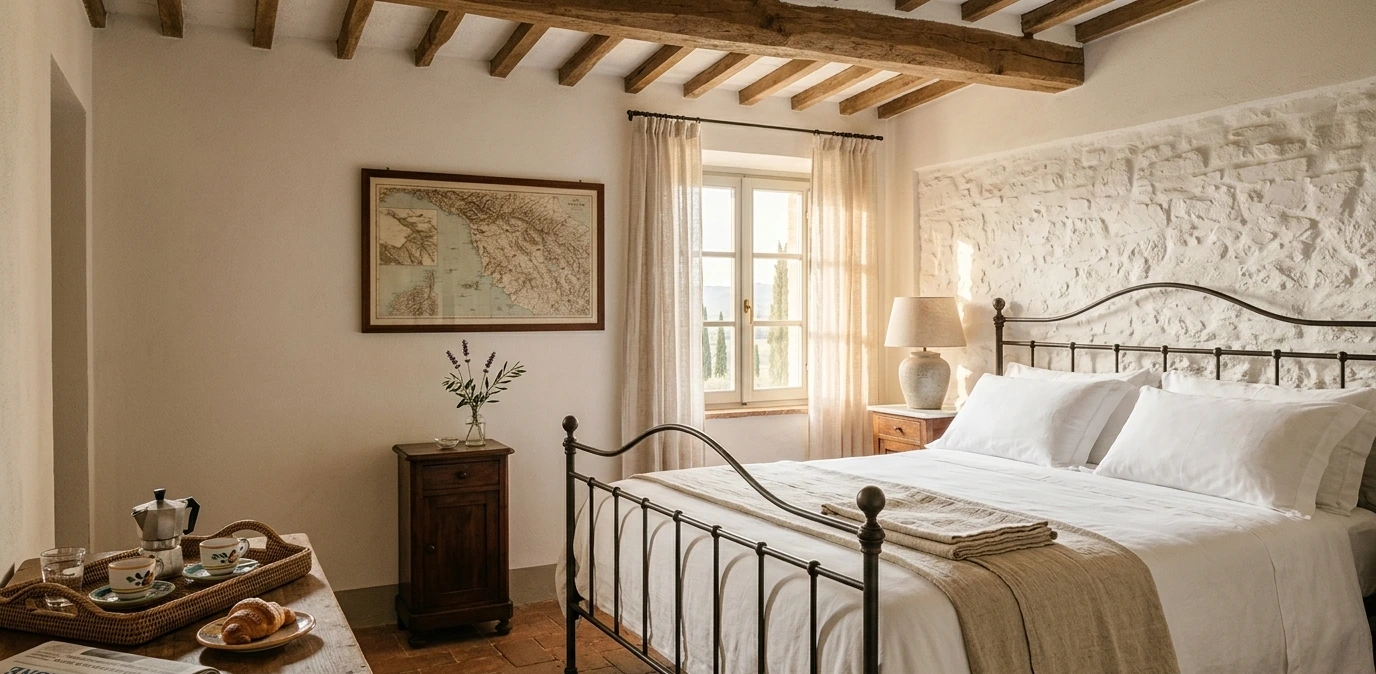
The success of a B&B ultimately rests on the property itself. An attractive location, a characterful property and attentive service are the three pillars of a profitable and sustainable operation.
Location
The golden rule: choose a property in a high-tourism-demand area or in an emerging destination with growth potential. Key criteria include proximity to cultural or natural attractions, accessibility (railway station, airport, motorway), the seasonality of local tourism and the density of existing competition. A municipality with few quality accommodations and growing visitor numbers is often more interesting than a saturated destination.
Property type
The highest-performing B&B properties are those with strong architectural character: stone village houses, trulli in Puglia, Tuscan farmhouses (casali), apartments in historic palaces. Authenticity is a powerful commercial argument that travellers are willing to pay a premium for. A well-located ordinary property will always outperform an exceptional one in the wrong location.
Renovation and interior design
Before undertaking any works in Italy, always check the planning status of the property and the permits required. Some listed buildings or properties in protected areas are subject to strict renovation restrictions. Budget realistically: Italian craftsmen are skilled but timelines can be long, especially in rural areas. For interiors, lean into local authenticity rather than a standardised style — that is precisely what makes the difference on booking platforms.
Profitability: what you can realistically expect
The profitability of a B&B in Italy depends on many factors: location, standard, capacity, seasonality and occupancy rate. Here are realistic benchmarks to help you build your business model.
| Profile | Average price/night | Estimated occupancy rate | Estimated gross annual revenue |
|---|---|---|---|
| 2-room B&B, rural area | €80 to €120 | 50 to 60% | €30,000 to €50,000 |
| 3-room B&B, art city | €120 to €180 | 65 to 75% | €60,000 to €100,000 |
| 5-room affittacamere, coastal | €150 to €250 | 70 to 85% (season) | €100,000 to €180,000 |
| Villa with pool, Puglia/Sicily | €300 to €600 | 60 to 75% (season) | €150,000 to €350,000 |
These figures are gross estimates, before deducting costs: platform commissions (15 to 20%), cleaning fees, consumables, insurance, local taxes, potential management fees and tax. A net margin of 40 to 55% of gross revenue is a realistic target for a well-managed operation.
Seasonality is a critical factor in Italy: some coastal areas generate the bulk of their revenue over just 4 to 5 months. Conversely, art cities such as Florence, Rome or Venice enjoy near year-round visitors, which smooths income considerably.
Airbnb, Booking, direct: which distribution strategy?
Distribution is one of the most important levers of B&B profitability. Over-reliance on platforms erodes your margins; a diversified strategy gives you flexibility.
Airbnb
Airbnb remains the dominant platform for characterful and unique accommodation in Italy. Its host commission sits between 3 and 5% of revenue (plus 14 to 16% charged to guests). It is particularly well suited to character B&Bs and affittacamere that differentiate themselves through atmosphere and authenticity. The Airbnb algorithm rewards properties with numerous recent reviews — from day one, actively encourage your guests to leave feedback.
Booking.com
Booking.com reaches a broader audience and often generates higher volume, but at a higher commission (15 to 20%). The platform is particularly effective for multi-room properties with continuous availability. It imposes strict conditions on cancellation policies and rate parity — read the general terms carefully before signing up.
Direct bookings
Building your own website with a booking engine allows you to take reservations at zero commission. This is a profitable medium-term investment: each direct booking saves 15 to 20% in commission. Build a database of past guests, send a seasonal newsletter, and offer a small incentive (complimentary breakfast, late check-out) to encourage return visitors to book directly.
The channel manager
As soon as you are listed on multiple platforms, a channel manager — centralised availability and pricing management software — is essential to avoid double bookings. Solutions such as Lodgify, Smoobu or Hostaway are well suited to small properties and integrate with all major platforms.
Common mistakes and how to avoid them
- Underestimating regional administrative requirements: regulations vary significantly from one region to another. What is permitted in Tuscany may not be in Campania. Always consult a local professional before committing.
- Forgetting the CIN: since January 2025, operating without a Codice Identificativo Nazionale exposes you to serious fines. It is the first step to take — before you publish any listing.
- Neglecting guest registration with the questura: this obligation is often overlooked by new hosts. Non-compliance carries criminal sanctions, not just administrative ones.
- Misjudging seasonality: a stunning property in a coastal resort may generate the bulk of its revenue in 10 weeks. Your cash flow model must account for the quiet months.
- Pricing too low: out of fear of remaining empty, many new hosts underprice their property. Analyse local competition, position yourself in line with your standard, and do not hesitate to apply dynamic pricing by season.
- Ignoring double taxation treaties: if you are a tax resident in the UK, US or elsewhere, your Italian income must be correctly reported in both countries. Errors can be very costly.
- Buying without checking planning status: some properties carry planning irregularities that make them unusable for tourist rental. Rigorous due diligence before purchase is non-negotiable.
How Allerenitalie.com supports you
Opening a B&B in Italy as a foreign national is an ambitious project combining property purchase, Italian administrative procedures, tax optimisation and operational management. Each of these areas requires specific expertise — and a mistake in any one of them can jeopardise the entire project.
At Allerenitalie.com, we have been supporting international buyers and investors looking to make this kind of project a reality in Italy for several years. Our network of bilingual professionals — lawyers, tax advisors, estate agents, notaries — covers the entire Italian territory and steps in at every stage of your journey:
- Property search and selection: identifying high-potential areas, comparative market analysis, introductions to specialist local estate agents.
- Legal and planning due diligence: verifying property status, easements, potential irregularities and compatibility with tourist use.
- Purchase support: negotiation, preliminary contract monitoring, notary coordination, document translation and explanation.
- Business setup: choosing the right legal status, opening a partita IVA, filing the SCIA, obtaining the CIN, registering with the questura.
- Tax optimisation: structuring your activity across borders, applying the relevant double taxation treaty, choosing the most advantageous tax regime.
- Operational support: introductions to local property managers, advice on distribution and pricing, ongoing accompaniment.
Do you have a B&B project in Italy?
Our bilingual advisors will assess your project and connect you with the right professionals for your situation. First consultation complimentary.
Conclusion
Opening a B&B or guesthouse in Italy is both an exciting and demanding project. The country offers extraordinary conditions — an unmatched cultural heritage, a deeply rooted hospitality culture and tourist demand that shows no sign of slowing. But success rests on rigorous preparation: choosing the right legal status, meeting local administrative obligations, optimising your tax position and building a coherent commercial strategy.
The pitfalls are numerous for those who launch without proper support — and often costly. The success stories, on the other hand, are real and lasting for those who take the time to lay solid foundations. That is precisely why we are here.
Discuss my project with an advisor
Frequently asked questions
Can a foreign national open a B&B in Italy?
Yes, with no nationality restrictions. A UK, US, Australian or other foreign national can open a B&B in Italy on the same basis as an Italian citizen. They will simply need an Italian codice fiscale and, depending on the status chosen, a partita IVA. Non-EU nationals should check the conditions attached to their residence permit.
Do you need to live in Italy to open a B&B?
For the non-professional B&B status, yes — the owner must reside in the property. For an affittacamere or casa vacanze, residence is not required, but you will need to appoint a reliable local manager or manage the operation remotely, which requires careful organisation.
How much does the administrative set-up of a B&B in Italy cost?
The administrative procedures themselves are low-cost: the SCIA is free in most municipalities, and the CIN is issued free of charge by the Ministry of Tourism. The real costs are those of bringing the property up to standard and the professional fees if you engage an accountant or lawyer to set up the business.
Can you manage a B&B in Italy remotely from abroad?
Yes, for the statuses that do not require on-site residence. This involves having a reliable local manager for check-ins, cleaning and maintenance, and using appropriate digital tools (smart locks, channel manager, remote communication). Remote management is feasible but requires solid organisation.
Which is the best Italian region to open a B&B?
There is no universal answer: it depends on your budget, lifestyle project and profitability objectives. Tuscany and the Amalfi Coast offer the highest yields but also the highest purchase prices. Puglia, inland Sicily and the Marche offer a better price-to-potential ratio for investors anticipating growing demand.
Is Airbnb rental regulated in Italy?
Yes. Since 2024-2025, regulation has tightened considerably: the CIN is mandatory, guest registration with the questura is required, and tourist tax must be collected and remitted. Some municipalities have also introduced restrictions on the number of rental nights per year or on permitted zones. Always check the specific regulations of your municipality before publishing any listing.