


Table of contents
Why learn Italian in 2026?
Italian is the fourth most spoken Romance language in the world and the sixth most studied language globally. But beyond the statistics, it is a language that opens concrete doors — especially for English speakers who have a connection with Italy, whether personal, touristic or professional.
For a property buyer, mastering a few dozen legal and administrative terms can make the difference between a smooth signing at the notary’s office and a costly misunderstanding. For an entrepreneur, being able to read a commercial lease or correspond with an Italian chamber of commerce without relying on a translator is a genuine competitive advantage. And for the traveller, it is simply the key that transforms a tourist stay into an authentic immersion.
In 2026, learning tools have evolved considerably: artificial intelligence, adaptive apps and specialised online courses make it possible to progress faster, in a more targeted way and at your own pace. There has never been a better time to get started.
How long does it take to learn Italian?
Italian is considered one of the more accessible languages for English speakers, thanks to the significant Latin root vocabulary shared between the two languages. Researchers estimate that around 60% of everyday Italian vocabulary has recognisable English cognates — giving you a solid head start compared to speakers of non-European languages.
Here are the milestones typically observed among English-speaking learners:
| Level | What you can do | Indicative timeframe |
|---|---|---|
| A1–A2 | Introduce yourself, read signs, order at a restaurant | 1 to 3 months (30 min/day) |
| B1 | Hold everyday conversations, follow simple media | 6 to 9 months |
| B2 | Negotiate, write emails, understand official documents | 12 to 18 months |
| C1–C2 | Full fluency, formal and technical registers | 2 to 3 years |
These timeframes assume consistent practice of 30 minutes to one hour per day. Regularity matters far more than occasional intensive sessions. And for specific needs — administrative vocabulary, reading contracts, dealing with Italian institutions — a targeted course can get you operational within weeks, without waiting to reach a general B2 level.
The best methods for learning Italian in 2026
There is no single best method: the best one is the one you actually use. Here is an honest overview of the approaches available, with their strengths and limitations.
Mobile apps
Duolingo, Babbel, Pimsleur, Italki — apps have come a long way in recent years. They are ideal for building foundations, expanding vocabulary and practising daily in just a few minutes. Their weakness: they remain generalist and rarely cover professional or administrative Italian. They make an excellent complement, but rarely a complete solution for a specific goal.
Online private lessons
Finding a native speaker on Italki or Preply allows you to progress quickly in spoken Italian and receive personalised feedback. It is the most flexible approach, but also the most expensive if you aim for several hours per week. For a specific goal such as understanding notarial documents or writing professional emails, you need to find a specialist teacher — which is not always straightforward.
Audio methods
Pimsleur and Michel Thomas are particularly well suited to learners on the move — during commutes, cooking or exercise. Active listening fixes pronunciation and sentence structures durably. These methods are less effective for writing and technical vocabulary.
Progressive immersion
Watching Italian series in the original language with subtitles, listening to podcasts such as Coffee Break Italian or Italiano Automatico, reading Italian news online — these gentle immersion habits considerably accelerate passive comprehension and build vocabulary naturally. Netflix and RAI Play both offer extensive catalogues to get started without pressure.
Structured online courses
For learners with a specific goal and a timeline, a structured course with a clear learning progression, practical exercises and support remains the most effective approach. This is especially true for professional Italian, where the generalist vocabulary of apps simply falls short.
Free resources to progress quickly
Before investing in a course, several free resources can help you build solid foundations or complement an ongoing learning journey:
- RAI Play: the Italian public broadcaster’s platform, freely accessible from outside Italy. News bulletins, documentaries, talk shows — a goldmine for training your ear.
- Treccani online: the reference dictionary of the Italian language, available for free. Essential for precise vocabulary and official definitions.
- Italiano Automatico (YouTube): a hugely popular channel by Alberto Arrighini, specialising in natural Italian acquisition. Ideal for intermediate learners.
- Coffee Break Italian (podcast): short, progressive and well structured. Perfect for beginners and false beginners.
- Anki: spaced repetition software for vocabulary memorisation. Ready-made Italian decks are available for free download.
- Wordreference.com: the reference English-Italian bilingual dictionary, with a discussion forum covering linguistic nuances.
Administrative and commercial Italian: a level apart
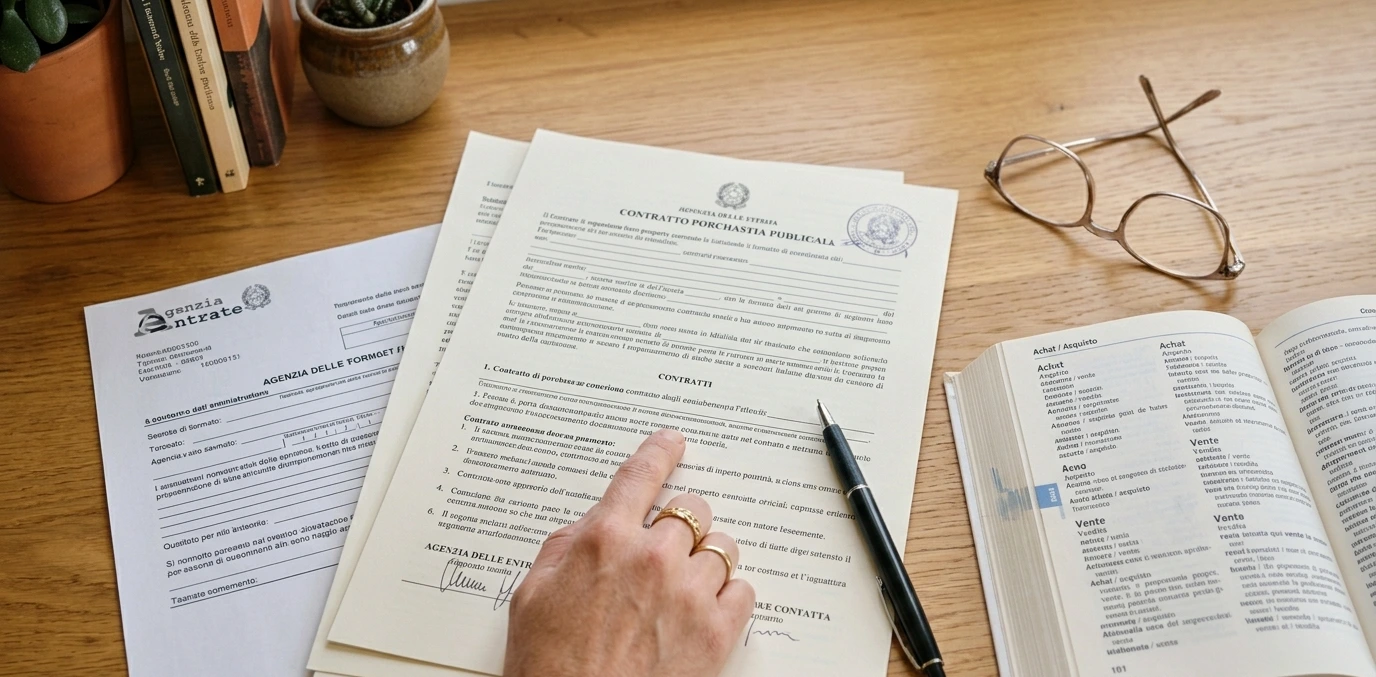
Knowing how to ask for directions in Florence is one thing. Understanding a property purchase agreement, a letter from the Agenzia delle Entrate (Italy’s tax authority), a commercial lease or the articles of association of an Italian company — that is an entirely different matter.
Administrative and legal Italian follows very specific stylistic conventions: long sentences, passive constructions, Latin-rooted vocabulary, institutional abbreviations (S.r.l., p.IVA, rogito, visura catastale…). Even a fluent Italian speaker can find themselves at a loss when faced with an official document or a notarial letter.
For English speakers buying property in Italy, setting up a company, opening a bank account or managing a business from abroad, mastering this register is directly linked to their legal and financial security. A misunderstanding in a contract is never trivial — it can have real consequences on significant commitments.
This is precisely the observation that led us to create our own course within the Aller en Italie Academy.
Our online professional Italian course — Aller en Italie Academy
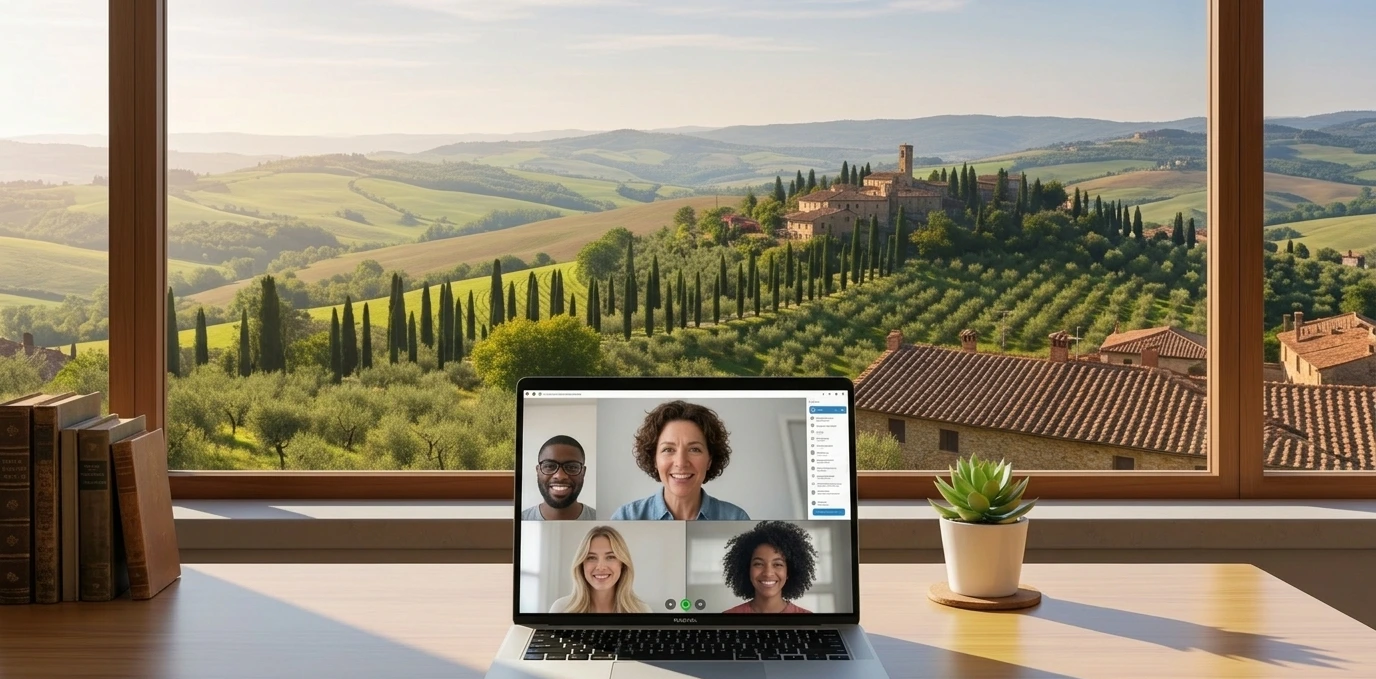
At Allerenitalie.com, we support hundreds of people every year in their Italian projects. And we have observed, project after project, the same recurring friction point: the language barrier in official procedures. Too many people sign documents they only half understand, or depend entirely on an intermediary for exchanges they could handle themselves with the right targeted vocabulary.
This is why we created, within the Aller en Italie Academy, an online professional Italian course designed entirely for English speakers. Its distinctive feature? It is delivered by a specialist teacher with deep expertise in Italian administrative and commercial contexts. Every explanation is built around your existing knowledge of English: bridges between the two languages are systematically exploited, false friends are clearly flagged, and the conventions of official Italian are explained with reference points that actually make sense to you.
No generic programme designed for every audience on the planet. A direct approach, built around your reality: you have a project in Italy, you need to understand what you are signing, what people are writing to you and what they are saying — and you want to get there quickly, without detours. The goal is clear: to make you autonomous, effective and credible in your professional dealings in Italy.
Week-by-week programme
| Week | Topic | Practical component |
|---|---|---|
| Week 1 | First contact — email and WhatsApp Introducing yourself effectively, writing professional emails, understanding Italian communication codes |
Writing and correcting real messages |
| Week 2 | Sales calls and calls to action Feeling confident on the phone, structuring an exchange, steering towards an objective |
Role plays |
| Week 3 | Proposals and commercial relationships Presenting an offer, proposing partnerships, structuring next steps |
Creating proposals |
| Week 4 | Dealing with Italian administration Communicating with institutions, avoiding common mistakes |
Simulations |
| Week 5 | Commercial approach and business development Sharpening your pitch, handling objections, growing your activity in Italy |
Real case studies |
Format and structure
The course runs entirely online, in small groups for greater interaction and effectiveness. Session times are agreed with the group at the start. Each week, you work for 2 hours with your teacher, using concrete materials: video explanations, downloadable vocabulary sheets, comprehension exercises and real-life situations drawn from authentic Italian documents.
A questions-and-answers space allows you to get clarification between sessions. And because every project in Italy is different, our bilingual advisors remain available to guide you towards the most relevant content for your situation.
Practical information
| Price | €600 |
| Total duration | 10 hours |
| Pace | 2 hours per week |
| Next start date | Last week of April |
| Format | Small groups — session times agreed with participants |
Our tips for making real progress
Whatever method you choose, here are the principles that genuinely make a difference over time:
- Practise every day, even for five minutes: consistency beats weekend marathons every time. Your brain retains what it revisits frequently.
- Start with what you need right now: if you are buying a property in six months, focus first on notarial and administrative vocabulary — not verb conjugations.
- Listen as much as you read: listening comprehension is often the weak point for self-taught learners. Integrate podcasts, videos and active listening sessions from the very beginning.
- Write by hand: copying vocabulary or key phrases by hand significantly improves long-term retention.
- Embrace imperfection: speaking approximate but confident Italian is infinitely more useful than saying nothing for fear of making a mistake. Italians always appreciate and encourage the efforts of foreigners.
- Set a concrete goal: “learn Italian” is too vague. “Understand my lease before 1 June” or “hold a conversation with my estate agent in Naples” — these are the kinds of goals that motivate and direct your learning.
Frequently asked questions
Is Italian hard to learn for an English speaker?
It is one of the more accessible languages for English speakers, thanks to the large amount of shared Latin-root vocabulary. Pronunciation is consistent and logical, which also helps with listening comprehension. Most learners are pleasantly surprised by how quickly they start to recognise words and structures.
Can you learn Italian on your own, without a course?
Absolutely — provided you combine varied resources and practise regularly. Apps, podcasts and online materials allow you to make solid progress independently. For administrative or commercial Italian, a structured course considerably accelerates the acquisition of specialised vocabulary.
How much time per day do you need to learn Italian?
Thirty minutes a day is enough to progress steadily. The key is consistency: a daily 30-minute session is more effective than a 3-hour block at the weekend.
What is the difference between everyday Italian and administrative Italian?
Administrative and legal Italian uses a very specific formal register, with technical vocabulary specific to institutions, contracts and official procedures. This register is not acquired naturally through generalist methods — it requires targeted training.
Is the Aller en Italie Academy course suitable for beginners?
The course is primarily aimed at people who already have some basic Italian (minimum A2 level) or a good familiarity with legal and administrative English. If you are starting from scratch, we recommend beginning with the foundational vocabulary modules before tackling the specialist ones.
Do you need to speak Italian to buy property in Italy?
No — our network of bilingual professionals is here to support you at every stage. But understanding the key terms of property and administrative vocabulary allows you to follow conversations, ask the right questions and commit to decisions with full confidence. That makes a significant difference to the quality of your experience.
Conclusion
Learning Italian in 2026 is an investment in your independence — whether you are preparing a property purchase, a professional project or simply your next trip. The tools available have never been so numerous or so effective. And to go beyond the tourist who orders their aperitivo confidently — to truly understand what you are signing, what people are writing to you and who you are working with — professional and administrative Italian is the missing piece that no generalist method will ever give you.
That is exactly what we set out to build at the Aller en Italie Academy: a short, targeted, immediately useful course — delivered by a specialist teacher who understands your starting point, your needs and the realities of life in Italy.