

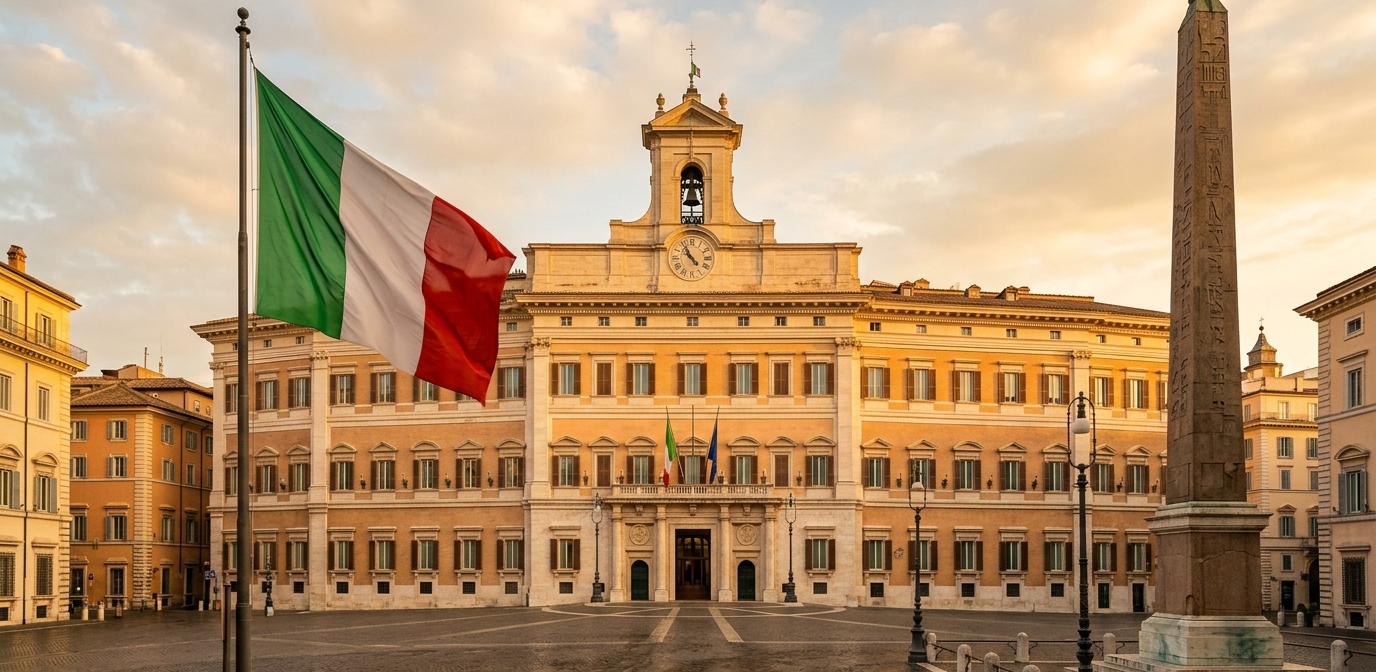
Italy fascinates, draws people in, and sometimes bewilders them. For anyone thinking about moving there or investing, understanding the country’s political life is not a luxury; it is a practical necessity. With a government that is holding firm despite a historic referendum defeat, general elections on the horizon in 2027, and tax reforms under pressure, things are moving fast. This guide gives you all the context you need to make sense of it.
1. Italy’s political system, simply explained
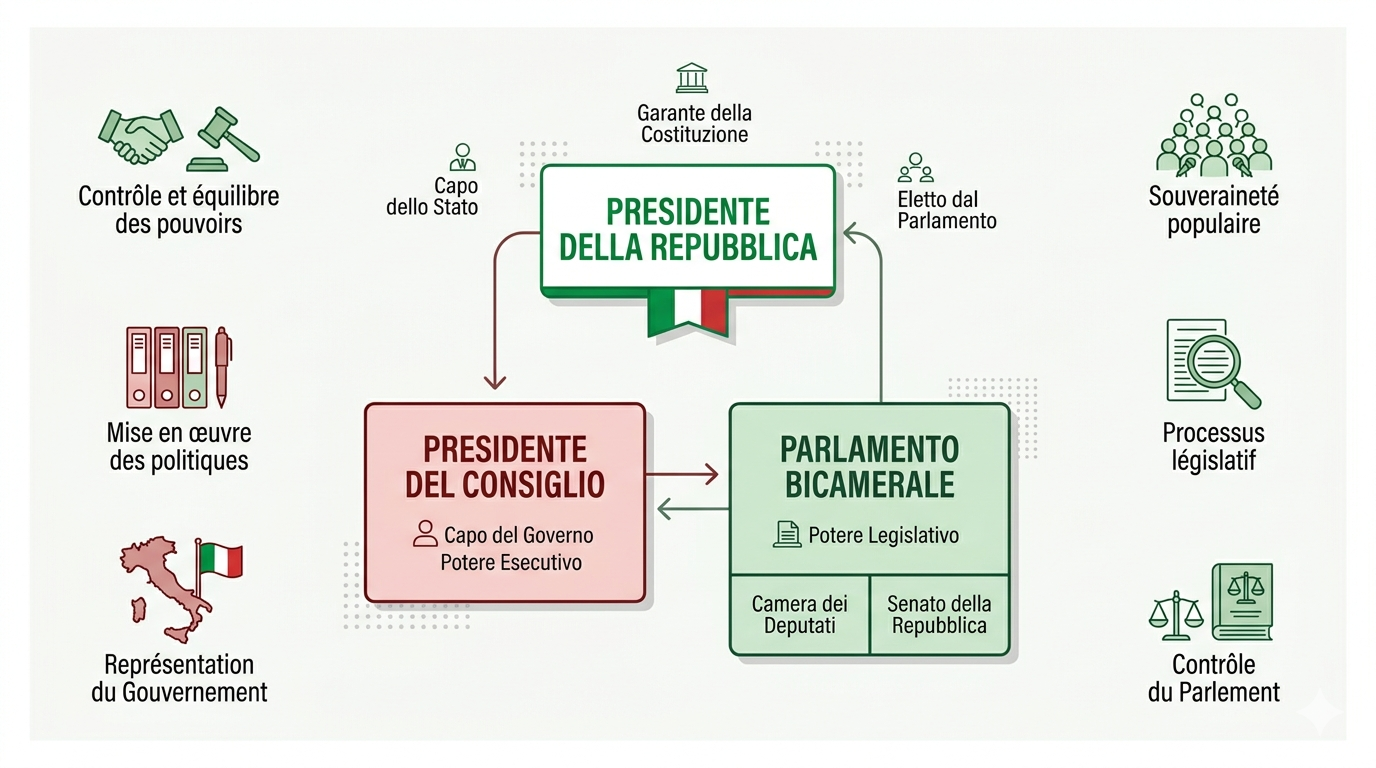
Italy is a parliamentary republic, shaped by its 1948 Constitution adopted in the aftermath of fascism. Its political system rests on a carefully constructed balance between several institutions, which goes some way to explaining the country’s reputation for instability.
At the top of the state sits the President of the Republic, elected for a seven-year term by Parliament in joint session. The role is that of an institutional guardian: the President does not govern, but can dissolve the chambers, appoint the Prime Minister, and refuse to sign legislation deemed unconstitutional. This makes the office a fundamental check on executive power.
The real head of the executive is the President of the Council of Ministers, the equivalent of a Prime Minister. This is the person who leads the government, sets the political agenda, and answers to Parliament.
Parliament itself is bicameral: it consists of the Chamber of Deputies (400 seats since the 2020 reform, down from 630) and the Senate (200 seats). Both chambers hold equal powers, which can slow the legislative process considerably when the two houses cannot agree.
2. Who governs Italy in 2026?
Since 22 October 2022, Italy has been led by Giorgia Meloni, leader of the Fratelli d’Italia (FdI) party. The first woman to hold the office of President of the Council in Italian history, she formed a centre-right and far-right coalition with Matteo Salvini’s Lega and Forza Italia.
As of April 2026, her government is approaching its fourth anniversary, an absolute record for longevity in modern republican Italy. With approval ratings holding at around 40% and her party Fratelli d’Italia polling above 30%, Meloni remains by far the country’s dominant political figure.
On the economic front, the 2026 budget, passed at the eleventh hour in late December 2025, has been described as “prudent” by the government itself. It includes a modest income tax reduction for the middle class (cutting the marginal rate from 35% to 33% for incomes between €28,000 and €50,000), but offers little in the way of structural investment to revive a still sluggish economy. The government’s overriding priority is to exit the EU’s excessive deficit procedure by spring 2026.
3. The March 2026 referendum: Meloni’s first real setback
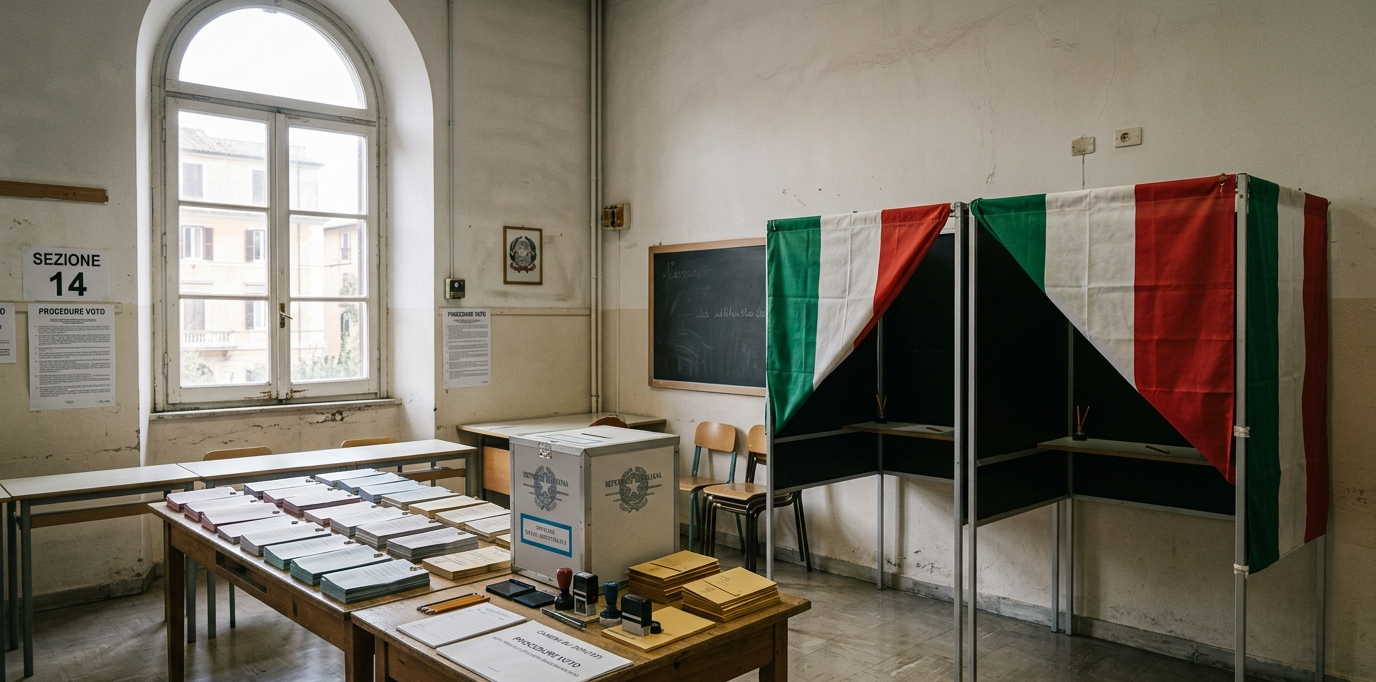
On 22 and 23 March 2026, Italians were asked to vote on a constitutional reform of the justice system, championed by the Meloni government. The official aim was to draw a clearer line between the careers of judges and prosecutors. The political concern raised by the opposition was different: that the reform would weaken judicial independence and strengthen the executive.
The result was unambiguous: the NO vote won with around 54%, against 46% for YES. Turnout was historically high for a constitutional referendum, which amplified the symbolic weight of the outcome. This was the third rejection of an institutional reform by referendum in Italy, and the second time, after Matteo Renzi in 2016, that a sitting Prime Minister has been defeated on a flagship proposal.
Meloni refused to resign and announced she would continue her mandate. Within 48 hours of the vote, however, three members of her government stepped down, including Tourism Minister Daniela Santanchè, who had already been weakened by legal proceedings. This quiet political earthquake nonetheless exposed cracks within the coalition.
4. The main Italian political parties you need to know
Italy’s political landscape can take some getting used to. Here are the main forces at play in 2026:
| Party | Leader | Orientation | Polling (April 2026) |
|---|---|---|---|
| Fratelli d’Italia (FdI) | Giorgia Meloni | Far right | ~30–32% |
| Partito Democratico (PD) | Elly Schlein | Centre-left | ~21–23% |
| Movimento 5 Stelle (M5S) | Giuseppe Conte | Populist | ~10–12% |
| Lega | Matteo Salvini | National right | ~8–9% |
| Forza Italia | Antonio Tajani | Centre-right | ~7–8% |
| Alleanza Verdi-Sinistra | Fratoianni / Bonelli | Left | ~6–7% |
| Italia Viva | Matteo Renzi | Liberal centre | ~3–4% |
Sources: aggregated Italian polls, April 2026. Figures fluctuate and are provided for reference only.
The ruling coalition (FdI + Lega + Forza Italia) retains its parliamentary majority, but internal tensions between Salvini, more Trumpist and sovereignist in outlook, and Meloni, who tries to maintain a broadly pro-European stance, surface regularly. The opposition, meanwhile, continues to struggle to unite around a shared programme and a common candidate ahead of 2027.
5. Is Italy really politically stable?
This is the question anyone considering a move to Italy tends to ask, and the answer is more layered than it might seem.
Yes, the current government is solid by Italian standards. Three and a half years in office without a major crisis is genuinely exceptional. The coalition is holding, the institutions are functioning, and daily life is entirely unaffected by the turbulence in Rome.
But the horizon toward 2027 is growing complicated. According to political scientist Hervé Rayner (University of Lausanne), Meloni faces a strategic dilemma: if she waits for the September 2027 elections, she will have to account for a weakening economic picture once the EU’s PNRR recovery funds expire in July 2026. If she calls an early election, she does so with a near-empty reform record — no major legislation has passed since 2022.
On the social front, the end of 2025 saw significant protests against austerity policies, security legislation, and in solidarity with Palestine, though none of this translated into organised political opposition. Italy is simmering, but within calm institutional boundaries.
6. What Italian politics actually means for expats

Beyond the parliamentary debates, here is what genuinely deserves your attention as a future resident or investor in Italy.
The flat tax for new residents: still in place
One of the most attractive arrangements for wealthy newcomers — the flat tax of €100,000 per year on foreign-source income — has not been abolished, but access has been tightened under Meloni. The government sends mixed signals: on one hand, a stated desire to attract foreign capital; on the other, populist pressure against what are perceived as fiscal privileges. If this scheme is central to your plans, keep a close eye on developments before committing.
Immigration and visas: a paradoxical policy
While Meloni’s official rhetoric is tough on irregular immigration, her government has simultaneously opened the door wide for skilled workers: 500,000 entry quotas have been granted for non-EU workers over the 2026–2028 period. For EU citizens, residency remains free and unrestricted, though administrative processing times have been lengthening in some municipalities.
Property: a market largely unaffected by politics
The broad trends in Italian real estate rising prices in major cities, opportunities in the South — are driven more by demographics and interest rates than by the colour of the government. The €1 house schemes continue to exist in depopulated villages, and the programme to restore historic town centres is ongoing, backed by PNRR European funds.
7. Italy and the European Union: a balance under strain
The relationship between Rome and Brussels is one of the most complex within the EU. Meloni maintains an ambiguous position: as a member of the European Conservatives and Reformists group, she keeps her distance from the Franco-German core while avoiding outright confrontation with the Commission.
On migration, tensions remain high. On the budget, Italy has played by the rules of fiscal discipline to exit the excessive deficit procedure, a constraint that directly limited the room for manoeuvre in the 2026 budget.
The big story of the year is the PNRR (National Recovery and Resilience Plan), for which Italy is the largest European beneficiary at €191.5 billion. The funds expire at the end of 2026, a development that will significantly alter the country’s economic picture — and potentially the political calculations ahead of the elections.
On the international stage, Meloni was among the first European leaders to build a relationship with Donald Trump, a bet that initially paid off but is now looking riskier: Trump’s approval rating among Italians fell from 35% to 19% between March 2025 and March 2026, as his decisions on Iran and global trade played out.
What to take away
Italy in 2026 is a country that is politically stable in the short term, governed by a right-wing coalition that has survived its first electoral defeat, the March 2026 referendum, without collapsing. Giorgia Meloni remains firmly in control, even as the road to 2027 grows more complicated.
For anyone considering a move to Italy or an investment there, daily life is entirely decoupled from these political currents. What does deserve attention is the evolution of tax arrangements (the flat tax and other benefits for new residents) and the expiry of PNRR European funds in July 2026, which could weigh on the local economy.
If your plans are well advanced, there is little reason to wait for the 2027 elections before acting. The current rules are known, the institutions are working — and Italy remains one of the most fascinating and accessible countries in the world for anyone ready to make a change.