

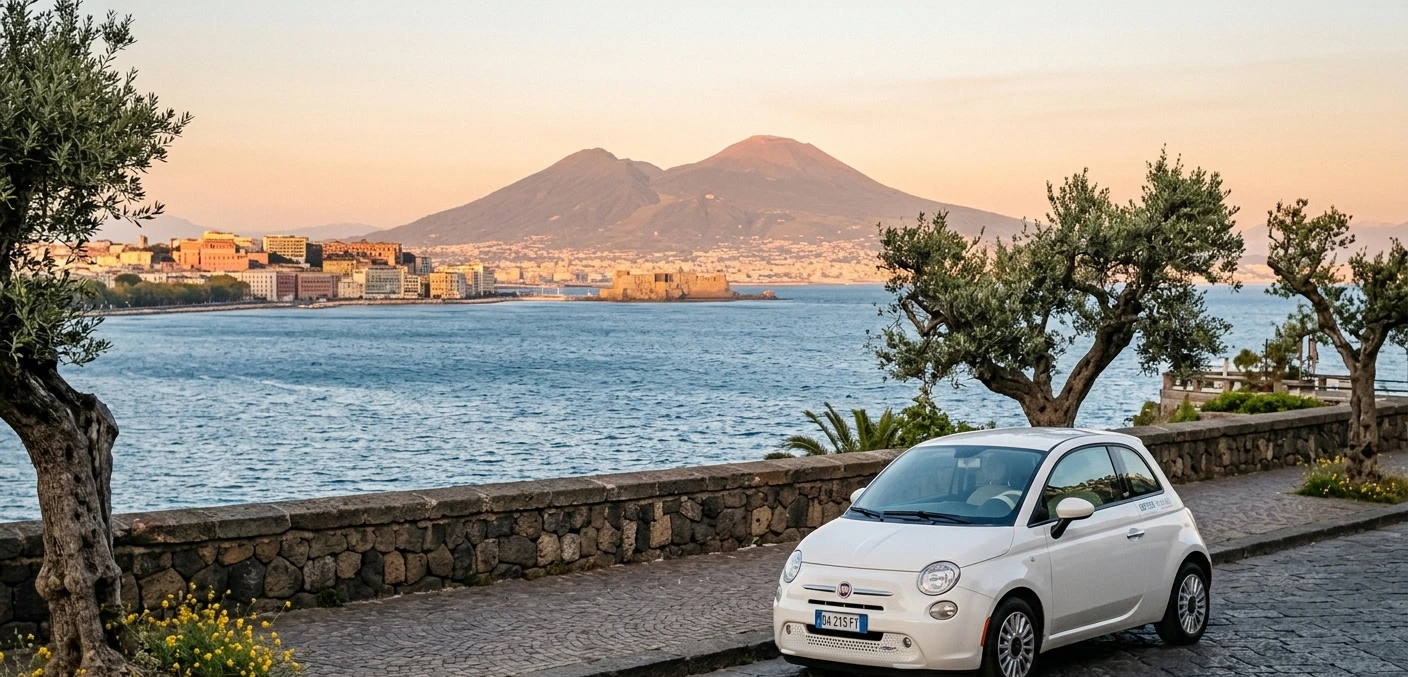
Naples fascinates, overwhelms, and crackles with energy — and it has intimidated more than a few travellers before they even sit behind the wheel. The legendary traffic, the scooters appearing from nowhere, the historic centre’s streets barely wider than a corridor: renting a car in Naples can seem like a wild idea at first. And yet, without a car, some of Campania’s most spectacular places stay out of reach. Pompeii at sunrise, the vertiginous roads of the Amalfi Coast, the caves of Castellammare, the villages of the Cilento: all of these require keys in hand.
In this complete guide, you will find everything you need to know before booking a vehicle in Naples: where to pick it up, which rental company to choose, how much to budget, how to drive through the city without collecting a ZTL fine, and the best day trips you can make by car from this Campanian capital.
Table of Contents
- Do you actually need to rent a car in Naples?
- Where to rent a car in Naples: airport, train station, or city centre?
- Which vehicle to choose for Naples and Campania?
- Prices and budget: how much does car rental cost in Naples?
- Driving in Naples: what you absolutely need to know
- Insurance and cover: what you actually need
- The best day trips by car from Naples
- Conclusion
- FAQ
Do you actually need to rent a car in Naples?
The honest answer is: it depends entirely on your itinerary. If you are spending three days purely within Naples itself — the Spanish Quarter, the Museo Nazionale, Piazza del Gesù — you can manage perfectly well without one. The metro, funiculars, and taxis are more than enough to get around on foot and by public transport. The UNESCO-listed historic centre is largely pedestrianised anyway, and driving through the narrow streets of Spaccanapoli or the Sanità district is closer to an extreme sport than a relaxed outing.
If your trip includes excursions outside Naples, however, a car becomes almost indispensable. The Amalfi Coast, Pompeii, Vesuvius, Herculanum, Paestum, the islands (departing from Pozzuoli or Castellammare): public transport connections exist, but they are often slow, packed in summer, and inflexible on timing. With a car, you leave when you want, return at your own pace, and discover places that organised tours never reach.
It is also worth thinking about cost when travelling as a group of two, three, or four: hiring a small city car for a day trip to Pompeii often works out cheaper and far more convenient than buying four bus tickets, dealing with connections, and waiting in the August heat.
Our advice: if your programme includes at least one trip outside Naples, book a car. But avoid driving into the historic centre — park on the outskirts or at your accommodation, and explore the city on foot.
Where to rent a car in Naples: airport, train station, or city centre?
You have several options for picking up your Naples airport car rental or collecting a vehicle in the city, each with its own advantages.
Naples Capodichino Airport (NAP) is the most convenient pick-up point if you are arriving by plane. All the major companies are represented there: Hertz, Avis, Sixt, Europcar, Budget, Enterprise, Goldcar. The desks are accessible right after baggage claim, and vehicles are kept in a dedicated car park steps from the terminal. This is the ideal option if you want to head straight out into the region as soon as you land.
Naples Centrale train station also has rental agencies nearby, particularly in the streets around Piazza Garibaldi. This works well if you are arriving by train from Rome or another Italian city. Prices there are sometimes slightly lower than at the airport, though the vehicle selection can be more limited during peak season.
The city centre also has independent agencies, often cheaper than the big names, but with less standardised customer service. If you go with a local operator, read the reviews carefully and check the insurance terms before signing anything.
Whichever option you choose, book at least three to four weeks in advance between May and September. Last-minute availability is rare, and prices climb sharply. If you are arriving at one airport and leaving from another (Naples to Salerno, for example), check the one-way return fees: these can reach €100 to €200 depending on the company.
Which vehicle to choose for Naples and Campania?
The right vehicle depends directly on your itinerary. For the vast majority of travellers exploring Naples and its surroundings, a small city car or compact hatchback is the smartest choice.
Roads in the region are generally well maintained on national routes and motorways, but the historic centres of Naples, Amalfi, Ravello, and Positano have streets of formidable narrowness. A large SUV or people carrier quickly becomes a liability in these conditions. A city car (Fiat Panda, Volkswagen Polo, or similar) slips through everywhere, parks easily, and uses little fuel on journeys that rarely exceed 80 to 100 km per day.
If you are travelling as a family with luggage and a pushchair, a compact estate or small SUV such as a Fiat 500X or Jeep Renegade offers a good balance of comfort and manoeuvrability. Avoid anything too large for the Amalfi Coast: the SS163 is a two-lane road with tight bends where passing a tourist coach in a big 4×4 is an exercise in extreme precision.
Air conditioning is non-negotiable from May through October. Temperatures on the Neapolitan plain regularly hit 35 to 38°C in summer, and local traffic jams do not help. It comes as standard on virtually all modern vehicles, but double-check when booking.
Prices and budget: how much does car rental cost in Naples?
Renting a car in Naples is affordable, provided you plan ahead. Here are the typical price ranges by season for a standard city car:
- Low season (November to March): €20 to €40 per day
- Shoulder season (April–May, October): €35 to €65 per day
- High season (June to September): €60 to €130 per day, sometimes more if you book late
Renting a car in Italy — and in Naples specifically — is broadly affordable when you plan ahead. These rates are before fuel and optional insurance. For a week in July for two people, budget roughly €400 to €650 for the rental alone. Fuel is on top of that: petrol runs around €1.75 to €1.95 per litre, with diesel slightly cheaper. Stations off the motorway are noticeably cheaper than those at service areas, so use them when you can.
For the best prices, use comparison platforms such as Rentalcars, Discovercars, or Autoescape. These sites often surface rates well below what agencies charge directly, and they give you a clear breakdown of excess amounts and inclusions.
Watch out for the hidden fees that inflate the final bill: young driver surcharges (under 25 or 26), additional driver fees, child seat charges, built-in GPS, and full-to-full versus full-to-empty fuel policies. Read every line of the contract before signing at the counter.
Driving in Naples: what you absolutely need to know

Naples has a reputation for some of the most chaotic traffic in Europe, and that reputation is not entirely undeserved. But travellers who drive there rarely come back traumatised — you simply need to adjust your driving style and learn a few local ground rules.
- ZTL zones (Zone a Traffico Limitato): this is the number one trap for visitors. These restricted traffic zones cover a large part of the historic centre and are marked by orange signs. Access is prohibited for non-residents at certain hours. Violations are automatically passed on to the rental company and then charged to your card, sometimes months after you return home. Fines range from €80 to €300. The golden rule: do not drive into the centro storico, and park in signposted car parks on the edge of the centre.
- Parking: the colour-coded kerb markings work the same way as in most European countries — blue lines mean paid parking (€1 to €2 per hour), white lines are free, and yellow lines are reserved. In tourist areas, look for a parcheggio offering a daily rate. Be wary of informal attendants who appear out of nowhere to “watch” your car in exchange for a few euros.
- Road rules: Italy follows standard European driving laws. A high-visibility vest and two warning triangles are compulsory. Seatbelts are required front and back, and using a phone while driving carries heavy penalties.
- Motorways: the Campanian network is tolled (A1, A3, A30). Bring cash or a card — not all toll booths accept every foreign card. The A3 gets you to Salerno, the gateway to the Amalfi Coast, in under 45 minutes from Naples.
Insurance and cover: what you actually need
Insurance is the area where travellers are most often caught off guard. The standard excess offered by rental companies can reach €1,000 to €2,500 in the event of damage — a figure that can derail a trip if anything goes wrong on Naples’s streets.
Here is how to protect yourself sensibly:
- CDW (Collision Damage Waiver) is often included in the base rate, but with a high residual excess. It covers bodywork damage in a collision, but not tyres, the roof, the underside of the vehicle, or the windows.
- Excess waiver (Super CDW or Full Protection) removes your financial liability entirely. Expect to pay €10 to €25 more per day. In a dense urban environment like Naples, it is often the most cost-effective peace of mind you can buy.
- Your premium bank card (Visa Premier, Mastercard Gold or Platinum, Amex) may include car rental insurance that covers all or part of the excess. Check the exact terms before you travel, as cover varies significantly between cards and countries.
- Third-party insurers such as Qover, RentalCover, or InsureandGo offer standalone policies, often cheaper than the rental company’s add-ons for an equivalent level of protection. Worth looking into if you rent frequently.
In any case: inspect the vehicle thoroughly before leaving the agency. Photograph every scratch, scuff, and dent in good light from every angle, and make sure they are all noted on the condition report. In Naples, rental cars have often had a few adventures before you — make sure you do not inherit the blame for them.
The best day trips by car from Naples
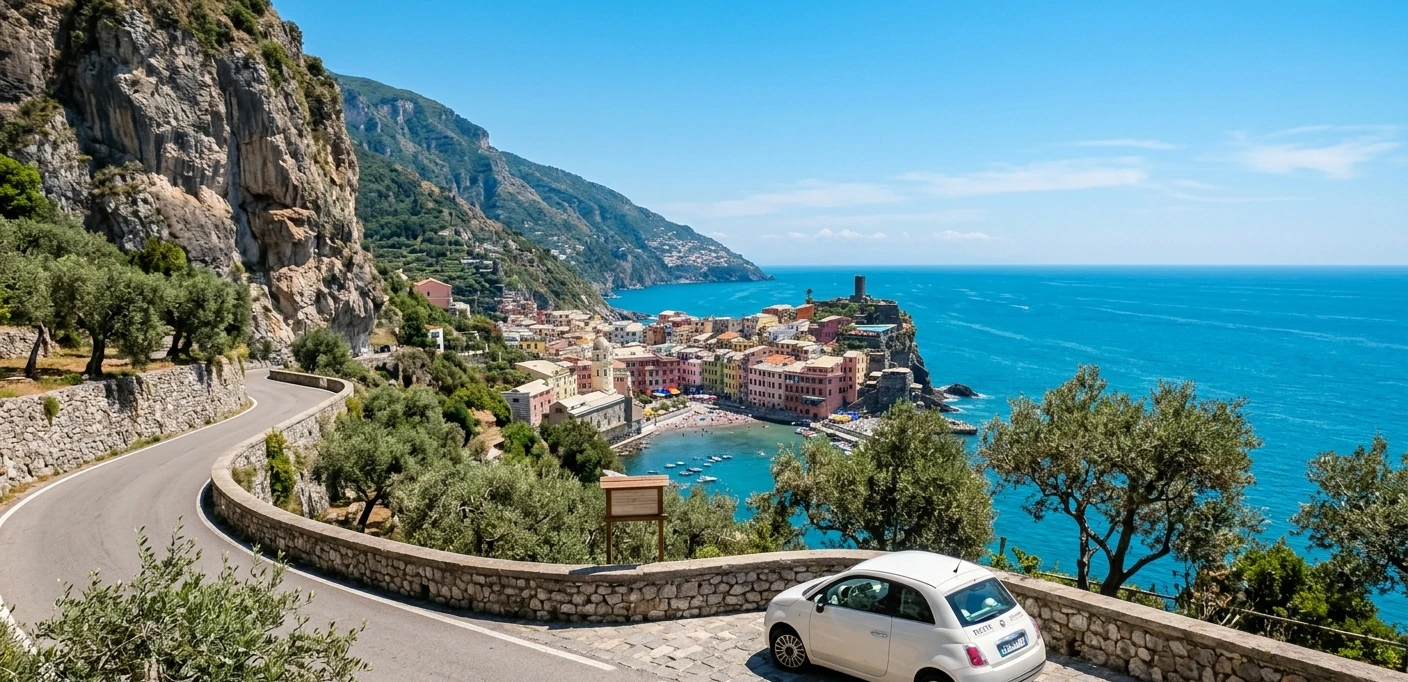
This is where a car truly earns its keep. Naples is an exceptional base for exploring one of Italy’s most varied regions. Here are the trips you will not regret:
Pompeii and Herculaneum (25 to 30 km): Italy’s two most famous archaeological sites are less than 30 minutes from Naples via the A3. The advantage of having a car? You can leave at 8am, ahead of the tour coaches, and park in the signposted paid car parks at the entrance to each site. Allow half a day for each; doing both together deserves a full day.
Mount Vesuvius (35 km): The road up to the crater (at around 1,000 metres elevation) is accessible by car as far as the car park at the summit trailhead, from which a shuttle or a 30-minute walk takes you to the top. Not to be missed for the panoramic view over the Bay of Naples.
The Amalfi Coast (60 to 80 km): The SS163, the coastal road linking Vietri sul Mare to Positano, is one of the most beautiful drives in Europe. By car, you can stop at Ravello, Amalfi, Praiano, or Atrani whenever you like — something no coach tour allows. One tip: avoid this route at weekends in July and August, when traffic backs up in both directions. Leave early in the morning (before 9am) or head out in the late afternoon.
Caserta (30 km): The Reggia di Caserta, often described as Italy’s answer to Versailles, is just 30 minutes from Naples via the A1. The royal palace and its cascading gardens are well worth a half-day visit. Parking nearby is easy and free.
Paestum (100 km): The Greek temples at Paestum are among the best-preserved in the world, and relatively little-known outside specialist circles. Less than an hour and a half from Naples via the A3, it makes a perfect full-day excursion, with a stop on the fine sandy beaches of the Cilento coast on the way.
For a 5 to 7-day road trip from Naples, here is a circuit that works well: Naples (2 nights) → Sorrento (1 night) → Amalfi Coast/Positano (2 nights) → Paestum/Cilento (1 night) → back to Naples. This covers roughly 400 to 500 km in total, with very manageable daily stages. You can return the vehicle at Naples Airport at the end of the trip, or drop it in Salerno if your flights allow.
Conclusion
Renting a car in Naples is not a luxury reserved for experienced drivers — it is simply the best way to experience Campania beyond the postcard version. The city itself is made for walking, but the moment you want to venture beyond it, having keys in hand changes everything. Book early, choose a nimble city car, read the insurance terms carefully, respect the ZTL zones without exception, and let the winding roads above the gulf do the rest. Naples will take care of everything else — with that particular blend of chaos, beauty, and energy that exists nowhere else in Italy.
Your next move? Compare deals on Rentalcars or Discovercars before you go, check what your bank card already covers, and start sketching your itinerary around Naples. Campania is waiting.
FAQ – Renting a car in Naples
Do I need an international driving licence to rent a car in Naples?
No. A driving licence issued by any EU country, as well as licences from Switzerland, the UK, the United States, Canada, Australia, and many other countries, is valid in Italy without any additional documentation. No translation or international permit is required to rent and drive in Naples. You simply need to present your national licence, your passport or ID document, and the credit card on which the deposit will be held.
Can I rent a car in Naples without a credit card?
The vast majority of rental agencies require a credit card (Visa, Mastercard, or American Express) to hold the deposit, which typically ranges from €300 to €1,500 depending on the vehicle type and the level of cover taken out. A few companies such as Enterprise, or certain local operators, accept debit cards, but this remains uncommon and often comes with additional conditions. Always check the specific policy of the agency you are booking with before finalising your reservation.
What is the best time of year to rent a car in Naples?
Spring (April to May) and early autumn (September to October) offer the best combination of value, weather, and road conditions: pleasant temperatures, less traffic, and rental rates significantly lower than in summer. In July and August, prices can double or triple compared to low season, and the Amalfi Coast becomes very congested at weekends. If you cannot choose your dates, set out early in the morning for coastal excursions and book your vehicle at least a month in advance.