Renting an Apartment in Bologna: A Complete Guide to Settling
Renting an apartment in Bologna requires careful planning. This guide covers key steps, costs, and tips for navigating the local rental market.

Aller en Italie
Relocation experts · since 2020
4.9
How many steps separate you from Italy?
A tailored offer based on your needs — in 3 min, no commitment
Tell us about your project
Profile, area, buying or renting
We select your services
From 50+ services in English
Receive your quote
Clear, detailed, personalized
*Indicative and customizable quote, no contractual commitment.
Free · 3 min · in English · no commitment
Create my offerBologna and Emilia-Romagna: useful background before you start your search
Emilia-Romagna ranks among the most populous and densely inhabited regions in Italy, which partly explains the sustained pressure on its property market. Understanding this context helps make sense of how the Bologna rental market operates.
Bologna, as the regional capital, has around 390,000 residents within its city limits, but its wider metropolitan area exceeds one million. Unlike many Italian cities where population is declining, Bologna is growing, which intensifies housing demand.
The city presents two characteristics that matter directly to prospective tenants: a population that skews older than the national average, and a strong international presence. This diversity directly shapes the housing offer, with a well-developed market for houseshares, student accommodation, apartments for young professionals, and expat-friendly rentals.
Bologna: when to start looking and what to prepare

To give yourself the best chance of finding the right place, start your search at least two to three months before your planned move. Bologna experiences particular spikes in rental demand around the university intake periods (September to October), when competition for good properties intensifies sharply.
Build your tenant file methodically before you even begin viewing properties. Landlords and agencies in Bologna typically expect a higher level of financial documentation and guarantees than tenants from many other countries might be accustomed to.
Be clear about your non-negotiable criteria from the outset: maximum budget including charges, acceptable distance from public transport, and any requirements specific to your situation (proximity to a university campus, workplace, or school). Stay alert to listings that look too good to be true — they often hide problems or, in some cases, are outright scams.
Living in Emilia-Romagna: practical pointers before choosing Bologna.
THEY TALK ABOUT US
Maisons & Jardins · Le Figaro · Challenges
« Founded on solid field experience and an in-depth knowledge of Italian procedures. »
Jessica Colpin, co-founder — Maisons & Jardins France, Jan.–Feb. 2026
Housing in Bologna: types of rental (furnished, unfurnished, room, houseshare)
Bologna offers several types of accommodation suited to different profiles and lengths of stay. The most common are:
- The studio (monolocale): a single open space with a kitchenette and separate bathroom
- The one-bedroom apartment (bilocale): a combined living and kitchen area with a separate bedroom
- The two-bedroom apartment (trilocale): typically two bedrooms and a living room
- The private room: usually within a shared apartment
- The houseshare (stanza in condivisione): a popular option for students and young professionals
The Italian rental process has some important differences from what many international tenants may be used to. Agencies play a more central role, financial guarantees are more formalised, and the documentation requirements tend to be more extensive.
Furnished vs unfurnished: which suits your stay?
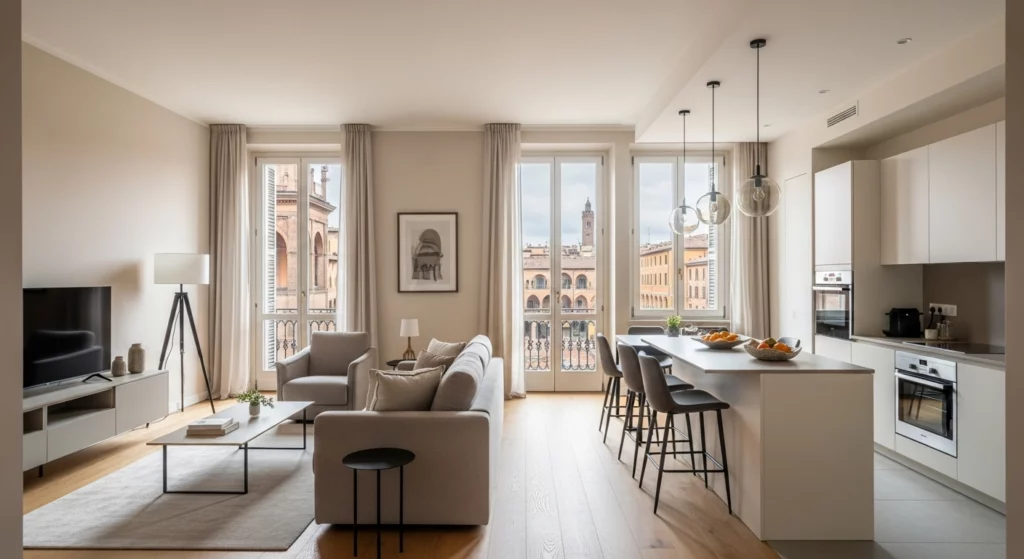
For a short or medium-length stay (a few months to a year), furnished apartments (arredato) are generally the better choice. They spare you the cost and logistics of buying and transporting furniture, and allow you to settle in quickly. Unfurnished rentals (vuoto or non arredato) are better suited to longer stays and tend to be cheaper per square metre.
Italian rental contracts differ from those in most other countries. The main types you will encounter are:
- The open-market contract (libero): terms negotiated directly with the landlord
- The regulated contract (concordato): rent capped according to local benchmarks
- The transitional contract (transitorio): for short stays, with specific conditions
- The student contract: aligned with the academic calendar
The standard lease duration is often four years, renewable for a further four (the so-called 4+4 structure), though shorter options exist depending on your situation.
Security deposit, inventory, and condition report: what to lock down
Before signing anything, make sure you have checked the following:
- The security deposit (cauzione): typically two to three months’ rent, returnable at the end of the lease
- The condition report on entry (stato dell’immobile): document the exact state of the property with photographs
- The furniture inventory: for furnished rentals, make sure every item is listed in detail
On the budget side, plan for several categories of expense: monthly rent, a security deposit, possibly one or more months’ rent in advance, agency fees (generally equivalent to one month’s rent plus VAT), and service charges.
Service charges (spese condominiali) can cover water, electricity for shared areas, communal heating, lift maintenance, and upkeep of common spaces. Some contracts include these in the rent; others bill them separately. Always clarify this before signing.
To put together your rental application, prepare proof of income, your employment contract or equivalent evidence of financial resources, and any supporting documents your landlord or agency may request.
Aller en Italie
French expatriation expert · since 2020
4.9
71 verified reviews
1,500+ expats supported
50+ services with French-speaking professionals
20 regions covered
Local consultants on the ground in Italy
Free appointment · 15 min · in French · no commitment
Book an appointmentLiving in Bologna: choosing your neighbourhood by lifestyle
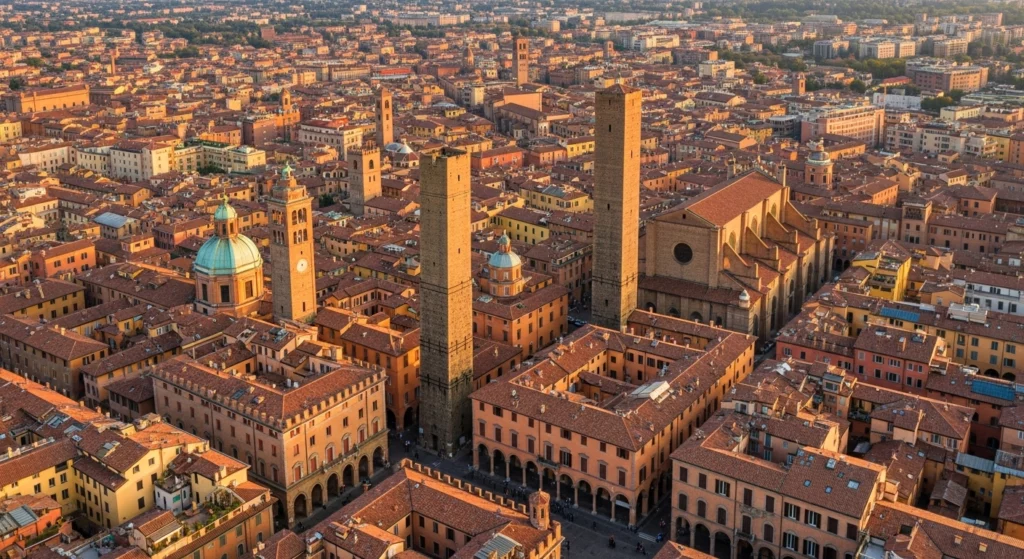
Choosing where to live in Bologna means getting to grips with how this historic and dynamic city is laid out. Bologna offers a variety of neighbourhoods with distinct characters, each suited to different needs and lifestyles.
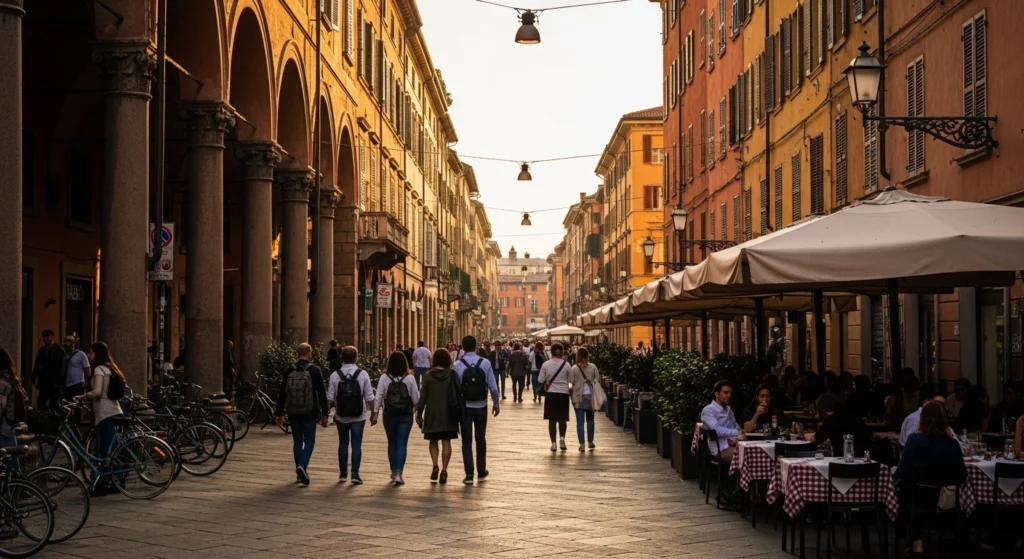
Practical criteria for choosing your neighbourhood (transport, noise, services, safety)
For students, the university quarter around Piazza Verdi and Via Zamboni offers a lively atmosphere with plenty of cafés and social spaces. Expect more noise, particularly on weekday evenings.
Families often gravitate towards quieter areas such as Saragozza or Santo Stefano, which have parks and schools nearby. These neighbourhoods are generally well served by public transport, though rents tend to be higher.
If you are moving for work, consider how close you will be to your workplace and to the central station (Stazione Centrale). Areas like Bolognina, which is undergoing significant transformation, offer a good balance between price and connectivity.
The historic centre, enclosed by what were once city walls (now ring boulevards), remains highly sought after and more expensive. Its main advantage is that almost everything is within walking distance.
Settling in Bologna: your administrative checklist for the first 30 days
Once you have signed your lease, several administrative steps need to be taken:
- Obtain your Italian tax identification number (codice fiscale), which is required for virtually every official process. How to get your Italian tax code
- Register your address with the local municipality (anagrafe) within 20 days of moving in. Registering your residence in Italy
- Opening an Italian bank account will make your regular payments considerably easier.
- Set up your utility contracts for electricity, gas, internet, and water (if not included in the service charges).
- Register with the Italian national health service (Servizio Sanitario Nazionale) and choose a GP.
Warning signs in a listing or from a landlord
Keep a close eye out for the following red flags:
- A landlord who refuses to show the property before receiving payment
- Rents significantly below the market rate with no apparent reason
- Any reluctance to provide a written contract
Renting and settling in Bologna: what to keep in mind
Moving to Bologna requires methodical preparation: understanding the local rental market, putting together a solid application file, securing your contract, and anticipating the administrative steps from the moment you arrive. The city’s student population makes the search competitive at certain times of year, but it remains entirely manageable with the right approach and the right information.
Take the time to verify the points that matter most: your total budget including charges and deposit, the contract terms, a thorough condition report at handover, and your residence registration. For a longer-term perspective, take a look at our guide on buying property in Emilia-Romagna to weigh renting against ownership based on your personal situation.
FAQ: Renting an apartment in Bologna
Is it possible to work in Bologna without speaking Italian?
- Italian is generally required for roles involving direct contact with clients, the public, or administrative tasks
- Some international sectors (technology, research, multinationals) may operate in English, but Italian remains a significant advantage in most contexts
- Planning to start language learning as soon as you arrive will meaningfully improve your professional prospects
Which sectors are most active in Bologna for international professionals?
- Industry, services, universities and research, and logistics are the most dynamic sectors
- Target companies with international operations or ties to overseas markets
- Having a signed employment contract before you arrive will make finding accommodation considerably easier
What documents do I need to rent an apartment in Bologna as a foreign national?
- A valid identity document, proof of income (payslips, employment contract) or evidence of financial resources
- Depending on your profile: a guarantor, a bank guarantee, or bank statements demonstrating financial stability
- Prepare a well-organised, clearly presented file — it will save time during viewings and strengthen your application
Can I secure a rental in Bologna before arriving in person?
- Avoid any payment before you or a trusted representative have visited and verified the property
- Insist on a detailed written contract and traceable payment methods
- Consider a short-term or temporary solution for your first few weeks, giving yourself time to view properties in person before committing
Why is it sometimes difficult to find housing in Bologna at certain times of year?
- The large student population creates spikes in demand in September and October, and again in January and February
- Bologna is a genuinely attractive metropolitan area with over a million residents in its urban zone, creating constant pressure on the market
- The recommended approach: widen your search area, have a complete application file ready in advance, and respond quickly to new listings