Investing in Cortina d’Ampezzo After the 2026 Winter Olympics: Market Review and Outlook
Post-2026 Olympics, Cortina d’Ampezzo offers unique investment opportunities with modernized infrastructure and shifting property market dynamics.

 The Milan-Cortina Winter Olympics are over. The flame has gone out, the teams have packed up — but for property investors, the real question starts now: what does the Olympic legacy actually mean for Cortina d’Ampezzo? With modernised infrastructure, renewed international visibility, and a market rebalancing after a period of intense activity, this is a good moment for a clear-eyed analysis.This article walks you through what the 2026 Games concretely changed in Cortina, how the property market is evolving in this post-Olympic phase, which types of property to target depending on your goals, and how to approach a purchase with confidence. You will also find a comparison with other Italian alpine resorts to put Cortina in context.
Aller en Italie
Relocation experts · since 2020
4.9
How many steps separate you from Italy?
A tailored offer based on your needs — in 3 min, no commitment
Tell us about your project
Profile, area, buying or renting
We select your services
From 50+ services in English
Receive your quote
Clear, detailed, personalized
*Indicative and customizable quote, no contractual commitment.
Free · 3 min · in English · no commitment
Create my offerCortina d’Ampezzo, a resort in a class of its own: the fundamentals that endure
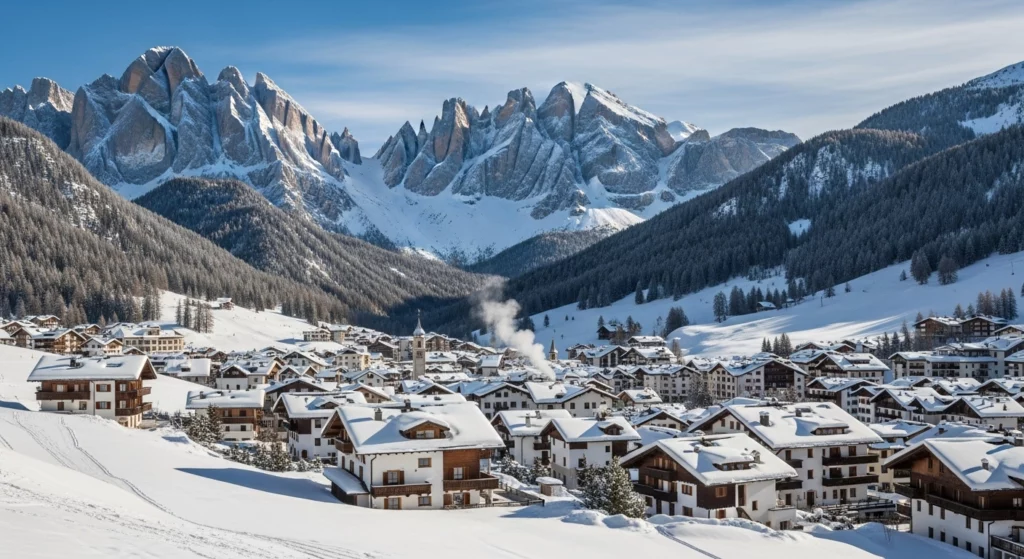
Nestled in the heart of the Dolomites, Cortina d’Ampezzo did not need the Olympics to establish itself as one of Italy’s most prestigious alpine resorts. Its premium positioning rests on solid foundations that have held firm across decades and sporting events alike.
An Olympic heritage now doubly established
Cortina has now hosted two Winter Olympics: in 1956, and again in 2026. This dual Olympic history gives it a unique standing among Italian resorts and reinforces its international profile over the long term. For any investor thinking on a 10 to 15-year horizon, that is a meaningful advantage.
A ski area of worldwide scale
The resort is part of Dolomiti Superski, the world’s largest ski carousel with over 1,200 kilometres of interconnected runs. Locally, Cortina offers 120 kilometres of slopes between 1,224 and 2,930 metres in altitude, served by around thirty lifts, several of which were upgraded as part of the 2026 Games.
The resort is organised around a central village and several distinct ski areas:
- The Tofana sector, known for its technical runs
- The Faloria/Cristallo zone, popular for its sunshine
- The Lagazuoi/5 Torri sector, offering exceptional panoramic views
Cortina’s fundamentals — historic prestige, a loyal international clientele, preserved alpine architecture, and integration into an exceptional ski domain — do not depend on any single event. They form the enduring basis of local property value.
Opening a bank account in Italy is often a recommended first step before exploring this particular market.
THEY TALK ABOUT US
Maisons & Jardins · Le Figaro · Challenges
« Built on solid hands-on experience and an in-depth knowledge of Italian procedures. »
Jessica Colpin, co-founder — Maisons & Jardins France, Jan.–Feb. 2026
The 2026 Olympic legacy: what concretely changed in Cortina
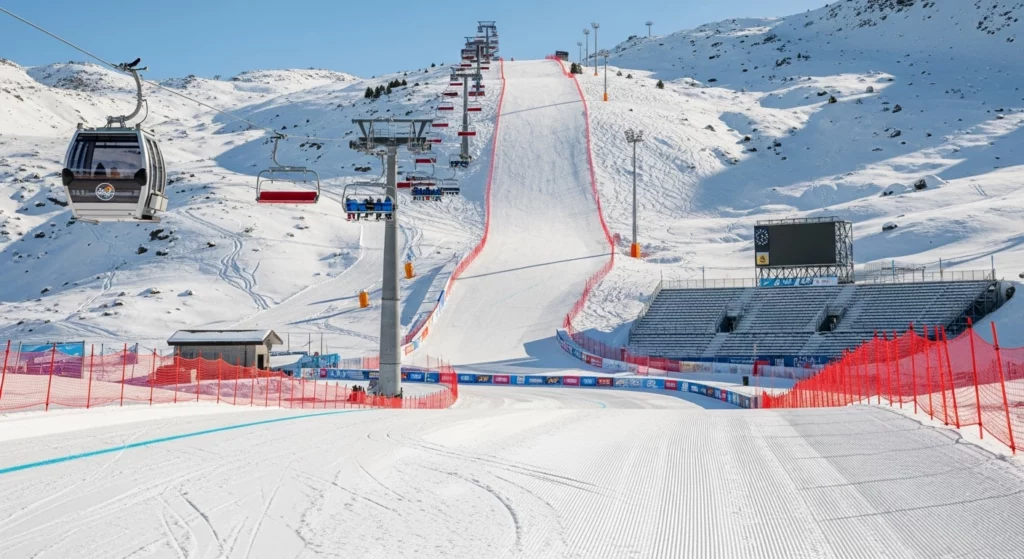
Now that the Games are behind us, it is possible to assess objectively what they delivered — and where the promises fell short.
Infrastructure that was genuinely modernised
The Olympic works focused primarily on three sites in Cortina:
- The restoration of the historic ice rink, completed with technical upgrades that respected the building’s heritage character
- The Olympic alpine ski run, now meeting the highest international standards
- Improvements to road access and signage to handle the flow of spectators
What did not change — and that is good news
A plan to build a new ski run had been dropped before the Games for budgetary and environmental reasons. That decision, which drew criticism at the time, now looks consistent with Cortina’s identity: the resort was not turned into a construction site, preserving its authentic alpine character and the balance of its residential neighbourhoods.
International visibility, a lasting legacy
Millions of viewers around the world rediscovered Cortina during the competitions. This level of media exposure, unprecedented since 1956, is already generating interest from foreign visitors and buyers — an effect that will materialise progressively over the coming months and years, and that is far more structurally significant than the Games themselves.
The philosophy behind the 2026 Games ultimately mirrored that of 1956: modernise and adapt rather than build at scale. That historical continuity bodes well for the sustainable management of the post-Olympic legacy.
Aller en Italie
French expatriation expert · since 2020
4.9
73 verified reviews
1,500+ expats supported
50+ services with French-speaking professionals
20 regions covered
Local consultants based in Italy
Free appointment · 15 min · in French · no commitment
Book an appointmentThe property market after the Games: prices, trends, and opportunities
Cortina’s property market went through a period of pressure in the lead-up to the Games, with prices pushed up by speculation and limited supply. Now that the event is over, the dynamic is shifting — and that can work in your favour.
A partial short-term price correction
Properties acquired purely for a quick capital gain tied to the Olympics may see a modest price softening in the months following the closing ceremony. This is a pattern observed in other Olympic host cities. By contrast, well-located properties — close to the lifts, well-oriented, with views — retain their long-term value, underpinned by structurally solid seasonal rental demand.
Rental demand that is consolidating
The improved infrastructure and greater international profile of the resort should support strong occupancy rates in the seasons ahead. Visitors who discovered Cortina through the Games represent a pool of future renters and buyers — a gradual but real ripple effect.
Cortina also draws a growing summer clientele — hiking, via ferrata, mountain biking — which complements the winter season and meaningfully improves annual rental yields.
The post-Olympic buying window
The immediate post-Olympic phase is often more favourable for buying than the pre-Games period, which tends to be marked by inflated prices. With a market that is rationalising and infrastructure already delivered, the patient investor has an interesting window of opportunity — provided they choose the right property, in the right location, with the right professionals.
Which properties to target in Cortina d’Ampezzo, depending on your project
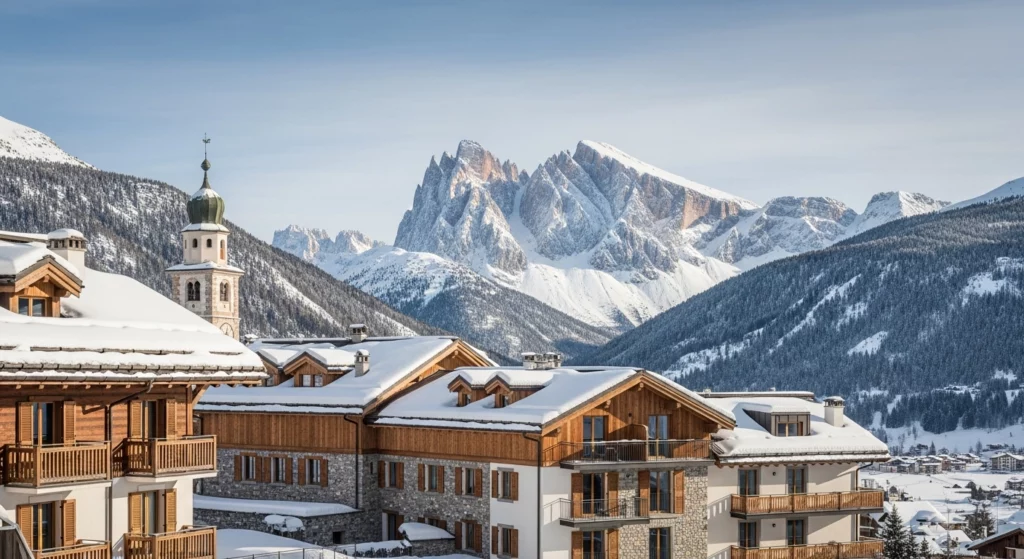
Cortina’s property offer is organised around a central village and several distinct ski sectors. Each configuration suits different objectives depending on your project.
Apartment, chalet, or serviced residence: advantages and limitations
Apartments are the most common option, particularly in the town centre. Their main advantage is easy access to shops and the ability to manage without a car. Well suited to short-term rentals, they represent the most accessible entry point and the most liquid asset at resale.
Standalone chalets, rarer and more expensive, offer privacy and space, but come with higher maintenance costs — particularly for winter snow clearance and roofing. Their location is often further from the ski lifts.
Serviced residences (with concierge, maintenance, pool or spa) are a worthwhile option for those who want to delegate management and rent out during their absence. Monthly service charges are, however, significantly higher.
Period properties to renovate versus newer builds: points to watch
A period property requiring renovation may look attractive on paper, but Cortina enforces strict aesthetic standards for any renovation work (facades, materials, colours). Budget at least 20 to 30% more than a standard renovation estimate: local tradespeople are in high demand and materials suited to the alpine environment carry a premium.
For newer properties, pay close attention to energy performance, which matters considerably in a region with harsh winters.
Whatever your choice, three criteria determine long-term value:
- Proximity to the ski lifts (decisive for seasonal rental income)
- Sun exposure and views (quality-of-life factors that also affect resale value)
- Year-round accessibility (some sectors can be difficult to reach during heavy snowfall)
Buying in Cortina d’Ampezzo: practical steps
Buying property in Cortina follows Italian law broadly, with a few specificities tied to its status as an alpine resort and its location within a UNESCO-listed area (the Dolomites).
From budget to purchase offer: a realistic sequence
Before you start viewing properties, lay the groundwork:
- Define clearly how you intend to use the property: holiday home, rental investment, or a mix of both
- Set your investment horizon
- Obtain a financing agreement in principle if you plan to borrow
- Open an Italian bank account — necessary for transactions and paying ongoing charges
- Obtain your Italian tax identification number (codice fiscale), a simple process at the Italian consulate or in person in Italy
The notary, the preliminary contract, and the final deed: checkpoints to know
The preliminary contract (compromesso) stage is where attention to detail matters most. Before signing, systematically verify:
- The seller’s title of ownership
- The status of any outstanding service charges or condominium fees
- Planning and land registry compliance of the property
- Technical surveys and the actual condition of the property
- Any existing easements or pre-emption rights
The Italian notary (notaio) plays a central role: they verify the legality of the sale and draft the final deed. For non-residents, arrange translation of key documents in advance and consider a power of attorney (procura) if you cannot be present on the day of signing.
Signing the compromesso is normally accompanied by a deposit (caparra confirmatoria) of around 10 to 30% of the purchase price, before the final deed is signed a few months later.

Investing in Cortina means understanding the full cost picture, both at purchase and over time, to avoid unwelcome financial surprises.
Acquisition costs to budget for
- Notary fees: approximately 2 to 3% of the purchase price
- VAT (on new builds purchased from a developer) or registration tax on resale properties (generally 2% for a primary residence, 9% for a secondary residence)
- Estate agent fees: 3 to 4% excluding VAT, split between parties or borne by the buyer depending on local practice
- Miscellaneous costs (translations, technical surveys): between €500 and €2,000
Recurring costs to factor into your budget
- IMU (property tax on secondary residences): varies according to the property’s cadastral value
- Condominium charges: highly variable depending on included services (lift, concierge, pool, etc.)
- TARI (waste collection tax) and routine maintenance costs
Allow for 10 to 15% in additional costs on top of the purchase price. The overall level is broadly in line with other Western European countries, though the composition differs — make sure you understand the breakdown before you reach the signing table.
Conclusion: post-Games Cortina, an opportunity worth pursuing with method
Cortina d’Ampezzo emerges from the 2026 Olympics with modernised infrastructure, a stronger international profile, and a property market that is rebalancing. The resort’s fundamentals — prestige, an exceptional ski domain, a loyal clientele — are not marketing claims: they underpin durable structural demand that extends well beyond the Olympic event.
The key takeaway: the post-Olympic period is often more favourable for buying than the pre-event fever phase. If you have a serious project, now is the time to move to the concrete stage: define your total budget (price plus costs), identify the sector and property type that fits your objective, and surround yourself with the right local professionals (notary, agent, specialist lawyer).
Before any commitment, draw up a complete checklist of documents to verify and a detailed budget covering all acquisition and ownership costs. That methodical approach will let you move forward on your Italian property project with confidence.
FAQ — Cortina d’Ampezzo property after the 2026 Games
Have property prices fallen in Cortina d’Ampezzo since the 2026 Olympics?
A modest correction is possible on properties that were overpriced in the speculative run-up to the Games. However, well-located properties — close to the lifts, with views, in good condition — are holding their value, supported by solid seasonal rental demand and a higher international profile.
Can I rent out my property in Cortina year-round, or only in winter?
Cortina now draws a growing summer clientele — hiking, via ferrata, mountain biking — which complements the ski season. Well-located properties benefit from dual seasonality, which meaningfully improves overall rental yield and reduces dependence on winter alone.
Is it necessary to use a local estate agent to buy in Cortina?
There is no legal requirement to do so, but it is strongly advisable. The Cortina market is highly specific: some properties are sold off-market, micro-location matters enormously, and there are numerous alpine regulatory constraints. A local professional will save you time and help you avoid costly mistakes.
Which Olympic sites were modernised in Cortina d’Ampezzo?
The Olympic upgrades focused on three sites: the historic ice rink (restored while preserving its heritage character), the Olympic alpine ski run (brought up to international standards), and the access roads and spectator facilities. A plan for a new ski run had been dropped before the Games for budgetary and environmental reasons.
Can the 1956 Olympic legacy offer any insight into what to expect after 2026?
The 1956 experience is highly instructive: after those Games, Cortina successfully built on its Olympic visibility over the long term to establish itself as a premium international destination. The philosophy in 2026 was the same — modernise without disfiguring — and the tourist base today is far broader than it was in the 1950s. The historical precedent points to a positive long-term legacy.