How to Write a CV for Italy: Format, Sections and Common Mistakes
Learn how to craft an effective CV for Italy, covering formats, essential sections, and common pitfalls to avoid for a successful job application.

The golden rule to keep in mind from the start: a standard CV is non-negotiable on automated recruitment platforms, but a speculative application with a creative CV can turn a simple email into a real opportunity. Here is everything you need to know to write an Italian-style CV that actually makes a difference.
THEY TALK ABOUT US
Maisons & Jardins · Le Figaro · Challenges
« Built on solid field experience and an in-depth knowledge of Italian procedures. »
Jessica Colpin, co-founder — Maisons & Jardins France, Jan.–Feb. 2026
Standard or creative CV: which format suits your situation?
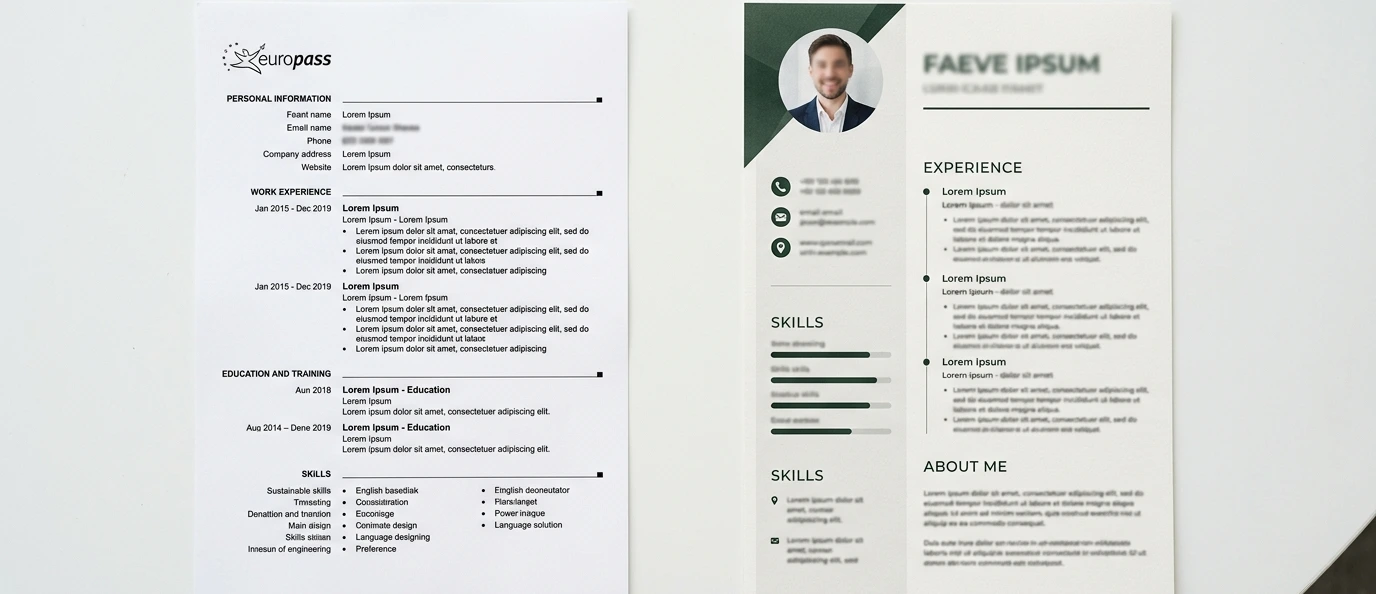
When it comes to working in Italy, the format of your CV matters more than you might think: it depends entirely on how you are applying. The major recruitment platforms — LinkedIn, Indeed Italia, InfoJobs, Subito Lavoro — use ATS (Applicant Tracking Systems) that automatically scan and process CVs before any human ever sees them.
A heavily designed CV with complex columns, tables or embedded icons can be misread by these systems, and your application may be rejected before it reaches a recruiter. On the other hand, for a speculative application sent directly by email to an SME or an HR manager, a polished creative CV instantly sets you apart from the pile of standardised submissions.
Standard CV
Europass or reverse-chronological format, plain text, readable by any HR software.
- ATS-compatible (no tables)
- Clearly defined sections
- Single font (Calibri, Arial)
- .pdf or .docx format
- Europass recommended
Speculative application
Creative CV
Considered design, colour, original layout — for creative sectors or family-run SMEs.
- Immediate visual impact
- Reflects your personality
- Sent directly (email, in person)
- Canva, Adobe or Figma
- Ideal for speculative applications
Aller en Italie
French expat expert · since 2020
4.9
73 verified reviews
1,500+ expats supported
50+ services with French-speaking professionals
20 regions covered
Local consultants on the ground in Italy
Free appointment · 15 min · in French · no commitment
Book an appointmentThe must-have sections of a CV in Italy
The Italian curriculum vitae follows a precise structure, with several sections that have no direct equivalent in a standard British or American CV. Before working in Italy, make sure your CV includes each of the following elements.
-
Professional photoA photo is expected in Italy, unlike in the UK or US where it is typically omitted. Use a neutral background, appropriate attire and an open expression. Leaving it out can genuinely surprise Italian recruiters.
-
Personal details — Dati personaliFull name, date of birth, place of birth, nationality, address, phone number, email address.
-
Profile summary — Obiettivo professionaleA short paragraph of 3 to 4 lines summarising your profile, your ambitions and the value you bring. Italian recruiters respond well to this section and it works much like the personal statement found at the top of many UK CVs.
-
Work experience — Esperienze lavorativeReverse chronological order. Job title, company name, dates, city. Describe 2 to 3 key responsibilities and include quantified results wherever possible.
-
Education — Istruzione e formazioneQualifications obtained, institution, year of graduation. If useful, indicate the Italian equivalent of your qualifications (A-levels / Bachelor’s degree = diploma di maturità / laurea triennale, Master’s = laurea magistrale).
-
Language skills — Competenze linguisticheCEFR level (A1 to C2) for each language. Italian is a given, English is always a plus, and if you are a native English speaker, that is a genuine competitive advantage on the Italian market — make it visible.
-
IT skills — Competenze informaticheSoftware proficiency, digital certifications (Microsoft Office Suite, Adobe, ERP, CRM, project management tools, etc.).
-
Interests — Interessi personaliOptional but worth including. Italian recruiters tend to pay attention to this section, particularly when your interests connect to the industry or reveal personal qualities relevant to the role.
-
GDPR consent clause — Autorizzazione al trattamento dei datiMandatory. Add this statement at the bottom of every CV: “Autorizzo il trattamento dei miei dati personali ai sensi del D.Lgs. 196/2003 e del GDPR (Reg. UE 2016/679).”
UK CV vs Italian CV: a comparison
The cultural differences between the two job markets run deeper than they first appear. This table lets you see at a glance exactly what you need to adapt in order to work in Italy with a CV that meets local expectations.
| Criteria | UK CV | Italian CV |
|---|---|---|
| Photo | Not included (standard practice) | Mandatory, strongly expected |
| Date of birth | Not included (data protection) | Always included |
| Place of birth | Not included | Always included |
| Standard format | Free format, 1–2 pages | Europass or chronological, 1–2 pages |
| Profile summary | Personal statement, optional | Obiettivo professionale, recommended |
| Chronological order | Reverse (most recent first) | Reverse (same) |
| Soft skills | Mentioned but rarely highlighted | Valued (lavoro di squadra, etc.) |
| GDPR clause | Not required on the CV | Mandatory at the bottom of the page |
| Cover letter | Expected for most applications | Lettera di presentazione less systematic |
| Maximum length | 2 pages (general convention) | 2 pages accepted for 10+ years of experience |
| Interests | Often omitted | Welcome, humanise the profile |
| File format | .pdf preferred | .pdf or .docx depending on the company |
Writing your CV in Italian: language, tone and phrasing
The question of language matters a great deal if you want to work in Italy. The general rule: write in Italian, unless the position is explicitly international or the job posting states that an English CV is acceptable. A CV submitted in English without prior explanation can come across as a lack of effort or a signal that your Italian is not at the level required for the role.
The minimum Italian level needed to write a convincing CV is B2. Below that, it is strongly advisable to have your document reviewed by a native speaker or a professional proofreading service before sending it out.
The creative speculative application: when to go for it

In Italy, the candidatura spontanea (speculative application) is a well-established and widely accepted practice, particularly within the network of family-run and artisan SMEs that make up the backbone of the local economy. This is precisely the context where a creative CV can change everything: it signals initiative, personality and the ability to think outside the box — qualities that are highly valued in creative sectors and smaller organisations.
For those aiming at working in Italy in a competitive and fast-moving sector such as fashion, design, food and drink or marketing, a visually strong CV sent directly by email to the right person can open doors that a standard application would never reach.
Where the creative format works
- Fashion and design (Milan, Florence)
- Gastronomy and hospitality
- Marketing and communications
- Architecture and visual arts
- Italian tech start-ups
- Tourism and events
Standard CV — sectors where tradition matters
Where to stay traditional
- Banking, finance and insurance
- Law and notarial services
- Public sector (PA)
- Heavy industry and manufacturing
- Accounting and audit
Common mistakes made by English-speaking candidates
Here are the most frequent pitfalls observed among candidates from English-speaking countries applying to work in Italy for the first time. Any one of these mistakes on its own can be enough to get an otherwise strong application rejected.
- Leaving out the photo: In many English-speaking countries, omitting a photo is standard practice and even recommended. In Italy, its absence is noticed and can come across as odd or raise unnecessary questions with recruiters.
- Omitting the GDPR clause: Without this legal statement at the bottom of the page, your CV can be set aside on procedural grounds. It has been mandatory under GDPR (Reg. EU 2016/679) and its absence is noticed.
- Sending your CV in English without explanation: Submitting a CV written in English to an Italian company — unless the job posting specifies otherwise — can be read as a signal that your Italian is not at the level the role requires. Always write in Italian, and if you are not yet confident enough to do so, work with a native-speaking proofreader.
- Listing hobbies with no connection to the role: Mentioning interests is appreciated in Italy, but only when they say something relevant about you in relation to the position or sector. “Reading” or “travel” without any context adds nothing. On the other hand, “wine tasting” for a hospitality role, or “photography” for a communications position, genuinely strengthens your profile. If your hobbies have no real connection, it is better to leave them out.
- Sending a creative CV through an ATS platform: Automated tracking systems cannot read complex columns or tables. The result: your application is filtered out automatically before any human sees it.
- Applying for a senior or specialist role without a cover letter: In Italy, the lettera di presentazione is not always required, but for a management, technical or specialised position, leaving it out is a mistake. It is precisely this document that lets you explain your background as an international candidate, personalise your application and show that you understand what the role involves. Keep it short, direct and in Italian — those three rules are all you need for it to do its job.
- Using an automatic translation without reviewing it: False friends and an inappropriate register are immediately obvious to a native recruiter. Always have your CV reviewed by a trusted Italian speaker before sending it.