Notary in Italy (Notaio): Role, the Rogito, and How to Find One
Understanding the role of a notary in Italy is crucial for homebuyers, as they primarily authenticate the final sale deed, the rogito.

 Buying a house in Italy is an exciting project, often driven by a dream of a new life, sunshine and dolce vita. But between the cultural differences, the administrative processes and the particularities of the Italian legal system, understanding the role of each professional involved in the transaction is genuinely important.In many countries, the notary oversees nearly the entire purchase process. In Italy, the notary’s involvement is much more limited. The notaio steps in primarily at the moment of signing the rogito — the final deed of sale — to authenticate the transfer of ownership and ensure its legal validity. Before reaching that stage, the buyer needs to gather a team of specialists to confirm that the property is compliant, that the documents are in order and that the transaction is legally sound.This article explains the role of the notary, the fundamental difference between a notary and a lawyer in Italy, and the part each professional plays in a successful property purchase — so you can move forward with confidence.
Aller en Italie
Relocation experts · since 2020
4.9
How many steps separate you from Italy?
A tailored offer based on your needs — in 3 min, no commitment
Tell us about your project
Profile, area, buying or renting
We select your services
From 50+ services in English
Receive your quote
Clear, detailed, personalized
*Indicative and customizable quote, no contractual commitment.
Free · 3 min · in English · no commitment
Create my offerNotary or lawyer in Italy: what is the difference for your purchase?
This is one of the most common questions among foreign buyers, and also one of the most consequential: do you need a notary, a lawyer, or both to buy property in Italy? The answer is nuanced, and getting it wrong can have real consequences for the security of your investment.
In many countries — the UK, Australia, the United States — solicitors, conveyancers or attorneys guide buyers through much of the process, reviewing documents, negotiating terms and protecting the buyer’s interests from start to finish. In Italy, the notary’s role is far narrower.
| Professional | Main role | Neutral or acting for you? | Mandatory? |
|---|---|---|---|
| Notary (notaio) | Authenticates the rogito, registers the sale with the land registry, verifies identities and checks for mortgages | Neutral — represents the State, not the buyer | ✅ Yes |
| Property lawyer (avvocato) | Checks planning compliance, reviews documents, negotiates protective clauses, defends the buyer’s interests | Partisan — works exclusively for the buyer | ❌ No (but strongly recommended) |
The key distinction: the notary in Italy is not the buyer’s advocate. The notary guarantees the formal legality of the transaction, but does not check whether the property complies with planning regulations, whether works have been carried out without a permit, or whether the preliminary contract contains unfavourable clauses.
It is precisely to fill that gap that a specialist property lawyer — ideally bilingual in English and Italian — becomes indispensable for foreign buyers. An experienced lawyer based in Tuscany, Piedmont or Sicily, who regularly handles international transactions, protects you where the notary cannot.
In short: the notary authenticates, the lawyer protects. For a secure purchase in Italy, both roles are complementary.
THEY TALK ABOUT US
Maisons & Jardins · Le Figaro · Challenges
« Built on solid hands-on experience and an in-depth knowledge of Italian procedures. »
Jessica Colpin, co-founder — Maisons & Jardins France, Jan.–Feb. 2026
The role of the notary in Italy and the rogito
In Italy, the notary (notaio) occupies a central position in every property transaction. As a public official, the notary is responsible for the legal validity and transparency of the purchase deed. This means guaranteeing the legality of the sale, verifying the identity and legal capacity of both parties, and officially registering the transfer of ownership with the land registry (Catasto).
This culminating moment of the transaction is formalised in an official document called the rogito — also known as the atto di vendita — which is the Italian equivalent of the final deed of sale. It is the signing of the rogito before the notary that makes the transfer of ownership definitive and enforceable against all parties.
However, the Italian notary is not responsible for verifying the planning or cadastral compliance of the property. The notary carries out no on-site inspection and does not assess the technical or structural condition of the building. In other words, the notary authenticates the sale on a legal level, but does not guarantee that the property meets current regulations.
This distinction matters greatly. In Italy, a property can be sold legally even if it has irregularities — an undeclared extension, a discrepancy between the cadastral plans and reality, or a missing compliance certificate, for example. It is therefore the buyer’s responsibility to confirm the property’s regularity before the final rogito is signed.
To protect your purchase, it is strongly advisable to engage independent professionals — a surveyor, a specialist lawyer or an architect — before reaching the notarial stage.
Aller en Italie
French expatriation expert · since 2020
4.9
73 verified reviews
1,500+ expats supported
50+ services with French-speaking professionals
20 regions covered
Local consultants based in Italy
Free appointment · 15 min · in French · no commitment
Book an appointmentFinding an English-speaking notary in Italy

One of the most common concerns among foreign buyers is finding a notary in Italy who speaks English (or another language) well enough to make the legal documents genuinely understandable. The good news: it is possible, though availability varies by region.
Here is an overview by target region:
- Tuscany: one of the most popular regions among international buyers, several notarial offices in major cities (Florence, Siena, Arezzo) regularly work with foreign clients. Some notaries speak English or work with in-house translators.
- Piedmont: due to its proximity to several Western European countries, English-speaking and multilingual notaries are relatively more accessible here, particularly in border areas (Cuneo, Turin).
- Umbria: an increasingly popular region among expatriates. Notaries in Perugia or Spoleto regularly handle transactions with foreign buyers. An English-speaking notary in Umbria is generally found through a recommendation or the national directory.
- Sicily: Sicilian notaries handle a growing volume of transactions with international buyers, particularly in the context of one-euro house schemes. English proficiency remains less common here, which makes working with a certified interpreter all the more important.
The official resource to use: the National Council of Italian Notaries (notariato.it) offers a directory searchable by region and city. This is the definitive reference for identifying a qualified notary in your area.
⚠️ Important: even if your notary speaks your language, the presence of a certified interpreter is often still required at the signing of the rogito, because the notary bears legal responsibility for ensuring that all parties have fully understood the deed.
The role of other professionals in an Italian property purchase
Buying a house in Italy does not rest solely on signing the rogito with the notary. Several professionals are involved before and after that stage, each with a clearly defined role. Their shared purpose: to ensure the property is compliant, the transaction is legally secure and the buyer has peace of mind.
The estate agent in Italy

Among the first steps of buying property in Italy, the estate agent plays a prominent part. The agent’s role is to act as a link between seller and buyer, organise viewings and facilitate negotiations. That said, it is worth knowing that in Italy, the estate agent most often acts on behalf of the seller, with the primary objective of closing the sale quickly.
Based on our experience on the ground, we have seen that, in small villages or rural areas, some agents are not accustomed to working with foreign buyers. It can happen that buyers sign a purchase offer (proposta d’acquisto) without having received the property documents or understood that this offer is already legally binding. In Italy, unlike in many other countries, a written offer immediately commits the buyer, even before the preliminary contract (compromesso) is drawn up.
To avoid any unpleasant surprises, it is strongly advisable to be accompanied by an expert in Italian property law, independent of the agency, who will check:
- the cadastral and planning status of the property,
- the ownership history,
- compliance of all administrative permits,
- and the clauses of the offer or preliminary contract before signing.
The specialist property lawyer in Italy
In Italy, hiring a lawyer for a property purchase is not mandatory, unlike in some other countries. Yet more and more Italians themselves now choose to use one, aware of the many cases of planning non-compliance, incomplete documentation or administrative problems that can arise during a transaction.
A specialist property lawyer (avvocato) acts as an independent adviser, entirely separate from the sale and the estate agency, whose sole mission is to protect the buyer’s interests. The role goes well beyond basic legal checks: the lawyer analyses all property documents, verifies the validity of titles and administrative permits, reviews the preliminary contract (compromesso) and ensures that all the protective clauses the buyer needs are included from the outset.
An experienced property lawyer based in Tuscany, Umbria, Piedmont or Sicily can also anticipate risks associated with the property, identify any hidden disputes and advise on the tax implications of the purchase — particularly if the buyer is a non-resident or qualifies for a specific tax regime.
For buyers from abroad, working with a bilingual lawyer is a genuine advantage. It ensures a full understanding of every step in the process and clear communication with all parties involved (notary, agency, surveyor) through to the signing of the rogito.
The surveyor in Italy
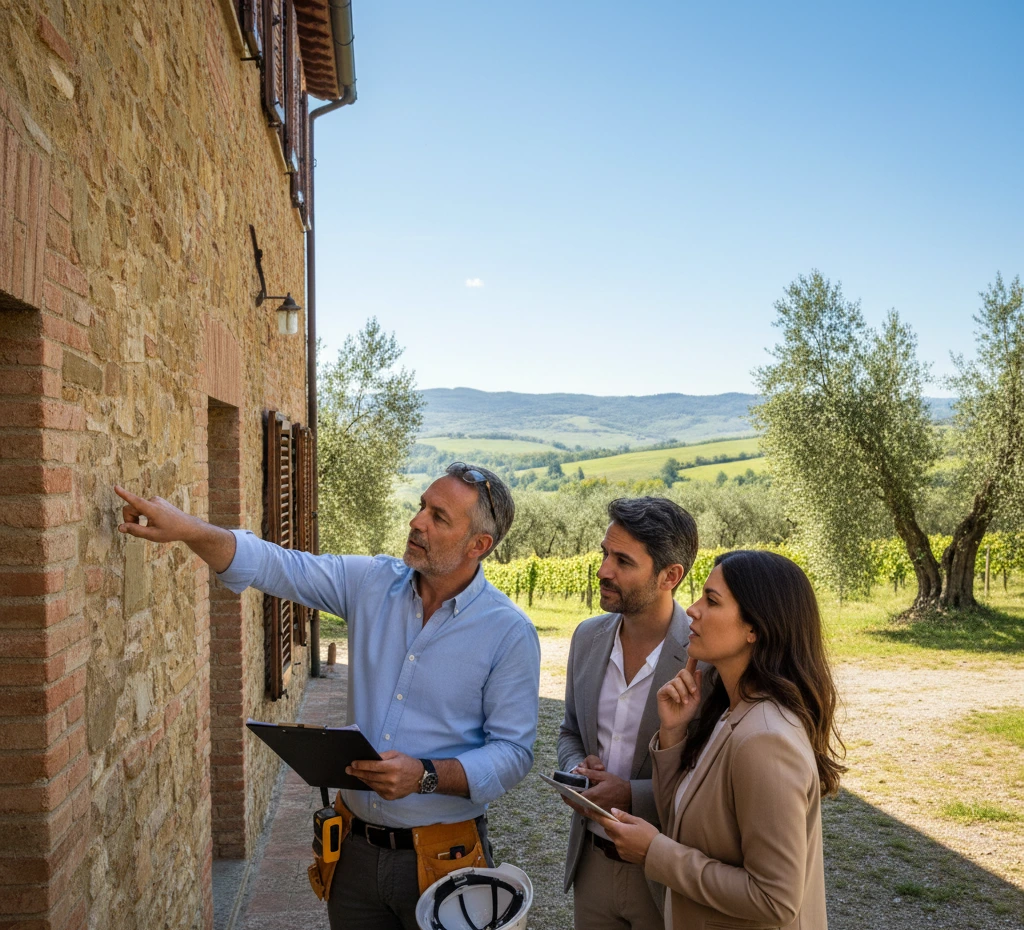
The surveyor (geometra) is the indispensable technical professional in any Italian property purchase. The surveyor analyses the cadastral and planning situation, identifies any irregularities (undeclared extensions, illegal additions, discrepancies between plans and reality) and produces a detailed technical report. This report serves as a solid foundation for the lawyer, who can then base legal verifications on reliable technical facts and include in the preliminary contract or rogito clauses tailored to the property’s actual condition.
Beyond these checks, the surveyor can also:
- assess the work required and provide a cost estimate,
- estimate the property’s true market value,
- guide the buyer through the regularisation process or permit applications with local authorities.
Fees typically range between €600 and €1,000 for a full inspection — a modest outlay given the risks avoided and the potential savings that come from a better-informed negotiation.
The interpreter in Italy

In Italy, the presence of a certified interpreter is mandatory when the buyer does not speak Italian fluently. At the signing of the rogito (atto di vendita), the interpreter provides a faithful, simultaneous oral translation of the contract clauses so that the buyer fully understands the legal commitments being made.
But the role does not end there: the interpreter also prepares a written translation of the notarial deed, which is appended to the official document. This translation, attached to the rogito, confirms that the buyer has understood the content and that the signature was given in full knowledge of the terms. In the event of a dispute, this annex can serve as additional evidence of the buyer’s understanding of the contract.
There are also other possible arrangements, such as signing by power of attorney: the buyer can delegate the signing to a trusted person or a mandated professional via an authenticated power of attorney. In practice, most notaries prefer a professional or certified interpreter, in order to eliminate any legal risk.
Notary fees in Italy: what to expect
Notary fees in Italy are often underestimated by buyers coming from abroad. They cover both the notary’s own fees and the taxes and duties collected by the notary on behalf of the Italian state.
Here are the main components to budget for when signing the rogito:
- Notary fees: generally between €1,500 and €3,000, depending on the property value, the complexity of the transaction and the region.
- Registration tax (imposta di registro): 2% of the cadastral value if you are buying as a primary residence (prima casa), or 9% for a rental investment or secondary residence.
- VAT: applies instead of the registration tax when the seller is a professional (property developer). Rates are 4% (prima casa), 10% or 22% depending on the case.
- Cadastral and mortgage taxes: fixed amounts (€50 each) when the registration tax applies.
Overall, notary fees and associated taxes for a property purchase in Italy typically amount to between 3% and 10% of the sale price, depending on your profile and the type of property. For more on the tax implications of buying, see our article on property taxes in Italy.
Conclusion: your Italian property purchase deserves the right team
Buying property in Italy is a wonderful adventure — but it calls for a solid team around you. The notary (notaio) is indispensable for authenticating the rogito and making the transfer of ownership official. But the notary does not replace the specialist lawyer who protects your interests, the surveyor who confirms the technical compliance of the property, or the interpreter who ensures you understand every clause on the day of signing.
If you are looking for an English-speaking notary in Italy, start with the official directory at notariato.it and consider working with a bilingual lawyer to coordinate the whole process.
The key point to take away: in Italy, the notary validates the transaction but does not protect you. Surround yourself with an independent lawyer and a surveyor before signing anything — including the initial purchase offer.
FAQ — Notary, lawyer and rogito in Italy
Is a notary mandatory when buying property in Italy?
Yes. In Italy, a notary is required by law to authenticate the rogito — the final deed of sale. Without a notary, the transfer of ownership cannot be legally registered with the land registry (Catasto).
How much does a notary cost in Italy?
Notary fees in Italy generally range between €1,500 and €3,000, depending on the property value and the complexity of the transaction. On top of this come registration taxes and duties, which can represent 2% to 9% of the sale price depending on the buyer’s profile and the type of property. Find out more: notary fees and property taxes in Italy.
What is the rogito in Italy?
The rogito (or atto di vendita) is the final deed of sale signed before a notary in Italy. It formally transfers ownership from the seller to the buyer and is subsequently registered with the land registry. It is the Italian equivalent of the final completion deed used in many other countries.
Can you find an English-speaking notary in Italy?
Yes. English-speaking or multilingual notaries can be found in Italy, particularly in Tuscany, Piedmont, Umbria and Sicily. You can search the official directory of the National Council of Italian Notaries at notariato.it. If no English-speaking notary is available, a certified interpreter is mandatory at the signing of the rogito.
What is the difference between a notary and a lawyer for a property purchase in Italy?
In Italy, the notary is a neutral public official: the notary authenticates the rogito and registers the sale, but does not defend the buyer’s interests and does not check planning compliance. The specialist property lawyer, on the other hand, acts exclusively to protect the buyer: reviewing documents, identifying irregularities, negotiating protective clauses and overseeing the full legal process through to completion. For buying in Sicily, see also our guide on buying a house in Sicily, or our dedicated article on buying property in Puglia.
Does the notary verify planning and cadastral compliance in Italy?
No. In Italy, the notary guarantees only the legal validity of the transaction (identity of the parties, absence of mortgages, registration of the sale), but does not check the planning or structural compliance of the property. These checks must be carried out by a surveyor or a specialist lawyer before the rogito is signed.
What happens if I signed a purchase offer without having the property checked first?
In Italy, a purchase offer is already legally binding: by signing it, the buyer takes on responsibility for any non-compliance (undeclared works, cadastral errors, etc.). Without protective conditions and prior checks in place, the buyer will be responsible for any regularisation costs. It is therefore important to include suspensive conditions and have the document reviewed by a property lawyer before signing.