Working in Italy Without Speaking Italian: A Practical Guide
Yes, you can work in Italy without speaking Italian. This guide details opportunities in various sectors for English speakers.


Working in Italy without speaking Italian — is it really possible, or just a dolce vita fantasy? The answer is yes, and far more often than you might think. Between multinationals that operate entirely in English, Italian SMEs actively recruiting native English speakers to develop their export markets, and freelance opportunities under a partita IVA, there are plenty of doors to walk through. This guide covers every concrete path to finding a job in Italy, even without mastering the language of Dante.
THEY TALK ABOUT US
Maisons & Jardins · Le Figaro · Challenges
« Built on solid field experience and an in-depth knowledge of Italian procedures. »
Jessica Colpin, co-founder — Maisons & Jardins France, Jan.–Feb. 2026
The linguistic reality in Italy: what you really need to know
Italy has a particular relationship with foreign languages. Unlike countries such as the Netherlands or Scandinavia, the general level of English is still relatively limited, especially in smaller towns and rural areas. That does not mean working in Italy without fluent Italian is impossible — but your strategy needs to be targeted.
In major cities such as Milan, Rome, Turin and Bologna, the situation is very different. International companies, tech firms, start-ups, universities and global organisations often use English as a working language. Milan in particular is by far the most international city in Italy and usually offers the best opportunities for English-speaking professionals.
Some regions also have strong multilingual traditions. In Trentino-Alto Adige/South Tyrol, for example, German is widely spoken alongside Italian due to the region’s historical and cultural ties with Austria. In many areas around Bolzano and the Dolomites, German-speaking profiles are highly valued, especially in tourism, hospitality and international business.
Northern Italy generally tends to have a higher level of English, particularly in regions with strong international economies such as Lombardy, Emilia-Romagna and parts of Veneto. Tourist destinations — Lake Como, Florence, Venice, the Amalfi Coast or parts of Tuscany — also create opportunities for English-speaking workers in hospitality, luxury and tourism sectors.
English is also commonly used inside Italian branches of international companies and multinational groups, creating real opportunities for internationally mobile professionals even before mastering Italian completely.
Aller en Italie
French expat expert · since 2020
4.9
73 verified reviews
1,500+ expats supported
50+ services with French-speaking professionals
20 regions covered
Local consultants on the ground in Italy
Free appointment · 15 min · in French · no commitment
Book an appointmentThe overlooked opportunity: the international-language market in Italy

Here is something most candidates fail to exploit: Italy is one of the markets that most actively recruits native speakers of major European languages, and the competition for these roles is far lower than you would expect.
Why? Because France, the UK, Germany and the broader international market represent a major commercial priority for many Italian companies in active growth mode. Businesses across Northern Italy in particular are investing heavily in their export strategies — and they need people who can work those markets from the inside.
Italian SMEs developing their international markets
Hundreds of small and medium-sized Italian companies — in fashion, food and drink, cosmetics, furniture, precision engineering and services — are looking to build or consolidate their presence in English-speaking and European markets. They need bilingual profiles to manage client relationships, prospecting, after-sales and marketing: roles where your native language is your primary skill, well ahead of any Italian ability.
International companies with a base or subsidiary in Italy
Many international companies are established in Italy and recruit bilingual profiles to bridge the head office and the local structure. These roles — often in sales, finance, HR or logistics — allow you to work in Italy within a predominantly English-speaking environment, with Italian as a gradual integration goal rather than a hiring requirement.
The strategic tip: search in Italian
On Indeed.it and LinkedIn, most internationally mobile candidates make the mistake of searching in English only. The smarter approach is to search directly in Italian using the terms “inglese madrelingua” (English native speaker) or “inglese fluente” (fluent English). These searches target precisely the roles where your language is a rare and valued skill — with significantly less competition. Try it; the results are often surprising.
Sectors where you can work in Italy without speaking Italian
Some sectors are far more accessible than others for internationally mobile professionals who do not yet speak Italian. Here are the most promising ones.
Tourism and hospitality
Italy is the fifth most visited country in the world. Upmarket hotels, beach resorts, travel agencies and tour operators are constantly looking for English-speaking staff. A native English speaker who is also comfortable in one or more other languages is a highly sought-after profile in tourist hotspots — the Amalfi Coast, Lake Como, the Cinque Terre, Sardinia, Sicily. Roles such as receptionist, guide, activities coordinator, concierge or reservations manager are accessible without Italian in many international establishments.
Tech, start-ups and digital
Italy’s tech ecosystem — concentrated in Milan, Turin and Bologna — operates predominantly in English. Profiles in software development, data science, UX/UI design, product management and cybersecurity are in strong demand. Hubs such as H-Farm, Mind Milano and Talent Garden bring together companies that recruit international talent without requiring Italian.
Language teaching and training
Being a native English speaker is a marketable skill in itself. Language schools, international schools (in Rome, Milan, Naples, Florence and elsewhere), private tuition and online training platforms all allow you to work in Italy using your mother tongue alone. Many British Council-affiliated schools and international curricula institutions also offer positions without requiring Italian.
International trade and export
Italian SMEs and mid-sized companies that export to English-speaking markets regularly recruit sales managers, export coordinators and account managers with native or near-native English. This is one of the strongest sectors for English speakers in Italy, because the value you bring is directly tied to your language.
Remote work from Italy
Since remote work became widespread, many internationally mobile professionals choose to relocate to Italy while keeping their existing employer or clients abroad. Milan, Florence, Rome or smaller cities like Lecce, Trento and Bolzano offer an exceptional quality of life alongside reliable internet connections. In this scenario, Italian is simply not needed for your work.
Where to find jobs: Indeed, EURES, temp agencies and more
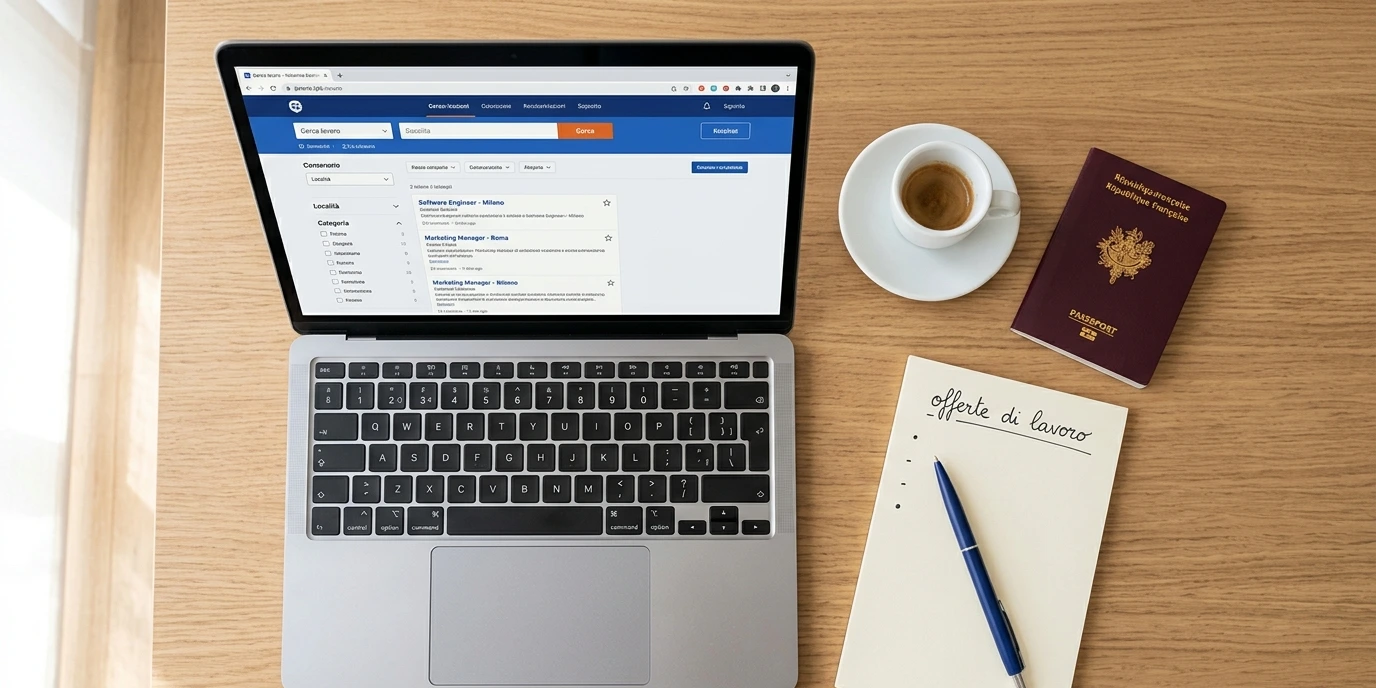
Finding a job in Italy from abroad is easier than ever, provided you know the right channels. Here is a full overview of the available resources.
Indeed.it: the essential starting point
Indeed Italy is the reference platform for an initial scan of the market. It aggregates listings from hundreds of company websites, agencies and specialist portals. Two effective strategies for English speakers: search in English (“English speaker”, “English native”) or directly in Italian using the terms “inglese madrelingua” or “inglese fluente”. Set up email alerts for new listings that match your profile — it is free and very practical.
LinkedIn: the go-to for qualified roles
LinkedIn remains the dominant platform for qualified profiles in Italy. Set up your profile in English and/or Italian, activate “Open to Work” (visible only to recruiters if you prefer), and use the location filter to target Milan, Rome, Turin or other cities. Italian recruiters rely heavily on LinkedIn for management and specialist positions.
The EURES portal: official European mobility
EURES (European Employment Services) is the official European Commission portal dedicated to professional mobility within the EU. Free to use at eures.europa.eu, it allows you to browse job listings in Italy, upload your CV and connect with EURES advisers — specialists in cross-border mobility present in every European region. It is an underused tool that works particularly well for positions in the public sector, education and care services.
Temp agencies in Italy
Temp agencies are an excellent entry point for starting work in Italy quickly, especially if you are looking for a first role without language skills. They offer placements in logistics, industry, hospitality, retail and services — often without requiring Italian depending on the role. The main agencies operating across Italy are:
- Adecco Italia — a very dense network, present in all major cities
- Randstad Italia — specialist in qualified profiles and industry
- Manpower Italia — generalist, with listings across many sectors
- Gi Group — a leading Italian agency, particularly active in the North-West
- Synergie Italia — part of the Synergie group, well positioned for multilingual profiles
Drop your CV directly with agencies in the city where you plan to settle. Consultants can direct you towards placements suited to your Italian level, and some agencies are particularly well set up to welcome internationally mobile candidates.
Monster Italia and specialist portals
Monster.it skews towards technical and managerial profiles. For sector-specific searches, also consider Subito.it (classifieds including job listings), expat Facebook groups such as “Expats in Italy” or “English Speakers in Italy”, and the networks of bilateral Chambers of Commerce between Italy and your home country — many of which regularly post openings for bilingual profiles and organise networking events.
Working as a freelancer in Italy with a partita IVA

For many internationally mobile professionals, the best way to work in Italy without speaking Italian is to do so as a freelancer. The partita IVA — Italy’s equivalent of a self-employment registration number — is the gateway that allows you to operate professionally on Italian soil.
Who is it for?
The partita IVA suits a wide range of profiles: consultants, translators, developers, graphic designers, coaches, trainers, copywriters, community managers, photographers, architects. As long as you have a marketable skill and clients — Italian, international, or back home — you can invoice legally from Italy.
The regime forfettario: a very attractive tax structure
If your annual turnover does not exceed €85,000, you can benefit from the regime forfettario, a simplified and highly attractive tax regime. The effective rate is 15% on a flat-rate taxable income (not on your actual revenue). For new businesses, this rate drops to 5% for the first five years. It is one of the most favourable tax regimes in Europe for self-employed professionals.
How to open a partita IVA in Italy
For EU citizens, opening a partita IVA is relatively straightforward. You first need to obtain a codice fiscale (Italian tax identification number), then declare the start of your activity to the Agenzia delle Entrate (the Italian tax authority). The process can be completed online or through a commercialista (Italian accountant). Working with a commercialista is strongly recommended for navigating the administrative details — expect fees of around €500 to €1,500 per year.
The advantage of being a bilingual freelancer in Italy
Positioned as a consultant or specialist in international markets, a bilingual freelancer based in Italy can offer services both to Italian clients looking to grow their presence abroad, and to international clients seeking a trusted contact on the Italian market. It is a doubly valued profile, with limited competition.
Your CV in Italian: the essentials
Even in an international company, a well-crafted Italian CV makes a real difference. A few key points to keep in mind.
The Europass format is the recognised standard in Italy — generate it for free at europass.europa.eu. Unlike practice in many Anglo-Saxon countries, a photo is still common on Italian CVs. Always specify your language levels clearly, noting your English as native or near-native and referencing the CEFR scale for any other languages. A concise one-to-two-page CV with quantified achievements is far more appreciated than a long, generalised document.
For a deeper understanding of all the conventions of the Italian job application — structure, lettera di presentazione, mistakes to avoid — we have put together a dedicated guide: → How to write an Italian CV that gets noticed.

Should you still learn Italian? An honest answer
To be clear: no, it is not a prerequisite for making the move. But yes, it is a very good idea once you are settled.
The more Italian you acquire, the more doors you open. Many well-paid positions in purely Italian companies require a minimum B2 level. Without it, you will be directed towards international companies, multinationals and very specific sectors — which is already a solid range of opportunities, but not the full market.
In daily life too, a working knowledge of Italian changes everything: shopping, handling an administrative issue, building friendships with neighbours. Italians genuinely appreciate foreigners who make the effort to speak their language, even imperfectly — and that goodwill frequently translates into professional trust.
Conclusion
Working in Italy without speaking Italian is not only possible, it represents a coherent professional strategy for many internationally mobile profiles. Whether you go through a multinational, an Italian SME looking to grow its international markets, a temp agency for a first placement, the EURES portal for a structured move, or you set yourself up as a freelancer with a partita IVA, the options are real and accessible.
The key is knowing where to look. Use the right keywords — “inglese madrelingua”, “inglese fluente” — on Indeed.it and LinkedIn. Upload your profile to EURES. Walk into temp agencies as soon as you arrive. And if you have a freelance profile, seriously explore the partita IVA with the regime forfettario.
Italy is a generous country for those who arrive with a genuine project. So take the step — and learn Italian along the way.
FAQ — Frequently asked questions about working in Italy without speaking Italian
Can you really work in Italy without speaking Italian?
Yes, it is entirely possible, particularly in multinationals, tourism, tech and Italian companies developing their international markets. In major cities like Milan or Rome, English is widely accepted as a working language. Learning Italian remains a valuable asset for accessing a broader range of opportunities over time.
What is the best way to find English-language jobs in Italy?
On Indeed.it and LinkedIn, search directly in Italian using the terms “inglese madrelingua” (English native speaker) or “inglese fluente” (fluent English). These terms target precisely the roles where your language is the key skill — with considerably less competition than general listings.
What is the EURES portal and how do you use it to find work in Italy?
EURES (European Employment Services) is the official European portal for professional mobility. It allows you to browse job listings across the EU, including Italy, and to connect with specialist cross-border mobility advisers. Free to access at eures.europa.eu.
Can you work in Italy with a partita IVA without speaking Italian?
Yes. The partita IVA is ideal for freelancers and consultants who want to base themselves in Italy while keeping their existing international clients. The registration process is accessible for EU citizens, and the regime forfettario offers a very attractive tax structure up to €85,000 in annual turnover.
Can temp agencies in Italy help an English speaker find work?
Absolutely. Agencies such as Adecco Italia, Randstad Italia, Manpower Italia and Synergie Italia offer placements without requiring Italian in many sectors — logistics, industry, hospitality. It is an excellent entry point for getting started quickly in Italy, especially when arriving without a local network.