Bilingual English–Italian experts based in Italy since 2020 · 500+ families supported
Real Estate Italy 2026
Profiles, purchasing behaviors and preferred areas of French-speaking buyers in the Italian real estate market.
The French-speaking reference for real estate in Italy
1. 1. PREFACE
A market in full expansion
The dream of buying a property in Italy has never been stronger among French, Belgian and French-speaking Swiss buyers. But between the fantasy and the notary's signature, reality is often much more complex.
This report 'Aller en Italie 2026' compiles two years of interactions, questions and testimonies from our French-speaking community engaged in a real estate project in Italy. It represents the first comprehensive analysis of purchasing behaviors, areas of interest and, above all, the real obstacles that slow down buyers.
In 2026, French-speaking demand for the Italian real estate market exceeds pre-Covid volumes for the first time. Prices in some historically sought-after areas (Tuscany, Amalfi Coast, Lake Como) have increased by 15 to 22% in two years, pushing new buyers toward lesser-known but equally charming regions.
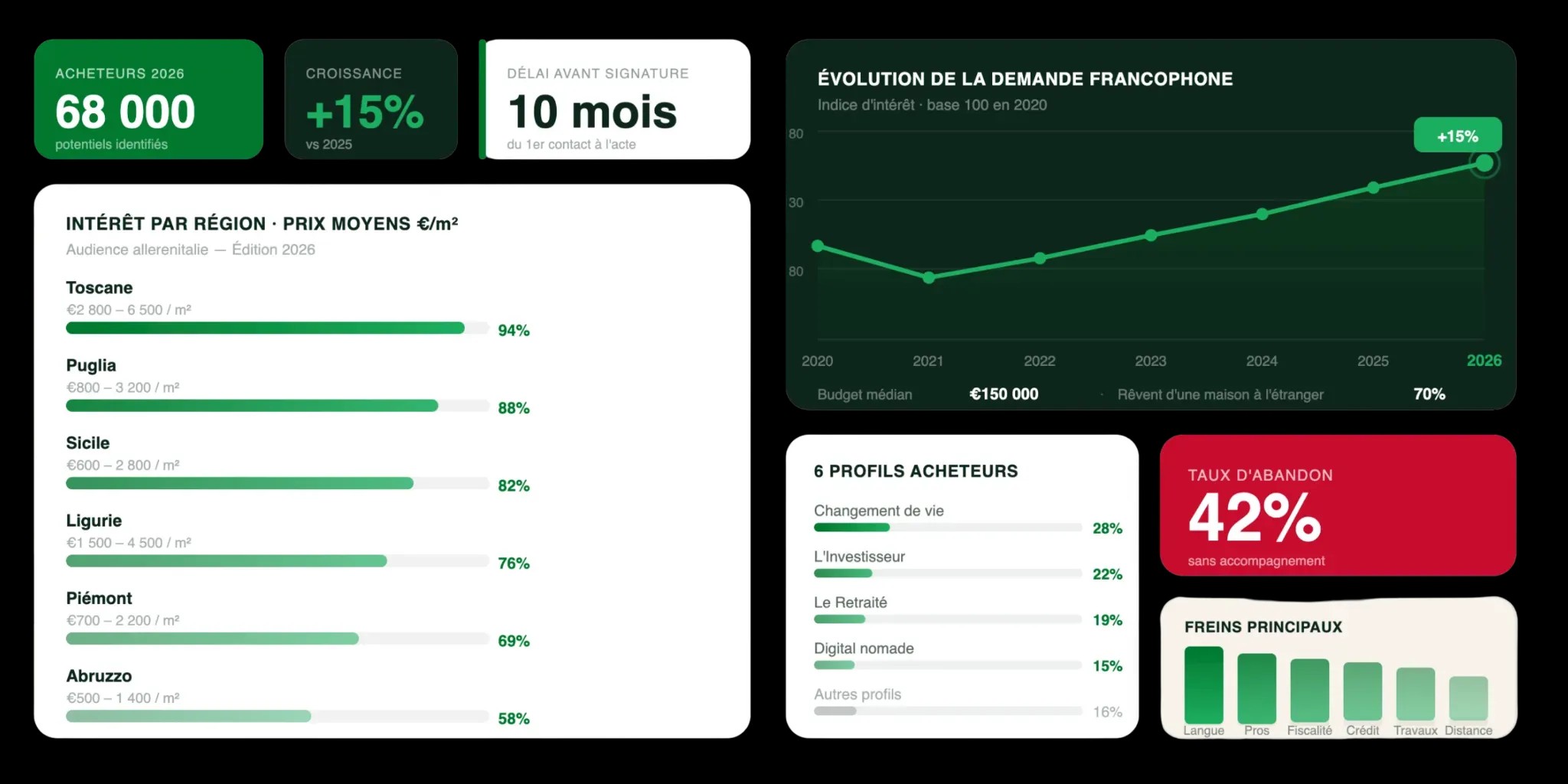
Paradoxically, despite this sustained demand, the project abandonment rate remains high: 42% of people who begin their searches do not complete a purchase within 36 months. The Italian administrative and legal complexity, the language barrier and the lack of structured support are the main causes.
This report is therefore both a tool for understanding the market and a call for quality French-speaking support — precisely offered by allerenitalie through its services, its platform and its network of bilingual professionals across Italy.
« Buying a house in Italy is a dream I had wanted to realize for a long time. But you quickly realize that the market is different, that the procedures are complex… and fear can quickly become paralyzing. »
Jean, prospective buyer, Lyon 2026
Why do Francophones choose Italy?
Discover the reasons that drive thousands of buyers to take the leap
Political instability and a sense of insecurity
Cost of living
Loss of traditions and a sense of not belonging
Quality of life and climate
1. I 6 buyer profiles in Italy
The analysis of our allerenitalie audience reveals six distinct archetypes, each with its own motivations, fears, and specific search behaviors.
The Life Change
Logic: lifestyle change28% of the audience in Allerenitalie
The Investor
Logic: invest + enjoy22% of the audience in Allerenitalie
The Retiree
Logic: live fully in Italy19% of the audience in Allerenitalie
The Digital Nomad
Logic: mobility + opportunity
15% of the audience in Allerenitalie
The Premium Buyer:
Logic: exceptional acquisition
9% of the audience in Allerenitalie
The Family Project
Logic: lasting settlement
7% of the audience in Allerenitalie
Perceived barriers vs reality on the ground
International clients encounter obstacles that slow down, or even block, their purchase process.
01 / The language barrier
02 / Finding the right professionals
03 / Understanding Italian taxation
04 / Obtaining a mortgage in Italy
05 / Renovations and property condition
06 / Distance and viewing logistics
1. CHAPTER 03
The real structural obstacles
Beyond perceptions, analysis of abandoned projects reveals systemic bottlenecks that buyers don't identify spontaneously — but that explain the majority of the 42% abandonment rate.
01
Cadastral and urban planning compliance
In Italy, it is common for a property to show discrepancies between the cadastral plans and the on-site reality (building violations, irregularities). This non-conformity can block notarization of the sale, affect the buyer's liability, or invalidate the preliminary sales agreement. Unlike in France, mandatory checks cover fewer situations. Reviewing the cadastral report and building permits is essential.
Present in 34% of transactions
02
The period between the preliminary sales agreement and the deed of sale
The period between the preliminary agreement (compromesso) and the final deed (rogito) is often misunderstood by the French. This phase, which lasts from 60 to 180 days, creates persistent anxiety: can the seller back out? What happens if the financing falls through? The rules governing the confirmatory deposit (retained or doubled) are not equivalent to the French system and lead to costly misunderstandings.
Source of abandonment in 28% of projects
03
Undeclared easements and rights of way
Property lien searches (visure ipotecarie) regularly reveal easements, mortgages, or rights of pre-emption that were not disclosed during viewings. In rural areas, agricultural rights of way can significantly affect the property's use. Interpreting historical deeds (notarial acts) requires a legal expert, who is rarely consulted by French-speaking buyers.
Discovered late in 45% of cases
Critical drop-off moments per phase
Typical Duration | Abandonment Rate | Primary Cause | |
|---|---|---|---|
1 — Initial exploration | 2–4 months | 38% | Misunderstanding of the market + language barrier |
2 — Negotiation | 2–6 months | 24% | Misunderstood compromise, poor legal advice |
3 — Due Diligence | 2–4 months | 18% | Cadastral irregularities discovered too late |
4 — Structuring | 1–3 months | 12% | Insufficient budget or area unsuited to the profile |
1. CHAPTER 05
The most searched areas in Italy
Analysis of search queries, of requests received and of the demand from our 'Andare in Italia' audience to identify areas of attraction in 2026.
01
Tuscany
TOSCANA · CENTRO-NORD
Flagship destination, still leading despite sharply rising prices. Emerging areas: Maremma, Lunigiana, Valdichiana.
€2,800 – €6,500 / m² (house)
02
Apulia
PUGLIA · SUD
A spectacular rise. The trulli, masserie and town houses of Salento charm with still-affordable prices and preserved authenticity.
€800 – €3,200 / m²
03
Sicily
SICILY · ISLAND
The island benefits from the 7% tax regime for retirees and from the "€1 Houses" programs. Palermo, Taormina and the Val di Noto concentrate most of the demand.
€600 – €2 800 / m²
04
Liguria
LIGURIA · NORTHWEST
Geographic proximity to France (PACA, Monaco). Popular with people from southeastern France. Sanremo, Ventimiglia, the Cinque Terre and the Genoa hinterland are on the rise.
€1 500 – €4 500 / m²
05
Piedmont
PIEDMONT · NORTHWEST
Undervalued market with an exceptional quality of life. Langhe, Monferrato and Barolo attract wine enthusiasts and heritage epicureans. Turin appeals to families.
€700 – €2 200 / m²
06
Abruzzo
ABRUZZO · CENTRAL
Area experiencing strong growth among digital nomads and neo-rurals. A combination of mountains, sea and untouched nature at some of the lowest prices in Italy. Fiber internet is available in numerous villages.
€500 – €1 400 / m²
07
Calabria
CALABRIA · FAR SOUTH
Market with the lowest prices in Italy. Eligible for the 7% tax regime. Numerous "Houses for €1" programs. Improving infrastructure. Market in a discovery phase for Francophones.
€300 – €1 000 / m²
08
Lombard Lakes
LOMBARDY · NORTH
Lake Como, Lake Maggiore, Lake Garda. Maximum prestige but sharply rising prices and a very closed market. Accessible exclusively to the Epicureo Patrimoniale and Premium Rental Investor profiles.
€4 500 – €15 000+ / m²
CHAPTER 06
Departure zones francophone and their Italian destinations
The geographic analysis of our audience reveals strong correlations between the Francophone region of origin and the targeted Italian area — with distinct proximity-driven, cultural, and fiscal dynamics.
Île-de-France
PARIS & GREATER AREA · 31% OF THE AUDIENCE
- Tuscany (Florence, Siena)34%
- Apulia (Salento)22%
- Sicily (Palermo, Taormina)18%
- Lombardy Lakes14%
- Others12%
PROFILES: The life-change - The Investor
Provence-Alpes-Côte d'Azur & Monaco
MARSEILLE, NICE, CANNES · 19% OF THE AUDIENCE
- Liguria (Sanremo, Imperia)48%
- Coastal Tuscany (Versilia)24%
- Sardinia (Porto Cervo)16%
- Piedmont (Cuneo)8%
- Others4%
PROFILES: The retiree - The family project
Auvergne-Rhône-Alpes
LYON, GRENOBLE, CLERMONT · 14% OF THE AUDIENCE
- Piedmont (Turin, Langhe)38%
- Lombardy Lakes26%
- Inland Tuscany20%
- Aosta Valley10%
- Others6%
PROFILES: The family project - The investor
Occitania
TOULOUSE, MONTPELLIER, NÎMES · 11% OF THE AUDIENCE
- Apulia (Itria Valley)32%
- Sicily (Val di Noto)28%
- Calabria22%
- Tuscany (Maremma)12%
- Other6%
PROFILES: Lifestyle changer-The digital nomad
Francophone Belgium
BRUSSELS, WALLONIA, LIEGE · 9% OF THE AUDIENCE
- Tuscany (Chianti, Val d'Orcia)40%
- Apulia (Alberobello)25%
- Umbria (Perugia, Spoleto)20%
- Lazio (Roman countryside)10%
- Other5%
PROFILES: The retiree-Lifestyle changer
Romandy (French-speaking Switzerland)
GENEVA, LAUSANNE, FRIBOURG · 7% OF THE AUDIENCE
- Lombardy Lakes (Como, Lugano)52%
- Piedmont (Langhe, Vercelli)24%
- Tuscany (Florence)16%
- Aosta Valley5%
- Other3%
PROFILES: The premium buyer-The investor
KEY
The 500 km rule
Our analysis reveals a strong correlation: buyers whose projects succeed have, on average, an Italian destination within 500 km from their home. Geographic proximity reduces costs and visit frequency, facilitates post-purchase management, and decreases the sense of isolation during the move. Projects towards distant destinations (e.g., Sicily from Lille) require enhanced support to compensate for this friction.