Buying a House in Sardinia: Complete Guide 2026
Discover the essential steps and insights into buying a house in Sardinia, an ideal location for holiday homes and investments in 2026.

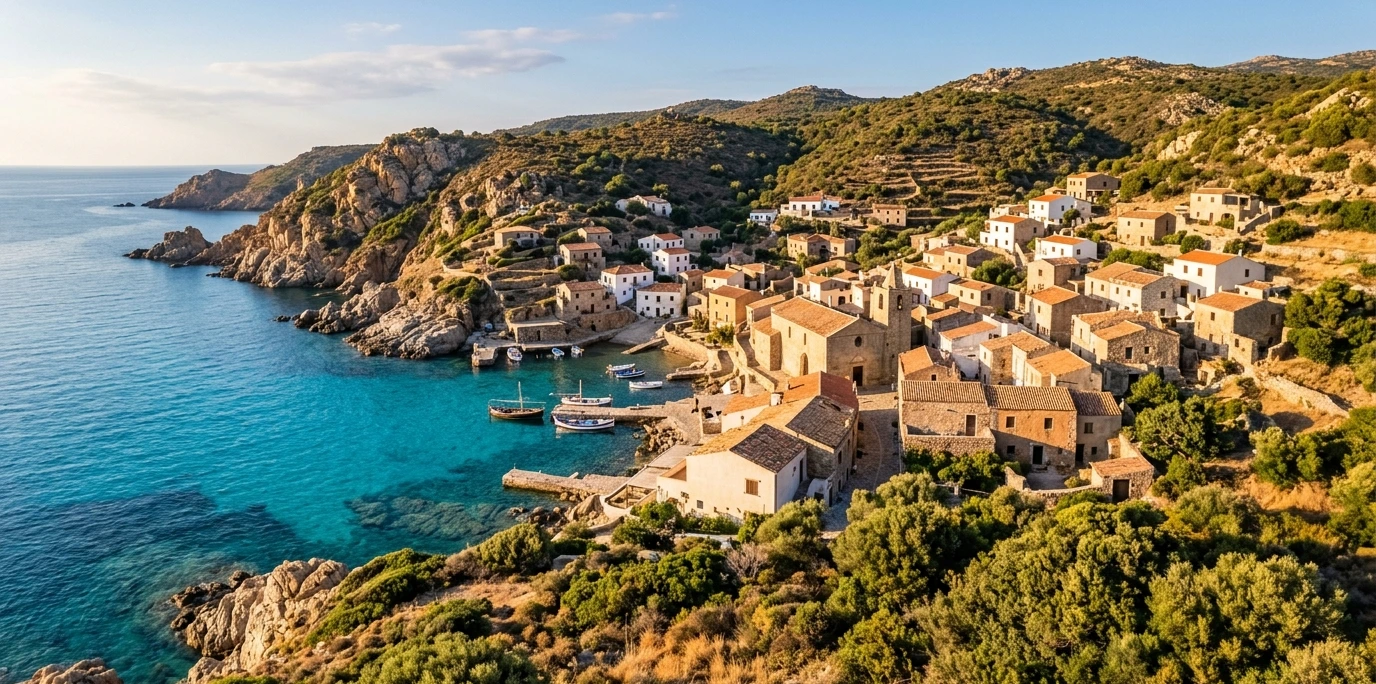
Sardinia is the kind of place that gets under your skin — not just once, but every time you visit. Turquoise sea, genuine villages, generous food, clean air: the island of the nuraghi has everything to offer those who are looking for an Italian quality of life, away from the crowds of the mainland. And a growing number of international buyers are taking the plunge: buying a house in Sardinia as a holiday home, a rental investment, or a permanent sunny retreat.
The good news is that the Sardinian property market remains broadly accessible, with some genuinely affordable areas inland. The less straightforward part — and it is worth understanding clearly — is that buying property in Italy comes with its own procedures, and Sardinia has its own particularities on top of that. This complete guide walks you through everything, from real prices to legal steps, from pitfalls to avoid to lesser-known opportunities like the €1 house scheme.
Aller en Italie
Relocation experts · since 2020
4.9
How many steps separate you from Italy?
A tailored offer based on your needs — in 3 min, no commitment
Tell us about your project
Profile, area, buying or renting
We select your services
From 50+ services in English
Receive your quote
Clear, detailed, personalized
*Indicative and customizable quote, no contractual commitment.
Free · 3 min · in English · no commitment
Create my offerWhy buy a house in Sardinia in 2026?
The Sardinian property market is at a turning point. After years of stagnation, prices are rising again in sought-after coastal areas — particularly around Olbia, Alghero, and the south of the island — driven by sustained foreign demand from mainland Italians, Germans, and British buyers. Inland, by contrast, prices remain stable or softening, opening up real opportunities for buyers on a tighter budget.
Several factors explain the growing international interest in Sardinian property:
- Quality of life: 300 days of sunshine a year, healthy food, a relaxed pace of life, and welcoming locals.
- Still-competitive prices: in the interior of the island, houses to renovate start from €30,000 to €50,000.
- Rental potential: Sardinia welcomes over 15 million tourists a year. A well-located property can generate significant rental income during the high season.
- The flat tax for new residents: Italy offers an attractive tax regime (a flat tax of €100,000 on foreign-source income) that is particularly appealing for retirees and remote workers.
- Accessibility: Cagliari is under two hours by air from many major European cities.
Buying in Sardinia is a good fit if you are looking for a Mediterranean base, a seasonal rental investment, or a permanent home with a lower cost of living. It may be less suitable if you want to settle in a large, fast-paced city — in that case, Rome, Milan, or Turin would be better options.
THEY TALK ABOUT US
Maisons & Jardins · Le Figaro · Challenges
« Built on solid hands-on experience and an in-depth knowledge of Italian procedures. »
Jessica Colpin, co-founder — Maisons & Jardins France, Jan.–Feb. 2026
Property prices per m² in Sardinia by area — 2026 table
The first thing any serious buyer should do is compare prices across different areas. In Sardinia, the gaps are striking: between the Costa Smeralda and a village in Barbagia, prices can differ by a factor of ten. The table below is based on 2026 market data (sources: Immobiliare.it, Idealista, Agenzia delle Entrate — OMI).
| Area / Province | Min. price (€/m²) | Average price (€/m²) | Max. price (€/m²) | Market profile |
|---|---|---|---|---|
| Cagliari (city) | €1,200 | €1,800 | €3,000 | Capital city, dense urban market, sustained demand |
| Cagliari — suburbs / nearby coast | €900 | €1,400 | €2,500 | Residential neighbourhoods, access to southern beaches |
| Sassari (city) | €900 | €1,300 | €2,000 | Second city, more affordable than Cagliari |
| Alghero (Sassari province) | €1,400 | €2,200 | €4,000 | Highly popular tourist town, strong foreign demand |
| Olbia (city and surroundings) | €1,200 | €2,000 | €3,500 | North-east gateway, dynamic market |
| Costa Smeralda (Porto Cervo, Porto Rotondo) | €4,000 | €6,500 | €15,000+ | Absolute luxury, high-end international market |
| Nuoro (city) | €700 | €1,000 | €1,500 | Inland city, quiet market, strong local traditions |
| Barbagia / Ogliastra (interior) | €300 | €650 | €1,100 | Lowest prices on the island, depopulated villages, renovation projects |
| Oristano (province) | €700 | €1,100 | €2,000 | Little-known west coast, excellent value for money |
| South Sardinia (Sulcis, Iglesiente) | €500 | €900 | €1,800 | Developing area, stunning under-the-radar beaches |
Sources: Agenzia delle Entrate (OMI Q4 2024), Immobiliare.it, Idealista Italia — indicative figures, to be verified locally for individual properties.
Our advice: do not rely solely on prices listed on property portals. In Sardinia, negotiation is standard practice. On renovation properties in the interior, a margin of 15 to 25% is often achievable. On the Costa Smeralda, sellers are rarely in a hurry.
Looking for a house in Sardinia?
We can guide you through the entire process.
Aller en Italie
French expatriation expert · since 2020
4.9
73 verified reviews
1,500+ expats supported
50+ services with French-speaking professionals
20 regions covered
Local consultants based in Italy
Free appointment · 15 min · in French · no commitment
Book an appointment€1 houses in Sardinia: participating municipalities and real conditions
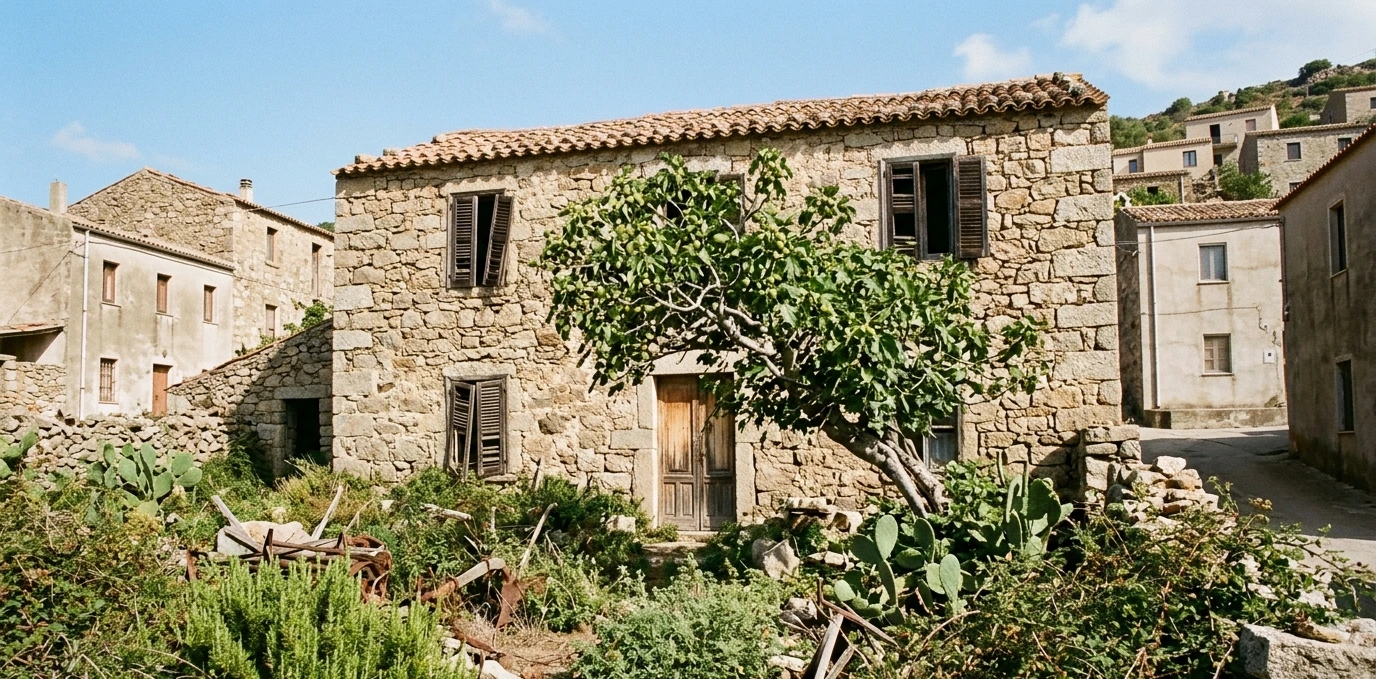
The €1 house programme in Sardinia (case a 1 euro) regularly makes international headlines. The concept is genuine: Sardinian municipalities offer abandoned properties at a symbolic price to attract new residents and revive their villages. But €1 at purchase does not mean free. The details matter enormously.
The Sardinian municipalities participating in the programme
The municipalities currently active in the scheme (non-exhaustive list, always verify directly with the local council):
- Nulvi (Sassari province) — well-documented programme, responsive local administration
- Mamoiada (Nuoro province) — village of the Barbagia masks
- Bortigali (Nuoro province) — small inland municipality
- Borore (Nuoro province) — programme recently relaunched
- Ollolai (Nuoro province) — one of the pioneers of the scheme in Sardinia
- Montresta (Oristano province) — small village, very few properties available
- Padria (Sassari province) — programme in the process of being organised
The real conditions of the programme
Each municipality sets its own rules, but the most common conditions are as follows:
- Mandatory renovation: you must commit to renovating the property within a set period (generally three to five years). A renovation quote is often required at the time of signing.
- Security deposit: a deposit of €3,000 to €10,000 is often required, returned once the works are completed.
- Primary residence: some municipalities require the property to become your primary residence, or at minimum that you are present on a regular basis.
- Real renovation budget: plan for between €50,000 and €150,000 in renovation costs depending on the condition of the property. Many of these houses have no roof, no sanitation, and no electrical installations.
- Local contractors sometimes required: certain municipalities insist that renovation work be carried out by locally based companies.
⚠️ Worth knowing: several municipalities have launched programmes that never got off the ground due to a lack of serious applicants — or, conversely, were overwhelmed with enquiries from abroad that came to nothing. Before applying, contact the local planning office (ufficio tecnico) directly to find out the current availability of properties and the exact conditions.
If the renovation budget gives you pause, regional and national grants do exist for the restoration of older properties (the modified Superbonus, Regione Sardegna incentives). A local tax lawyer or surveyor (geometra) can help you identify what you may be eligible for.
Buying by the sea in Sardinia: what you need to know
Owning a property in Italy by the sea is a dream shared by buyers from across the world. Sardinia, with its 1,800 km of coastline and beaches ranked among the most beautiful on the planet, attracts a large share of that demand. But buying on the Sardinian coast raises specific questions — legal, fiscal, and practical.
The most sought-after coastal areas (and their prices)
The Sardinian coastal market divides into several very distinct worlds:
- Costa Smeralda (north-east): the global benchmark for luxury beach living. Prices between €5,000 and €15,000/m², and higher still for Porto Cervo. Reserved for a well-heeled clientele.
- Golfo di Orosei (central-east): one of the most spectacular stretches of coastline in Italy. Very little seafront construction (protected natural park). A few houses in Cala Gonone between €2,000 and €4,500/m².
- Costa Verde / Costa di Sulcis (south-west): the great unknown. Wild beaches, few tourists, prices still reasonable (€1,500 to €3,000/m²). A developing area.
- South Sardinia (Villasimius, Costa Rei): crystal-clear water, easy access from Cagliari. Prices between €2,500 and €5,000/m² for a seafront property.
- Alghero and the Riviera del Corallo (north-west): a distinctive atmosphere, a good range of holiday homes (€1,800 to €4,000/m²).
- Oristano / Cabras (west coast): the most affordable stretch of Sardinian coastline. Prices from €1,200/m² for houses near the sea.
Coastal planning regulations in Sardinia: a constraint you cannot ignore
In Italy, and especially in Sardinia, the coastline is subject to very strict regulations. Two points to understand before any coastal purchase:
- The 300-metre strip: in coastal zones, any construction or extension within 300 metres of the shoreline is in principle prohibited or heavily restricted under the Sardinian Regional Landscape Plan (Piano Paesaggistico Regionale, PPR). This means many seafront properties are legally very limited in terms of expansion or modification.
- Unauthorised buildings (abusi edilizi): a recurring problem in Italian coastal areas. Before buying, always have the planning compliance of the property checked by a local surveyor (geometra) or a specialist lawyer. A non-compliant structure can be ordered for demolition, even if you purchased it in good faith.
- Beach concessions: if the property includes a beach concession (concessione demaniale), check the remaining term and the renewal conditions — European regulations on beach concessions are currently evolving.
Our coastal advice: for any seafront purchase in Sardinia, engaging a local surveyor (geometra) before signing anything is non-negotiable. They will verify the property’s compliance with planning rules, the legality of any existing constructions, and the absence of cadastral disputes. Their fee (€300 to €800) is a small price to pay to avoid very costly surprises.
Seasonal rental potential by the sea
A well-positioned property in Sardinia can generate between €1,500 and €5,000 per week in high season (July and August) on platforms such as Airbnb or Booking. June and September are also strong months. That said, Italian regulations on tourist rentals are tightening. Check with the local municipality regarding declaration requirements and any authorisations (SCIA) that may be required.
The property buying process in Sardinia for international buyers
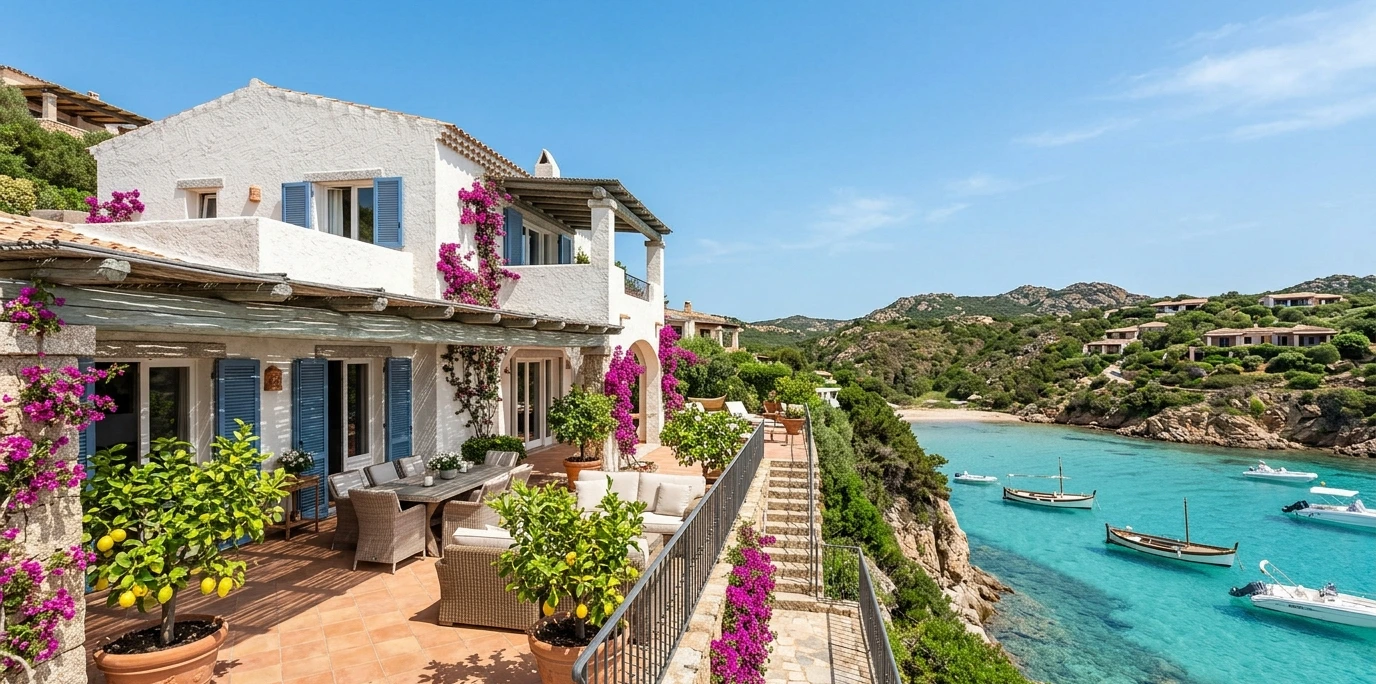
The good news for EU citizens: buyers from EU member states have exactly the same purchase rights as Italian nationals in Sardinia. No special permits, no acquisition restrictions. Here are the key steps in the process.
Step 1 — Obtain your codice fiscale
The Italian tax identification number (codice fiscale) is required for any property transaction. It can be obtained free of charge from an Italian consulate or embassy, or directly at the Agenzia delle Entrate in Sardinia. The process is quick, typically taking just a few days.
Step 2 — The proposta d’acquisto (purchase offer)
Once you have found a property, you submit a written purchase offer (proposta di acquisto). This is binding on both parties. A deposit (caparra confirmatoria) of 5 to 10% of the purchase price is generally paid at this stage. If the seller withdraws, they owe you double the deposit. If you withdraw, you forfeit the deposit.
Step 3 — The compromesso (preliminary contract)
The preliminary sale agreement (compromesso or contratto preliminare) is signed either before a notary or directly between the parties. It sets the definitive terms: price, deadline for signing the rogito, and any conditions precedent (securing a mortgage, outcome of a survey).
Step 4 — The rogito (final deed)
The final signature takes place at the notary’s office (notaio). As an international buyer, you have the right to request the presence of a sworn interpreter. In Italy, the notary represents the state and is neutral — they are not acting in your interest specifically. For this reason, it is strongly advisable to have your own lawyer to represent you throughout the transaction.
How long does the process take?
Allow an average of two to four months between an accepted offer and the signing of the rogito. This timeline can extend if complex planning checks are required or if bank financing is involved.
Can the whole process be done remotely?
To some extent, yes. It is possible to grant a power of attorney (procura) to a trusted lawyer or representative to sign on your behalf. However, we strongly recommend visiting in person at least once to see the property and meet the notary. Flights to Cagliari or Olbia from many European cities are inexpensive, often available from €60 to €80 on low-cost carriers.
Taxes and purchase costs to budget for in Sardinia
One of the most common questions from international buyers is: what does a property purchase in Sardinia actually cost, all fees included? Here is a clear breakdown.
Acquisition costs (on top of the purchase price)
| Type of cost | Primary residence | Secondary residence | Basis of calculation |
|---|---|---|---|
| Imposta di registro | 2% | 9% | Cadastral value (rendita catastale) |
| Imposta ipotecaria | €50 fixed | €50 fixed | Fixed fee |
| Imposta catastale | €50 fixed | €50 fixed | Fixed fee |
| Notary fees | €1,500 to €4,000 | Depending on value and complexity | |
| Agency commission (if applicable) | 2% to 4% + VAT | On the sale price | |
| Lawyer (recommended) | €1,000 to €3,000 | Depending on the case | |
| Estimated total costs | 4 to 7% | 10 to 15% | of the purchase price |
Important note: if you are buying as a primary residence and you qualify as a primo accedente (first-time buyer in Italy), additional tax advantages apply. Consult a notary or tax lawyer to confirm your eligibility.
IMU — Property tax on secondary residences
If your Sardinian property is a secondary residence (as is often the case for international buyers), you will be liable for the IMU (Imposta Municipale Unica), Italy’s annual property tax. The rate varies by municipality, ranging between 0.4% and 1.06% of the cadastral value. For an apartment with a cadastral value of €80,000, expect to pay between €400 and €850 per year.
The flat tax for new residents in Italy
If you are planning to move to Sardinia as your primary residence, Italy offers a very attractive tax regime: a flat tax of €100,000 on foreign-source income for 15 years (art. 24-bis TUIR). This is particularly appealing for retirees, those with investment income, or remote workers earning outside Italy. Find out more about the Italian flat tax →
Living in Sardinia as an expat: cost of living and everyday life
Wondering what it actually means to live in Sardinia as an expat? Buying a property is just the beginning — it means adopting a new rhythm, a new language, and a new culture. Here is an honest, practical picture.
Cost of living in Sardinia in 2026
Sardinia is less expensive than most Western European cities, though slightly pricier than some rural areas of mainland Italy. Here are some useful benchmarks:
- Food: local produce (pecorino, bottarga, lamb, market vegetables) is inexpensive. A weekly shop for two people: €80 to €120 depending on habits.
- Eating out: a full meal (set lunch menu) at a local trattoria: €12 to €18. A tourist restaurant by the sea: €30 to €60 per person.
- Energy and water: energy bills are comparable to other European countries, though sometimes slightly higher due to the island’s tariff structure. Water is a precious resource in Sardinia — budget around €30 to €60 per month for a two-person household.
- Transport: public transport is limited outside the main towns. A car is practically indispensable if you live inland. Fuel is slightly more expensive than on the Italian mainland.
- Healthcare: access to care in the main cities (Cagliari, Sassari, Olbia) is good. In rural areas, medical services become scarcer. With a residence permit, you can access the public health system (SSN) at reduced rates.
- Estimated monthly budget for a couple: €1,800 to €2,800 (excluding rent if you own your home) for a comfortable life in Cagliari or Sassari. In the interior, this can drop to €1,400 to €1,800.
The language barrier: a real consideration?
Italian is indispensable for living comfortably in Sardinia. English is not as widely spoken as in northern Europe. Some agencies and specialist firms operate in English (particularly in Cagliari and Olbia), but you cannot rely on it day to day. If you are planning a long-term move, starting Italian before you buy is a genuinely good idea.
The expat community in Sardinia
It is modest but real. Facebook groups such as “Expats Sardinia” bring together several hundred active members. Social gatherings and meetups are regularly organised in Cagliari, Alghero, and Olbia. These communities are also a great way to find reliable tradespeople or trusted notaries recommended by people who have already been through the process.
Conclusion: buying a house in Sardinia, yes — but with preparation
Buying in Sardinia is a project that is both accessible and demanding. Accessible because the market still offers real opportunities, with properties at prices well below what you would pay for an equivalent natural setting in comparable Mediterranean destinations. Demanding because Italian administrative procedures have their own logic, and the mistakes — planning non-compliance, abusi edilizi, poorly structured tax arrangements — can be expensive.
The key takeaway: before you begin, define your project clearly (primary residence? holiday home? rental investment?), choose your area based on your real budget including all fees, and surround yourself with a notary and a lawyer who are experienced in working with international buyers. Sardinia will wait for you — it is in no rush, but it rewards those who arrive well prepared.
Recommended first step: start by exploring Immobiliare.it and Idealista to compare real prices by area. Then plan an initial scouting trip that combines property visits with a meeting with a local professional. The rest will follow naturally.
FAQ — Frequently asked questions about buying a house in Sardinia
How much does a house in Sardinia cost in 2026?
Can you buy in Sardinia without speaking Italian?
Yes, it is entirely possible. Italian law provides for the mandatory presence of a sworn interpreter at the signing of notarial deeds. English-speaking estate agents and lawyers operate in Cagliari, Olbia, and Alghero. That said, for comfortable long-term living in Sardinia, learning Italian will remain indispensable.
Which are the most affordable areas to buy in Sardinia?
The most accessible areas are Barbagia and Ogliastra (Nuoro province), Sulcis-Iglesiente (south-west), and certain inland municipalities of Sassari province. Renovation properties can be found from €30,000 to €60,000. The west coast (Oristano province) also offers excellent value, with beautiful beaches and still-moderate prices.