Living in Sardinia: Cost of Living, Best Places to Settle and Tax Benefits for Expats
Explore the charm of living in Sardinia, from its picturesque landscapes to affordable living costs and tax benefits for expats.

Living in Sardinia means settling in a region of Italy where nature, culture and the sea come together in perfect harmony. From the paradise beaches of the Costa Smeralda to the hilltop villages of the interior, from the white cliffs of Santa Teresa di Gallura to the crystal-clear waters of Villasimius, Sardinia offers an exceptional living environment that is both authentic and refined.
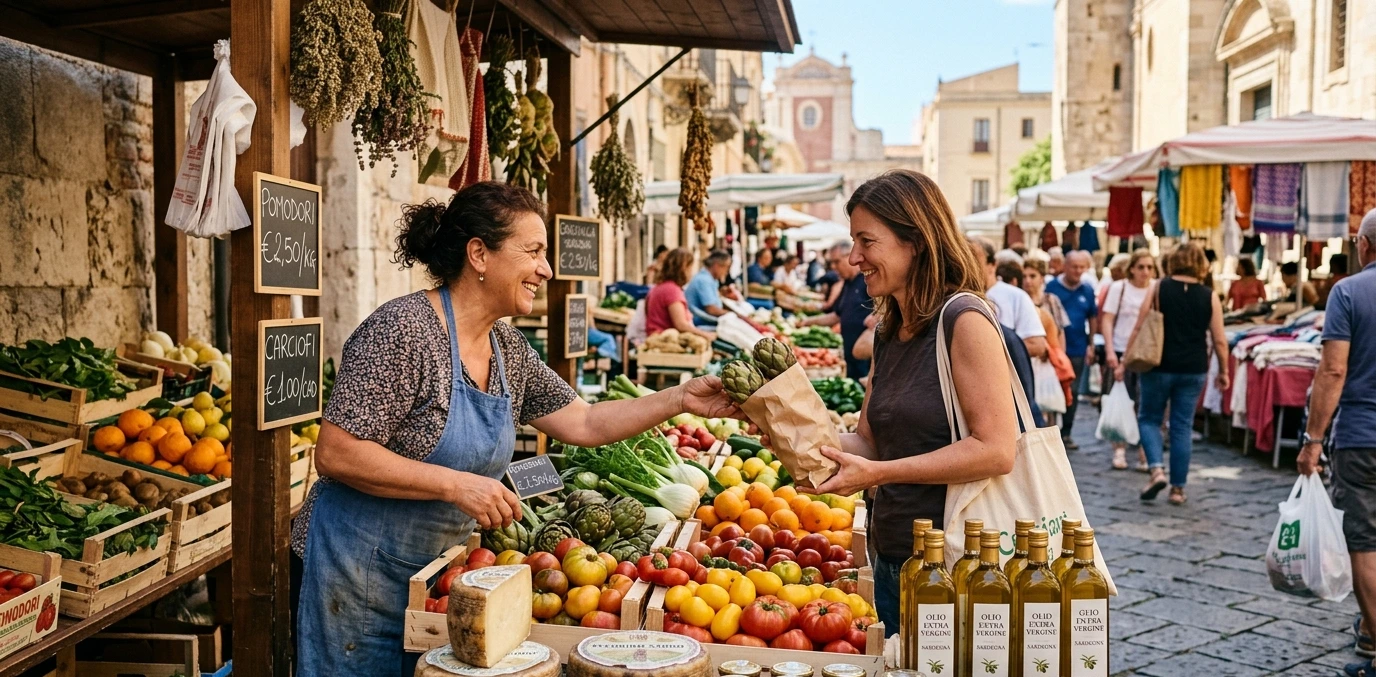
Every corner of the island reveals a unique identity: the flower-lined alleyways of Alghero, the lively markets of Cagliari, the wild cliffs of the Golfo di Orosei, and the vineyards of the mountainous interior. Sardinian cuisine, built around simple, natural ingredients — cheeses, wines, olive oil, honey and traditional carasau bread — reflects the deep bond between the islanders and their land.
In this article, we explore why more and more people are choosing to live in Sardinia, which areas are most attractive for settling down, how to assess the cost of living, how to optimise your tax situation as a foreign retiree, and what steps to take for a smooth move to this modern, welcoming and deeply Italian island.
Aller en Italie
Relocation experts · since 2020
4.9
How many steps separate you from Italy?
A tailored offer based on your needs — in 3 min, no commitment
Tell us about your project
Profile, area, buying or renting
We select your services
From 50+ services in English
Receive your quote
Clear, detailed, personalized
*Indicative and customizable quote, no contractual commitment.
Free · 3 min · in English · no commitment
Create my offerWhy choose to live in Sardinia?
Choosing to live in Sardinia means choosing a fascinating island — wild, elegant and deeply Italian all at once. Located at the heart of the Mediterranean, it offers a rare balance between turquoise sea, ancient traditions and an exceptional quality of life.
A region that is both culturally rich and remarkably preserved, Sardinia draws nature lovers, food enthusiasts and expats in search of calm and a more human pace of life. With cities like Cagliari, Sassari and Olbia, it combines economic dynamism and Mediterranean hospitality while maintaining a strong identity shaped by centuries of history.
Its economy rests on pillars including tourism, agri-food, craftsmanship and agriculture, as well as innovative activities in sustainable energy and technology. Between sea, mountains and fragrant maquis scrubland, Sardinia embodies the essence of the Italian art of living — a true Mediterranean retreat for those who dream of a new life without sacrificing quality.
THEY TALK ABOUT US
Maisons & Jardins · Le Figaro · Challenges
« Founded on solid field experience and an in-depth knowledge of Italian procedures. »
Jessica Colpin, co-founder — Maisons & Jardins France, Jan.–Feb. 2026
The cost of living in Sardinia
The cost of living in Sardinia depends heavily on where you settle. Major cities such as Cagliari, Olbia and Alghero are naturally more expensive, particularly for housing, while rural areas and inland villages offer a considerably more affordable lifestyle. Overall, Sardinia remains significantly cheaper than the major regions of northern Italy, while still offering a high quality of life and an exceptional natural setting.
In Cagliari, a single person typically spends between €1,400 and €1,800 per month, including rent. A one-bedroom apartment in the historic centre ranges from €900 to €1,200, while residential neighbourhoods such as Genneruxi, San Benedetto and Pirri offer rents between €650 and €850. In smaller cities such as Oristano, Nuoro and Sassari, the total monthly budget for a single person often stays below €1,300.
On the food front, Sardinia offers excellent value: local products such as olive oil, cheeses, honey, wine, and seasonal fruit and vegetables are affordable at markets, and a full meal at a trattoria averages €15 to €25 per person. Public transport is well developed in the main cities, with monthly passes around €35 to €45, though in most rural areas a car remains necessary.
Comparative table: cost of living in Cagliari, Olbia and Alghero
| Expense | Cagliari | Olbia | Alghero |
|---|---|---|---|
| 1-bed apartment, city centre | €650 – €900 | €750 – €1,050 | €580 – €800 |
| 1-bed apartment, residential / outskirts | €500 – €700 | €550 – €750 | €430 – €620 |
| Monthly food budget (couple) | €350 – €450 | €380 – €500 | €330 – €430 |
| Restaurant lunch menu | €12 – €16 | €14 – €20 | €11 – €16 |
| Urban transport pass | €35 – €45/month | Limited network | €20 – €35/month |
| Estimated monthly budget (single person) | €1,400 – €1,800 | €1,600 – €2,100 | €1,200 – €1,700 |
| Best suited for | Families, working professionals, all profiles | Remote workers, upmarket tourism | Retirees, couples, relaxed lifestyle |
Leisure options are varied and often free: beaches, hiking, festivals and food experiences. Even in tourist areas, prices remain very reasonable outside the high season.
Aller en Italie
French expatriation expert · since 2020
4.9
71 verified reviews
1,500+ expats supported
50+ services with French-speaking professionals
20 regions covered
Local consultants on the ground in Italy
Free appointment · 15 min · in French · no commitment
Book an appointmentWhere to settle in Sardinia?
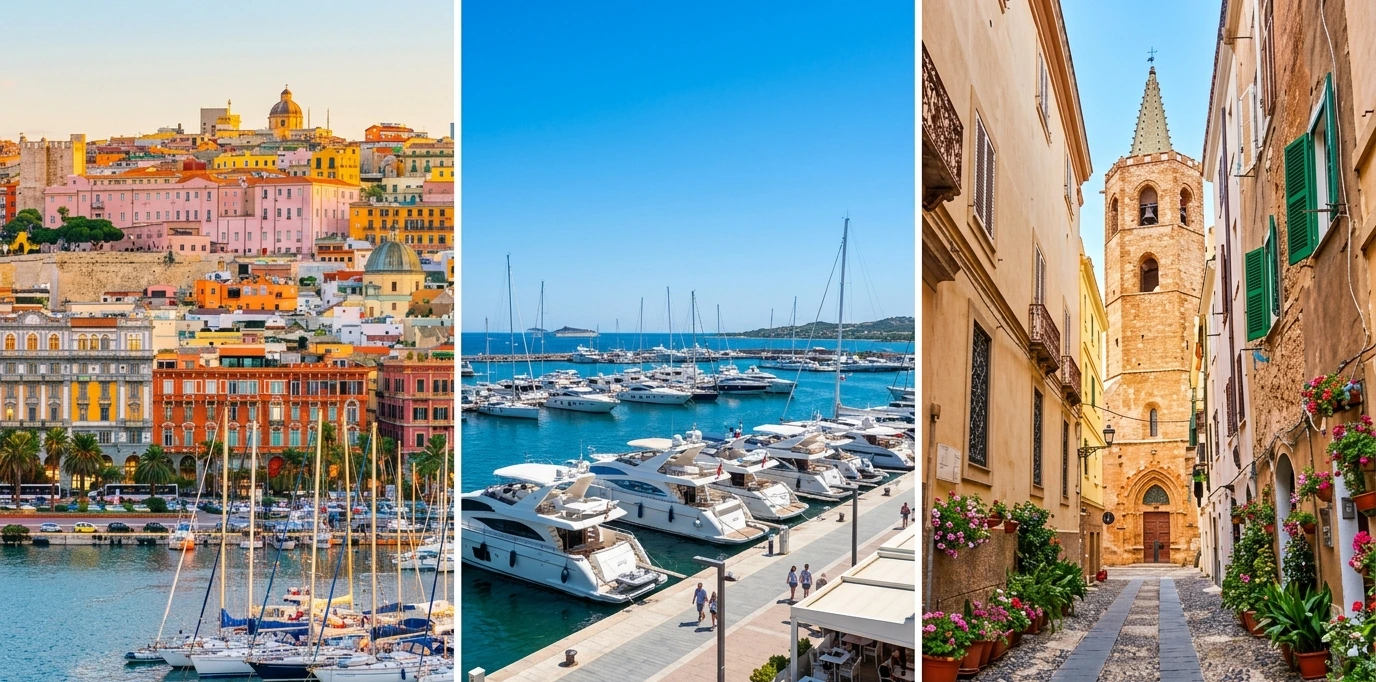
Settling in Sardinia means choosing between coastal living, rural charm and Mediterranean softness. The island offers a wide variety of environments, from the prestigious resort towns of the Costa Smeralda to the picturesque villages of the interior, through lively little port towns where the sea is simply part of daily life.
In the south, Cagliari, the regional capital, combines urban energy with quality of life. Cosmopolitan and welcoming, it draws those looking for professional opportunities, modern services and proximity to the sea. Residential neighbourhoods like Bonaria, Stampace and Poetto offer an excellent balance between city living and a beach atmosphere, with an urban beach considered one of the finest in Italy.
On the northern coast, the province of Olbia-Tempio attracts with its proximity to the Costa Smeralda. Towns such as Olbia, Arzachena and San Teodoro offer a paradise setting while remaining well connected by air and sea links — a real advantage for remote workers who travel regularly.
To the west, Alghero and Sassari offer a more authentic and cultural experience, with a Catalan heritage dating back to the 14th century and a strong local identity. These towns are particularly popular with families and retirees who want a peaceful pace of life close to the beaches of the Golfo di Alghero and the Porto Conte nature reserve.
For those who prefer a quieter, more rural environment, the provinces of Nuoro and Oristano represent an excellent compromise between nature and accessibility. Here you find hilltop villages, mountain landscapes, wild beaches and some of the lowest living costs on the island. In the south-west, Iglesias and Carbonia offer a lesser-known side of Sardinia, ideal for a relocation project or remote working life at the rhythm of the sea.
Favourable tax rules for foreign retirees in Sardinia
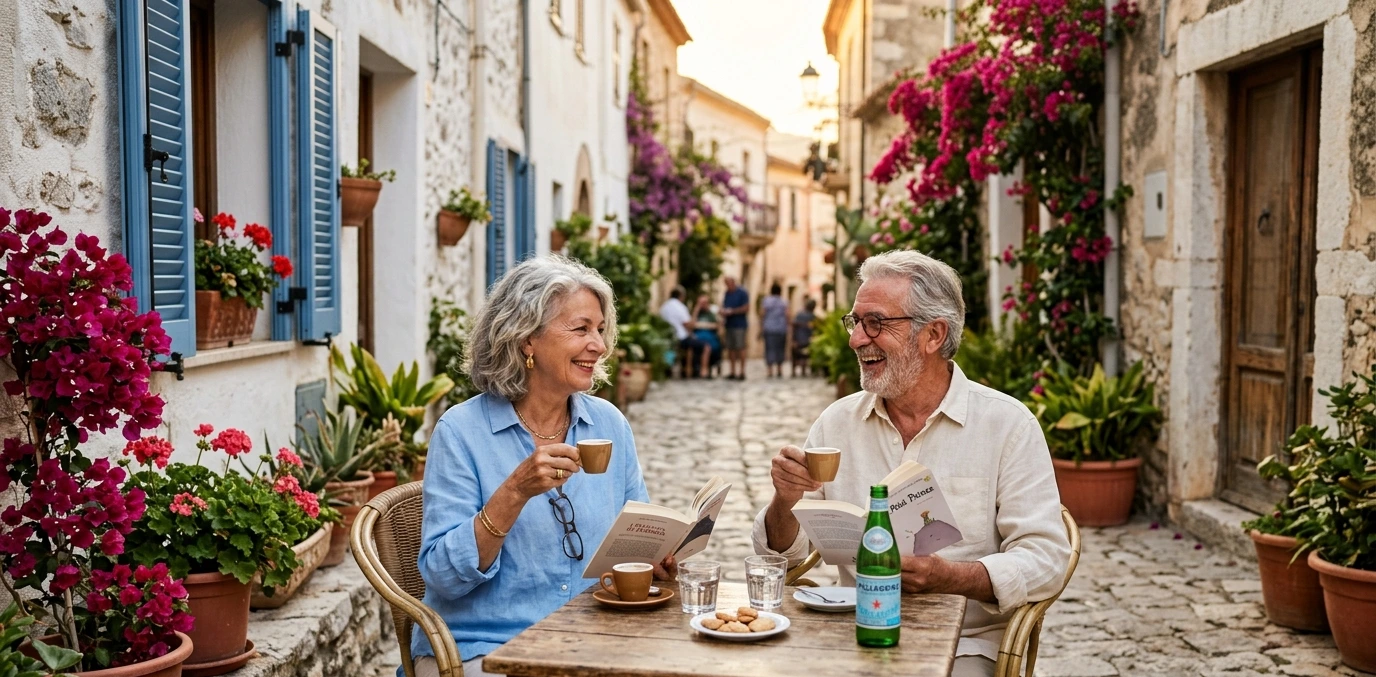
Sardinia is not only appealing for its landscapes and gentle way of life — it also offers attractive tax advantages for foreign retirees looking to settle here. Since 2019, the Italian government has operated a flat tax of 7% to encourage new residents to move to rural municipalities in southern and central Italy, several of which are located on the island.
How does the 7% flat tax work for retirees?
People who become tax residents in Italy and settle in a Sardinian municipality with fewer than 30,000 inhabitants can benefit from a flat tax rate of 7% on their foreign-source income — including overseas pensions — for nine years. To qualify, you simply need to not have been a tax resident in Italy during the previous five years, and to transfer your actual residence to an eligible municipality.
This scheme applies to foreign-source income: pensions, overseas rental income, dividends and so on. Income from Italian sources remains subject to the standard progressive tax scale (IRPEF). It is worth verifying the provisions of any applicable tax treaty between Italy and your home country for each type of income. For more detail, see our guide on property taxes in Italy.
A worked example: a retired couple receiving €3,500/month
| Situation | Standard tax rate (30%) | In Sardinia (flat tax 7%) |
|---|---|---|
| Annual income (pensions) | €42,000 | €42,000 |
| Estimated income tax | ~€8,400/year | ~€2,940/year |
| Annual saving | ~€5,460 per year | |
| Saving over 9 years (duration of the scheme) | ~€49,140 (before indexation) |
Thanks to this measure, Sardinia attracts a growing number of European retirees each year, drawn by Mediterranean quality of life and the opportunity to live in an exceptional natural setting. Inland villages, particularly in the south of the island, typically have fewer than 30,000 inhabitants and offer a perfect balance between authenticity, tranquillity and modern comfort. You may also want to consult our guide on insurance in Italy to plan your health and home cover ahead of the move.
The steps you need to take to live in Sardinia
Moving to Sardinia requires good preparation to avoid administrative setbacks and ensure a smooth settlement on the island. As soon as your plans take shape, the first step is to obtain your codice fiscale, the Italian tax identification number. This personal code is indispensable for every administrative step: signing a lease, buying a property, setting up utility contracts or taking up employment. You can obtain it free of charge from the Agenzia delle Entrate in Sardinia, or from the Italian consulate in your home country before you leave.
Once you are settled permanently, you will need to register your residence at the town hall (comune) of your new municipality. This registration formalises your presence in Italy and opens the door to a wide range of services: public healthcare, local taxation, vehicle registration and school enrolment for children.
Procedures vary from one municipality to another. Large cities such as Cagliari, Sassari and Olbia have well-organised administrative services, often accessible online, while in some smaller rural or coastal municipalities the process can take longer. It is therefore advisable to contact the local town hall directly before beginning the formalities.
You should also open an Italian bank account, register with the local waste management service, and check the rules around restricted traffic zones (ZTL) if you are living in a historic centre, particularly in Cagliari or Alghero. On the subject of driving, your existing licence remains valid in Italy, but an exchange may be required depending on your length of residence — see our guide on driving licences in Italy for details.
Do you need to speak Italian to live in Sardinia?
This is a question most people ask when considering a move to Sardinia. The honest answer is: yes, Italian is necessary for a comfortable life here, but no, you do not need to be bilingual from day one.
In large cities such as Cagliari, Olbia and Alghero, you can get by in English in tourist-facing shops, hotels and some administrative offices. But as soon as you step outside those environments — to sign a lease, understand an official document, visit a family doctor or simply chat with neighbours — Italian becomes indispensable.
The good news is that Sardinians have a well-earned reputation for being particularly patient and welcoming towards foreigners who make the effort to learn the language. An intermediate level (B1–B2) is generally enough to manage day-to-day life with confidence. Many expats progress quickly once immersed in local life, helped along by markets, neighbourhood associations and informal exchanges. Italian classes are available in Cagliari, Sassari and Alghero, both in person and online.
One linguistic curiosity worth knowing: in Alghero, part of the population still speaks Algherese Catalan, a legacy of the 14th century. In rural areas inland, Sardinian (sardu) remains very much alive. Both are fascinating, but Italian is the language of everyday exchanges across the whole island.
Renting or buying a home in Sardinia?
Finding a long-term rental in Sardinia can be a real challenge, especially for those looking for a year-round home. The island is highly popular with tourists, and a large part of its rental stock is oriented towards seasonal lets, particularly in coastal areas such as the Costa Smeralda, Villasimius and Alghero. As a result, properties available on long-term contracts are scarcer and tend to go quickly.
In major cities such as Cagliari, Sassari and Olbia, the rental market stays active all year round. Apartments in or near city centres and close to the beach are the most sought-after, while residential neighbourhoods and rural areas offer more affordable rents. The interior, being less touristy, sometimes yields detached houses at attractive prices, provided you are willing to accept a little more distance from the coast.
Rental contracts in Italy typically follow a “4+4” model (four-year terms, renewable), with six months’ notice required to leave. Transitional contracts (1 to 18 months) tend to suit expats in the early stages of settling in. Expect to pay a security deposit of two to three months’ rent, plus agency fees of around one month’s rent.
Buying a home in Sardinia
Buying a home in Sardinia means investing in an island that is authentic, sun-drenched and full of contrasts, where wild nature, ancient traditions and Mediterranean living all come together.
The average property price in Sardinia is around €2,379/m² (Immobiliare.it, 2025), though this varies widely by area. The Costa Smeralda, around Porto Cervo and Baja Sardinia, remains the most exclusive, with villas exceeding €6,000/m². For more accessible prices, cities such as Cagliari, Alghero, Olbia and Oristano offer properties between €1,800 and €2,500/m². In the rural areas of Nuoro and Ogliastra, it is still possible to find properties to renovate from as little as €800/m².
Before buying, it is important to verify the cadastral and planning compliance of the property. Many older homes have undergone undeclared modifications. Working with a lawyer who specialises in Italian property law or a local geometra (surveyor) will protect your purchase and help you avoid administrative complications. You should also consult our guide on property taxes in Italy to anticipate the taxes associated with acquiring and holding a property.
Working in Sardinia
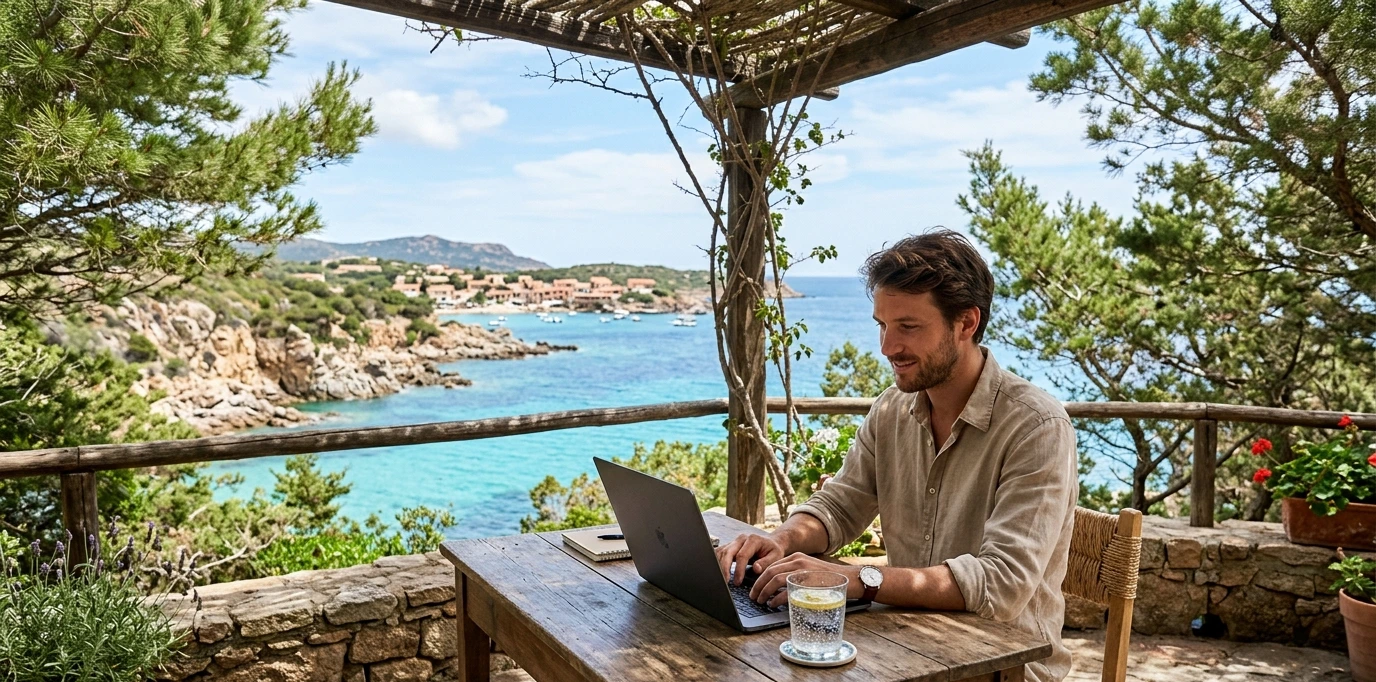
Working in Sardinia means enjoying an exceptional living environment while operating within a local economy in the midst of transformation, driven by tourism, services, craftsmanship and sustainable innovation.
The Sardinian economy rests primarily on tourism, the backbone of employment, particularly in hotels, restaurants, travel agencies, beach clubs and water sports. Cities such as Cagliari, Olbia, Alghero and Oristano concentrate most of the available positions, with a seasonal peak between May and September.
The island also has a diversified economic base: agri-food (olive oil, wine, cheese, seafood products); local crafts (textiles, ceramics, leather, traditional jewellery); renewable energy, a rapidly expanding sector; and digital technology, supported by innovation hubs in Cagliari and Sassari.
Average earnings sit slightly below the national average: an employed worker earns between €1,300 and €1,700 net per month, while qualified professionals (engineers, web developers, hotel managers, architects) can reach €2,500 to €3,000 net, depending on sector and experience. Bilingual profiles are highly sought after in tourism, international trade and expat services, where the international client base is growing steadily.
Healthcare and services in Sardinia
Sardinia offers a reliable and accessible healthcare system, able to meet the needs of both residents and new arrivals. The island has modern hospital facilities spread across the whole territory. The main hospitals are located in Cagliari, Sassari, Nuoro and Oristano, recognised for the quality of their services in cardiology, oncology, surgery, emergency medicine and paediatrics.
In Cagliari, the university hospital complex coordinates a wide range of specialist services and hosts medical research centres. Alongside these, a dense network of local health centres (ASL) and private practices provides accessible day-to-day care, with waiting times that are often shorter than in Italy’s major metropolitan areas.
In terms of infrastructure, Sardinia benefits from modern and well-maintained facilities. The international airports of Cagliari, Olbia and Alghero provide regular connections to the UK, Ireland and much of Europe. Before your move, take the time to consult our guide on insurance in Italy to make sure your health cover and home insurance are properly arranged from the outset.
The international community in Sardinia
In 2025, Sardinia is attracting a growing number of international residents, drawn by its Mediterranean climate, quality of life and outstanding landscapes. According to data from Tuttitalia, the permanent foreign community in the region numbers several hundred residents, spread across major cities such as Cagliari, Sassari and Olbia, as well as quieter coastal areas like Alghero and Oristano.
In Cagliari, the regional capital, the expat community is particularly active. You will find international schools and cultural associations that foster exchanges between expats and Italians. Profiles vary widely: freelancers, entrepreneurs, families and retirees who have come in search of a balance between sunshine, sea and a slower pace of life.
In the north of the island, Alghero draws many foreigners for its Catalan character, colourful streets and proximity to the sea. Olbia and the Costa Smeralda attract an international crowd, particularly in the fields of tourism, hospitality and luxury services. Inland, villages such as Bosa, Sanluri and Gavoi appeal to those seeking peace, authenticity and nature, often remote workers or retirees keen to integrate into local life.
Settling in Sardinia means choosing a welcoming island where modernity and tradition sit comfortably side by side. With an expanding expat community, a reasonable cost of living and a unique natural setting, Sardinia has become one of the most attractive destinations in southern Italy for those looking to live, invest or work remotely while enjoying the Mediterranean dolce vita. To round out your plans, take a look at our complete guide on living in Italy as an expat.
Frequently asked questions about living in Sardinia
Do you need to speak Italian to live in Sardinia?
Yes, particularly outside tourist areas. In cities such as Cagliari, Olbia and Alghero, you can manage in English for everyday transactions, but speaking Italian makes all administrative processes considerably easier and helps you integrate into local life. A B1 level is generally sufficient for daily needs.
What does it cost to live in Sardinia?
The cost of living in Sardinia is lower than in northern Italy and noticeably more affordable than many Western European capitals. In Cagliari, budget between €1,400 and €1,800 per month for a single person, including rent. In Alghero or medium-sized cities like Sassari or Oristano, that figure drops to around €1,200. Local produce is high quality and good value.
How do you find accommodation in Sardinia?
Finding a year-round rental can be difficult, especially near the coast where seasonal lets dominate. It is better to search out of season (October to March) and use platforms such as Immobiliare.it or Idealista.it. The standard contract is a “4+4” arrangement, with six months’ notice required. A security deposit of two to three months’ rent is typically expected.
What are the advantages of Sardinia for expats?
Sardinia offers an exceptional quality of life: a mild climate, unspoilt nature, safety and Mediterranean hospitality. Well connected to the rest of Europe by regular flights, it attracts retirees, remote workers and families in search of tranquillity. The 7% flat tax is a significant fiscal benefit for those who settle in an eligible municipality.
Can you retire to Sardinia as a foreign national?
Absolutely. Retiring to Sardinia as an EU citizen is not only possible but often highly advantageous. EU nationals can settle freely in Italy by registering their residence at the local town hall. The 7% flat tax on foreign-source income — including overseas pensions — allows you to significantly reduce your tax burden for nine years, provided you establish yourself in a municipality of fewer than 30,000 inhabitants. The quality of healthcare, affordable cost of living and growing expat community make Sardinia one of the most popular destinations in Italy for retirees from across Europe.