Open a Bank Account in Italy as a Foreigner: What Actually Works
Opening a bank account in Italy is essential for foreigners working or buying property, but the process can be challenging and requires specific documents.


Planning to work in Italy, or thinking about buying property there? In either case, opening a bank account with an Italian IBAN is not just a convenience — it is a practical necessity, and in some situations a legal requirement.The reality on the ground is often discouraging: Italian banks frequently refuse non-residents, solutions like Revolut or Wise do not work for every situation, and opening an account remotely is in practice impossible for foreigners. This article explains honestly how the system works, what you can do on your own, and where we can step in to help.
Aller en Italie
Relocation experts · since 2020
4.9
How many steps separate you from Italy?
A tailored offer based on your needs — in 3 min, no commitment
Tell us about your project
Profile, area, buying or renting
We select your services
From 50+ services in English
Receive your quote
Clear, detailed, personalized
*Indicative and customizable quote, no contractual commitment.
Free · 3 min · in English · no commitment
Create my offerWhy is an Italian IBAN indispensable?
A foreign bank account or a European neo-bank does not cover every situation in Italy. There are two cases where an Italian IBAN is either mandatory or strongly advisable.
To receive a salary: it is mandatory
In Italy, employers pay salaries exclusively into accounts with an Italian IBAN. This is not a preference — it is an administrative reality you cannot work around. A foreign IBAN will simply be rejected by your employer’s payroll department. The same applies to social security payments from the INPS and tax refunds processed through the 730 form.
To buy property: it is strongly advisable
Legally, a foreign IBAN can be sufficient to complete a property purchase in Italy. In practice, if you do not have an Italian bank account, the notaio is required to route the funds through an escrow account (conto deposito) that he manages himself. This service comes at an additional cost of around €700, payable by you.
Having an Italian IBAN lets you avoid that expense, simplifies transfers with the estate agency, and makes it easier to manage ongoing costs after the purchase (IMU, condominium fees, utilities).
In short: if you are working in Italy, an Italian IBAN is mandatory. If you are buying property, it saves you around €700 in notarial fees and considerably simplifies your administrative life.
THEY TALK ABOUT US
Maisons & Jardins · Le Figaro · Challenges
« Founded on solid field experience and an in-depth knowledge of Italian procedures. »
Jessica Colpin, co-founder — Maisons & Jardins France, Jan.–Feb. 2026
Documents required to open an account
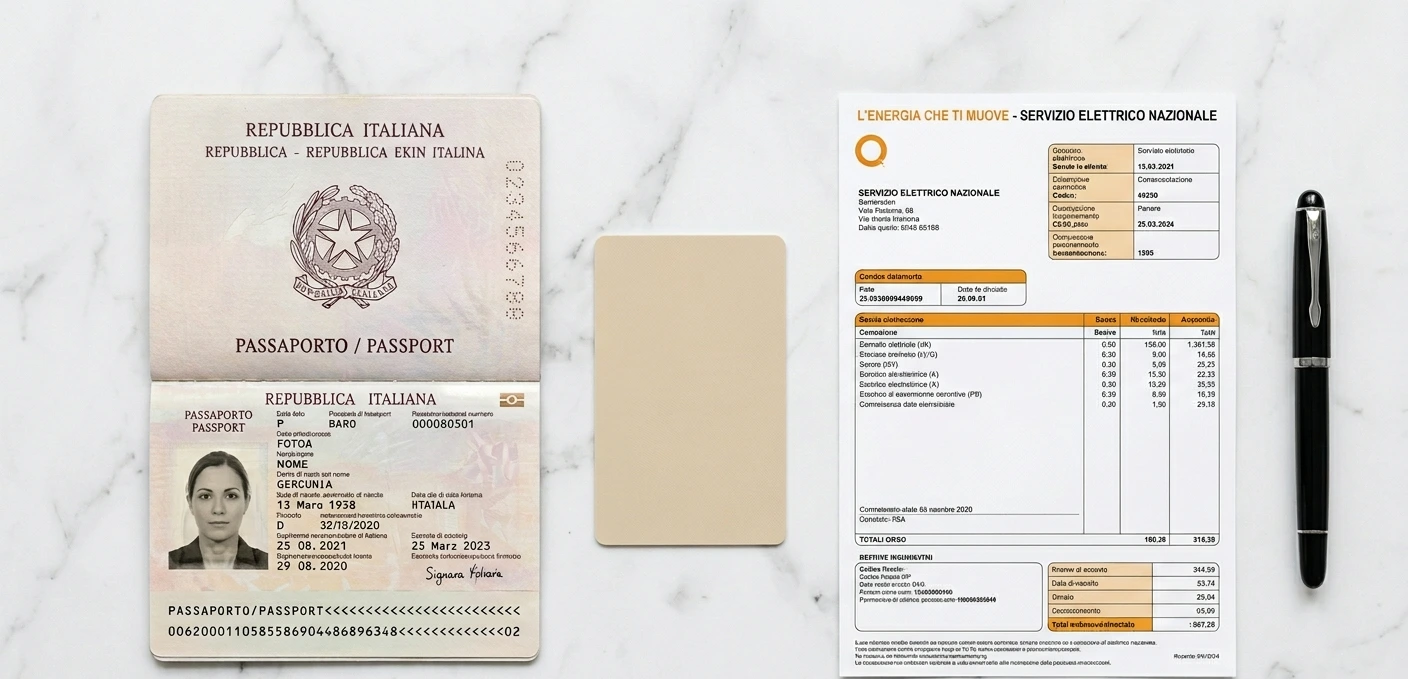
Regardless of which bank you choose, the core documents are the same. Prepare them in advance — arriving at a branch with an incomplete file means booking a second appointment.
Mandatory documents
Valid photo ID (passport or national ID card)
The Codice Fiscale — the Italian tax identification number, absolutely required and the first thing to obtain
Proof of address dated within the last 3 months (from Italy or your home country)
An active phone number, preferably an Italian one
Additional documents depending on your situation
Employment contract or job offer letter (for employees)
Company registration documents or translated articles of association (for self-employed and freelancers)
Preliminary sale agreement (compromesso) or notarial deed (for property buyers — reassures the bank about your plans)
Certificate of residence (certificato di residenza) if you are already registered with the Anagrafe
Get your Codice Fiscale first: without it, no Italian bank can open an account for you. You can obtain it free of charge from the Agenzia delle Entrate, at an Italian consulate in your home country, or online. In person, it is issued within 24 to 48 hours.
Aller en Italie
French expatriation expert · since 2020
4.9
71 verified reviews
1,500+ expats supported
50+ services with French-speaking professionals
20 regions covered
Local consultants on the ground in Italy
Free appointment · 15 min · in French · no commitment
Book an appointmentWhat actually works: neo-banks, Italian banks, and the reality on the ground
The topic of Italian bank accounts is often treated too optimistically online. Here is what we genuinely observe on the ground, and what we recommend to our readers.
Wise: a foreign IBAN, not always accepted
Wise is an excellent solution for international transfers and currency payments. However, the Wise account provides a Belgian (BE) or other non-Italian IBAN. Most Italian employers and public bodies refuse foreign IBANs for salary payments and administrative direct debits. Wise remains useful for managing transfers between countries, but it does not replace a genuine local account.
Revolut: Italian residency is required
Revolut requires you to be resident in Italy to open an account with an Italian (IT) IBAN. If you do not yet have a tessera sanitaria, you will not be eligible. For non-residents, Revolut provides a foreign IBAN, which creates the same problems as Wise.
Traditional Italian banks: often closed to non-residents
Intesa Sanpaolo, UniCredit, BancoBPM and most major Italian banks apply a strict policy towards non-residents. In practice, branch advisors frequently refuse applications, even though European law theoretically guarantees this right. The reasons given vary: no Italian address, a “higher-risk” profile, administrative complexity.
Opening an account online: not realistic for foreigners
Opening an Italian bank account online is not a realistic option for foreign nationals. The remote identity verification processes (KYC) used by Italian banks are designed for people already registered in Italian administrative systems. For non-residents, a physical visit to a branch is mandatory. Plan a trip to Italy specifically for this purpose.
What we see consistently: most readers who try to open an account on their own run into refusals or spend months getting nowhere. The main obstacle is not the law — it is having the right human contacts.
The account-opening process, step by step

If you want to go through the process yourself, here is the most effective approach:
Get your Codice Fiscale. This is the very first step, and you can do it before you arrive in Italy. Visit the nearest Italian consulate in your home country or apply online through the Agenzia delle Entrate website. It is free and issued within 24 to 48 hours in person.
Find a branch that is open to non-residents. Avoid walking into a large city-centre branch without an appointment. Neighbourhood branches or local cooperative banks (Banche di Credito Cooperativo) are often more flexible. Call ahead to check their policy before making the trip — this step is not optional.
Put together a solid file. The more complete your documentation, the better your chances. Bring all the documents listed above, along with a short cover letter explaining your plans in Italy (employment, property purchase, retirement). If you are buying property, a signed compromesso is a strong supporting document.
Go to the branch in person. There is no way around this. Book an appointment on a weekday, outside the lunch break (branches often close from 12:30 to 14:00). Present yourself as an EU citizen looking to open an account in connection with a project in Italy.
Sign the contract and wait for your IBAN. Once your file is approved, you will sign a contratto di conto corrente. Your IBAN will be issued within 5 to 10 business days. The bank card arrives by post within a further 10 to 15 days.
Banking fees: what to expect
Italian banks tend to charge higher fees than banks in many other countries. Here are the main costs to be aware of before committing:
Fee type | Typical range | Notes |
|---|---|---|
Account maintenance fee | €5 to €12/month | Often reduced or waived with salary direct debit |
Imposta di bollo | €34.20/year | Mandatory government tax if average balance exceeds €5,000 |
Debit card (Bancomat) | €10 to €25/year | Often included in packaged account offers |
Credit card | €30 to €80/year | Generally separate from the current account |
Incoming SEPA transfer | €0 to €2 | Free at most modern banks |
Out-of-network ATM withdrawal | €1.50 to €3 | Free within the bank’s own ATM network |
Good to know: some banks offer free accounts for customers under 30 or 35 (conto giovani). If you fall in that age range, ask specifically about this option when you visit the branch.
Struggling to open an account? We can help
We know from experience that trying to open an Italian bank account on your own as a foreigner can quickly become an exhausting process. Refusals are common, delays can stretch on for weeks, and making a trip to Italy with no guarantee of success is genuinely frustrating.
That is why we have built a network of banking contacts in Italy — advisors who understand the specific situation of foreign applicants and who regularly help international clients through this process.

Conclusion
Opening a bank account with an Italian IBAN is an unavoidable step as soon as you have a serious project in Italy, whether that means working there or investing in property. It is not an optional formality: it is a condition for receiving your salary and a concrete saving of around €700 when purchasing real estate.
The ground reality is clear: fully online solutions do not work for foreigners, Revolut requires Italian residency, Wise does not provide a valid Italian IBAN, and traditional banks regularly turn away non-residents without the right intermediary. A physical visit to a branch is non-negotiable.
The first concrete step to take today: get your Codice Fiscale. It is free, and it is the gateway to every administrative process in Italy. Then get in touch with us so we can help you open your account.
FAQ
Is an Italian IBAN mandatory to work in Italy?
Yes. In Italy, employers pay salaries exclusively into Italian IBANs. A foreign IBAN or a neo-bank account without an Italian IBAN (Wise, non-IT N26, etc.) will not be accepted for salary payments. The same applies to INPS social security payments and benefit transfers, which all require a local account.
Is an Italian bank account useful when buying property in Italy?
It is not legally required, but it is strongly advisable. Without an Italian IBAN, the notaio is required to route funds through an escrow account he administers, which generates an additional cost of around €700. A local account eliminates that expense and simplifies the management of ongoing costs after the purchase.
Can a non-resident open a bank account in Italy?
Yes, but it is difficult to do alone. Italian banks frequently refuse non-residents, Revolut requires Italian residency, and accounts like Wise do not provide a valid Italian IBAN. A physical visit to a branch is mandatory — no Italian bank will process a foreign applicant’s file entirely remotely. We have banking contacts who regularly assist international clients through this process, so feel free to reach out.
Is the Codice Fiscale mandatory to open an account in Italy?
Absolutely. Without a Codice Fiscale, no Italian bank can open an account for you — it is a legal requirement. You can obtain it free of charge from the Agenzia delle Entrate, at an Italian consulate in your home country, or online through the official Italian government website.