Mandatory Bidet in Italy: Law, Standards & Real Estate Impact
The bidet has been mandatory in Italy since 1975. Learn about the law, bathroom regulations, and what this means when buying or renting a property.

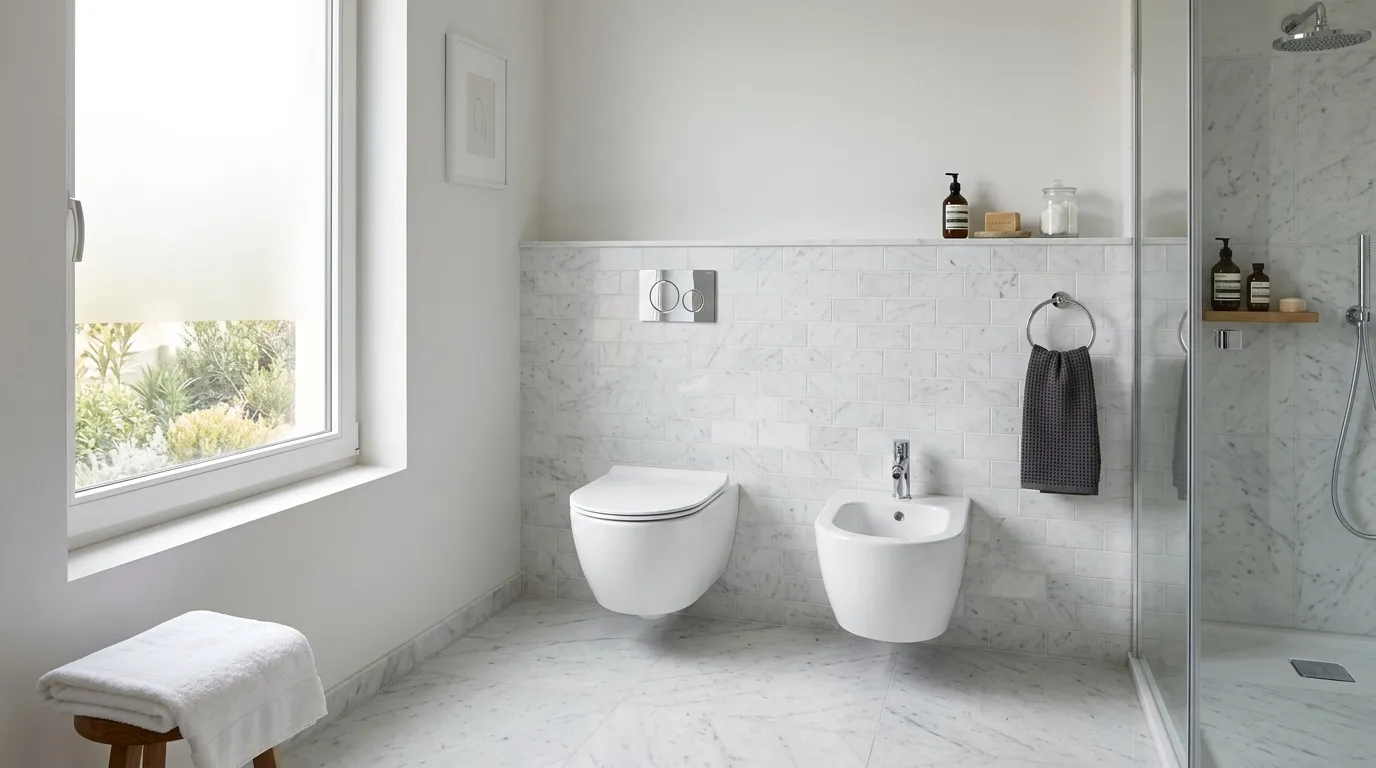
"The bidet? We'll remove it — that'll give us a bigger bathroom." This is one of the phrases we hear most often when our clients visit their future home in Italy. The intention is understandable: most people outside Italy don't use a bidet daily, and the extra space seems like an obvious gain. Yet this seemingly innocent remark conceals a legal reality that many foreign buyers discover too late: in Italy, the bidet is required by law in residential properties since 1975, on the same footing as the toilet or the washbasin. Removing it without due care, or purchasing a property that doesn't have one, can turn a minor comfort preference into a serious compliance issue — with real consequences at the notary, at resale, and even for rental.
Aller en Italie
Relocation experts · since 2020
4.9
How many steps separate you from Italy?
A tailored offer based on your needs — in 3 min, no commitment
Tell us about your project
Profile, area, buying or renting
We select your services
From 50+ services in English
Receive your quote
Clear, detailed, personalized
*Indicative and customizable quote, no contractual commitment.
Free · 3 min · in English · no commitment
Create my offer"The bidet isn't mandatory" — the misconception that comes at a price
Let's start with the question that comes up most often in our advisory work: many of our clients arrive in Italy convinced that the bidet is optional equipment — a simple comfort choice they can freely remove once they become owners. This is a perfectly natural assumption — it is the norm in many countries — but it does not reflect Italian regulatory reality.
In Italy, the bidet is not a preference: it is a legal obligation enshrined in the minimum habitability standards for residential properties. Confusing the two can lead to two costly mistakes: unknowingly purchasing a non-compliant property, or removing the bidet during a renovation and inadvertently making your own home non-compliant. In both cases, the problem often surfaces at the worst possible moment — during a resale, a rental process, or a technical inspection. Our advisory role is precisely to help you avoid this trap by clarifying, from the very first viewing, what the law actually says.
THEY TALK ABOUT US
Maisons & Jardins · Le Figaro · Challenges
« Built on solid hands-on experience and an in-depth knowledge of Italian procedures. »
Jessica Colpin, co-founder — Maisons & Jardins France, Jan.–Feb. 2026
The bidet law in Italy: the Ministerial Decree of 5 July 1975
The legal reference on which everything rests is Article 7 of the Ministerial Decree of 5 July 1975 issued by the Ministry of Health (known in Italy as "DM Sanità 5/7/1975" or simply "DM 5 luglio 1975"). This text sets the minimum requirements that any residential property must meet regarding sanitary facilities in order to be declared agibile — that is, habitable and compliant.
Article 7 is explicit: for each dwelling, at least one bathroom must mandatorily include a toilet (vaso), a bidet, a washbasin, and a bathtub or shower. This requirement applies across the entire national territory. It is therefore not a recommendation or a local custom, but a national legal obligation in force since 1975.
This decree is supplemented by other regulatory texts, notably DM 236/1989 on accessibility for people with disabilities, as well as the regolamenti edilizi (building regulations) specific to each municipality. These texts may provide for adaptations or alternative solutions in certain specific cases, but they never override the fundamental obligation established by the DM 1975.
An important point for understanding the spirit of the law: from the moment the decree came into force, all new construction and all renovation work subject to a building permit had to include a bidet in at least one bathroom in order to obtain the habitability certificate (agibilità). This standard has therefore been in place for over fifty years. Very old properties built before 1975 that have never been renovated may be in a situation of non-compliance that has never been subject to systematic inspection — but as soon as a significant renovation (manutenzione straordinaria) is carried out, compliance becomes mandatory again.
Aller en Italie
French expatriation expert · since 2020
4.9
73 verified reviews
1,500+ expats supported
50+ services with French-speaking professionals
20 regions covered
Local consultants based in Italy
Free appointment · 15 min · in French · no commitment
Book an appointmentWhat the law actually requires: a compliant bathroom
This is where the subtlety most misunderstood by foreign buyers comes into play. Having a compliant bathroom in Italy does not mean that every bathroom in the property must be identical. What the DM 1975 requires is that at least one bathroom per dwelling — known as the bagno principale — be equipped with all four elements: toilet, bidet, washbasin, and bathtub or shower.
That said, a property can perfectly well have a second bathroom, the bagno di servizio, without a bidet and even without a bathtub or shower. This second bathroom only needs to include a toilet and a washbasin. This is why many Italian listings specify "2 bagni di cui 1 con bidet": the second bathroom is a service bathroom, fully compliant even without a bidet.
| Type of bathroom | Toilet | Bidet | Washbasin | Bathtub/Shower |
|---|---|---|---|---|
| Bagno principale (main bathroom — mandatory) | ✓ Yes | ✓ Yes | ✓ Yes | ✓ Yes |
| Bagno di servizio (second bathroom) | ✓ Yes | ✗ Not required | ✓ Yes | ✗ Not required |
This distinction changes everything when evaluating a property. A three-room apartment with two bathrooms, one of which has no bidet, is perfectly compliant. However, a property where no bathroom has a bidet does not meet the national minimum hygiene standards — regardless of its size or level of finish.
Can you remove the bidet? What owners actually risk
We now come to the question at the heart of this article: "Can I remove the bidet from my bathroom once I own the property?" The answer requires some nuance, but it is clear in principle.
As long as your property retains at least one fully compliant bathroom, you are free to arrange other bathrooms as you wish — removing the bidet, converting a second bathroom into a dressing room, and so on. However, removing the bidet from the only compliant bathroom in the property makes the dwelling non-compliant with DM 1975. This is not merely an aesthetic matter: you are changing the regulatory status of your property.
In practical terms, a property where no bathroom has a bidet may face several difficulties:
- An inconsistency with the agibilità: if the habitability certificate attests compliance with sanitary standards that the property no longer meets, the situation will need to be rectified.
- A potential obstacle at resale: the surveyor instructed by the buyer or their bank may flag the non-compliance and require remediation before the sale can proceed.
- Complications in the notarial deed (rogito), in which the seller gives warranties regarding the planning and sanitary compliance of the property.
Our advisory recommendation is straightforward: if the bidet bothers you in daily use, don't simply remove it. Replace it with a recognised equivalent solution (see the next section), which preserves the property's compliance while freeing up space. You gain the comfort you are looking for without compromising the value or saleability of your home.
Studios and small spaces: permitted alternatives
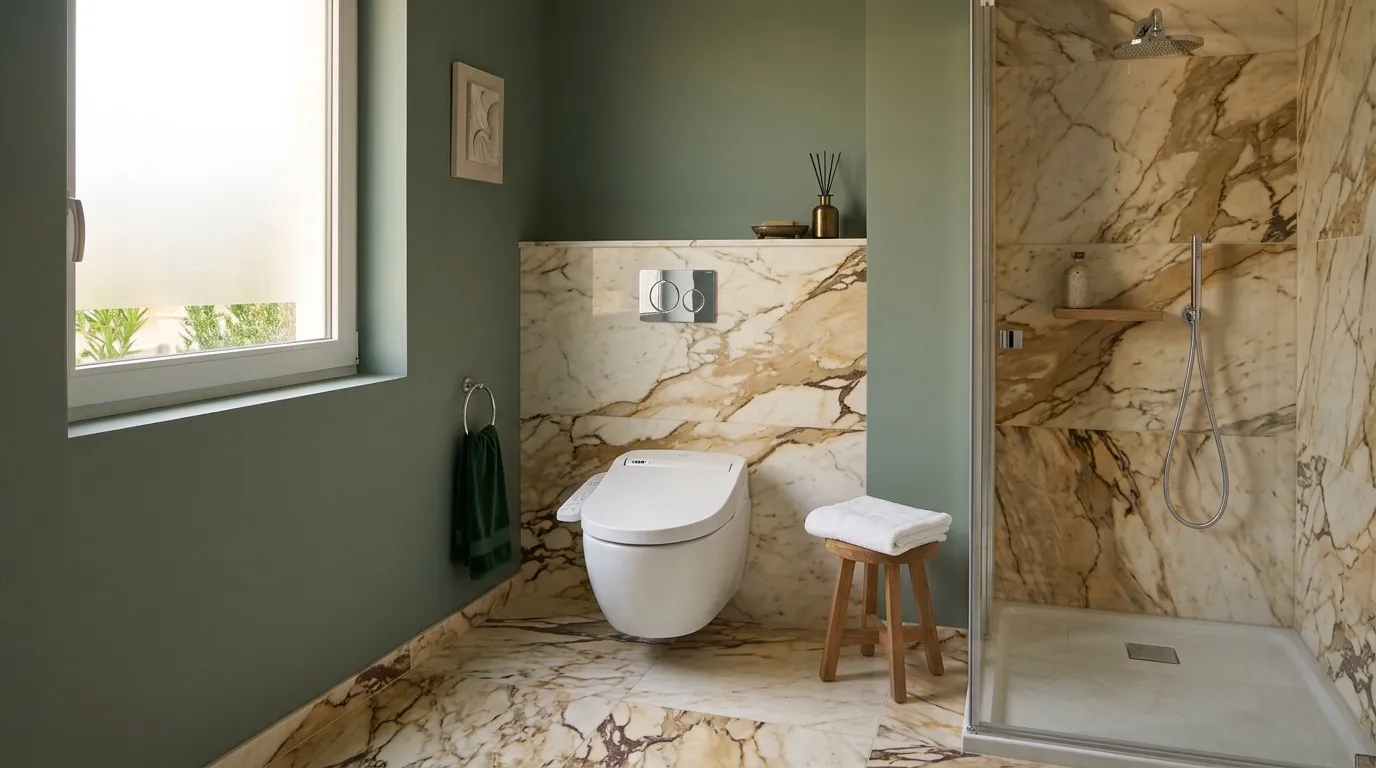
A common question concerns monolocali (studio apartments) and small properties. Does the rule apply in the same way to a 28 m² studio as to a 120 m² family apartment? In principle, yes: even in a studio, at least one bathroom must include a bidet. However, the regulations do provide for alternative solutions for very constrained spaces and for bathrooms adapted for people with reduced mobility (DM 236/1989).
The bidet may in these cases be replaced by an equivalent device, in particular:
- A combined WC-bidet (a toilet seat with an integrated spray, sometimes called a "washlet")
- A flexible wall-mounted spray hose installed next to the toilet
- Any other device providing equivalent intimate hygiene
These solutions do not represent a legal grey area but an official regulatory adaptation: they must be explicitly planned and documented as part of the works. This is exactly the approach we recommend to owners who wish to gain space without falling foul of the rules. The complete absence of a bidet or equivalent in a newly built or recently renovated studio remains a case of non-compliance.
Minimum clearance distances imposed by technical standards must also be respected: the bidet must be placed approximately 20 cm from the side wall, with 50 cm of clear space in front of it, and a centre-to-centre distance of approximately 15 to 20 cm between the toilet and the bidet. These dimensional constraints explain why small bathrooms often favour compact solutions.
Selling or renting a property without a bidet: the real risks
This is one of the most delicate situations we encounter when advising foreign buyers — and it concerns both sellers and future landlords alike.
At the point of sale, a property where no bathroom has a bidet may cause problems in relation to the attestazione di agibilità (habitability certificate), the compliance declarations the seller makes in the notarial deed, and in the event of a subsequent dispute if the buyer discovers the non-compliance after signing. In practice, such properties exist and do change hands, but their situation must be identified, documented, and factored into the price negotiation.
For rental, the same habitability rules apply. For a property to be legally offered as a residential rental, it must comply with the minimum standards of DM 1975, which includes the presence of a bidet (or an equivalent solution) in at least one bathroom. A landlord who lets a non-compliant property exposes themselves to challenges from the tenant, particularly in the event of a dispute over the condition of the property. The most prudent course of action, as an owner, is to ensure the property is a norma before putting it on the rental market.
Buying a property without a bidet: our advisory method
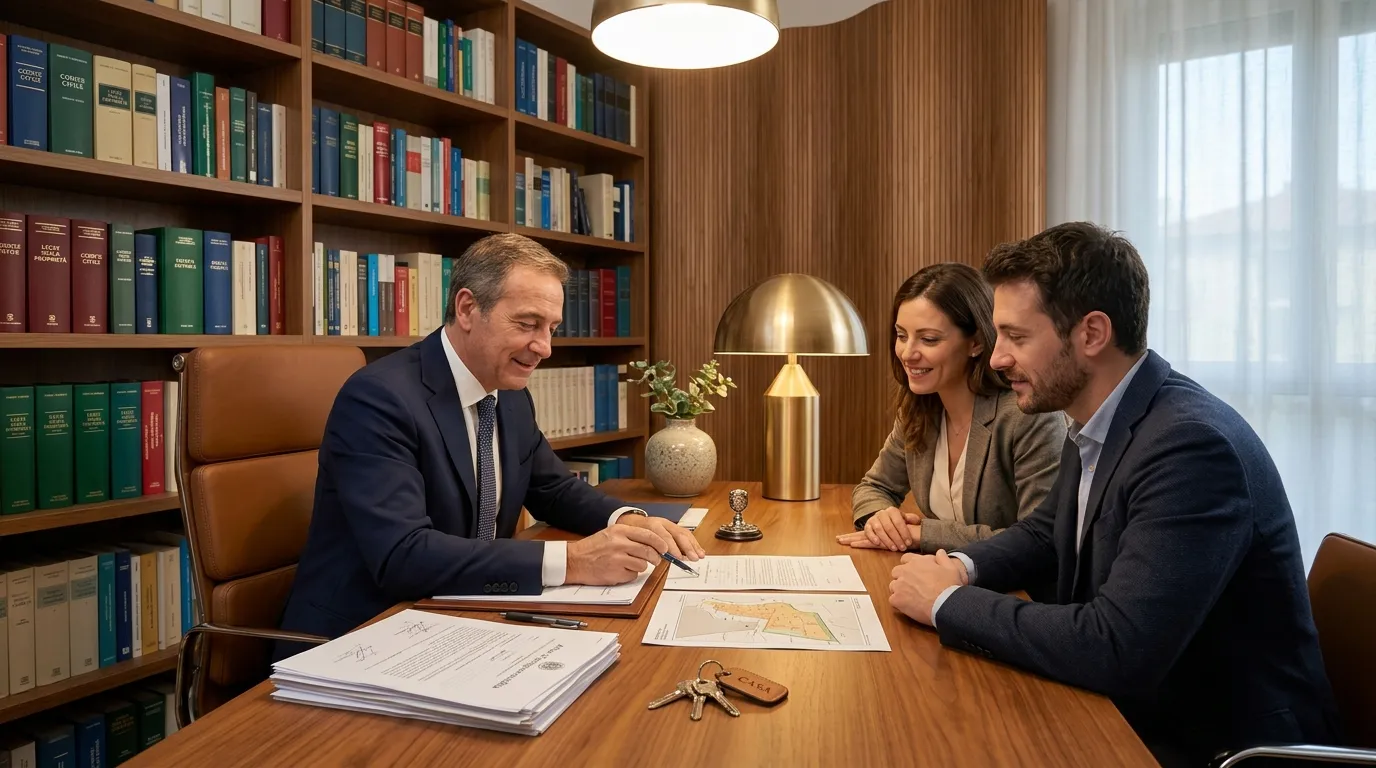
When one of our clients discovers that a property they are interested in has no bidet in the main bathroom, the first reaction is often concern. Let us reassure them straight away: in the vast majority of cases, this is a manageable situation — provided it is anticipated. Here is the approach we apply systematically.
- Bring in a technician before signing the preliminary contract: a surveyor (geometra), architect, or engineer assesses whether the bathroom can be brought into compliance and at what cost. Installing a standard bidet in an existing bathroom typically costs between €200 and €800, depending on the plumbing work required.
- Ask the notary to verify the agibilità: the notary checks whether the habitability certificate is in order and whether the non-compliance must be rectified before or after the sale.
- Negotiate the price accordingly: if remediation works are required, their cost should be factored into the negotiation.
- Plan the compliance works promptly: once you are the owner, carry out the works without delay so that the property is fully compliant — which protects its value and facilitates any future resale or rental.
We systematically recommend having the property's documents verified by a qualified professional, and consulting our guide on the steps to buying a house in Italy to understand exactly when these checks should take place in your purchasing process.
Summary: the compliant (a norma) bathroom in Italy
For a bathroom to be considered a norma (compliant) under DM 5/7/1975, it must satisfy both equipment requirements and dimensional standards. Here are the criteria applicable to the bagno principale:
| Criterion | Requirement |
|---|---|
| Toilet (vaso) | Mandatory |
| Bidet | Mandatory (or recognised equivalent solution) |
| Washbasin | Mandatory |
| Bathtub or shower | Mandatory with adequate protection |
| Distance: bidet to side wall | ≥ 20 cm |
| Clear space in front of bidet | ≥ 50 cm |
| Centre-to-centre distance: toilet to bidet | ≈ 15 to 20 cm |
| Bidet seat height | ≈ 40 to 45 cm |
| Toilet and bidet in the same room | Mandatory |
These standards apply to new construction and to renovations subject to a building permit. For older buildings that have not been renovated, the situation may be more complex — all the more reason to engage a qualified technician before any purchase. If you are planning to establish your primary residence in Italy, we also invite you to consult our article on tax residency in Italy and the relevant tax treaty.
Aucun produit
Conclusion
The key takeaway can be stated in one sentence: in Italy, the bidet is not a matter of personal taste — it is a legal obligation that determines whether your property is compliant and habitable. Assuming you can remove it without consequences is the most common mistake among foreign buyers, and one of the easiest to avoid. As long as at least one bathroom remains fully compliant, you retain complete freedom to arrange the rest of the property as you wish, and recognised equivalent solutions exist to save space without breaking the rules. Before any purchase, the single most important action is to have the agibilità and compliance of the property verified by a qualified technician and by the notary: this check, carried out at the right moment, turns a potential source of concern into a straightforward, manageable formality.
Frequently asked questions
Is the bidet really required by law in Italy?
Yes. Article 7 of the Ministerial Decree of 5 July 1975 (DM Sanità 5/7/1975) requires that at least one bathroom per dwelling be equipped with a toilet, a bidet, a washbasin, and a bathtub or shower. This is a national legal obligation in force since 1975, applicable to any residential property built or renovated under a building permit. Without a bidet in at least one bathroom, the property cannot be declared compliant with minimum hygiene standards or obtain the habitability certificate (agibilità).
Can you remove the bidet from a bathroom in Italy?
It depends. As long as the property retains at least one fully compliant bathroom (toilet, bidet, washbasin, and bathtub or shower), you are free to arrange other bathrooms as you wish and remove the bidet from them. However, removing the bidet from the only compliant bathroom in the property makes the dwelling non-compliant with DM 1975, with potential consequences for the agibilità, resale, and rental. The recommended solution is to replace it with a recognised equivalent (combined WC-bidet, wall-mounted spray hose) rather than removing it altogether.
Can you buy a house in Italy that has no bidet?
Technically yes, as some older or modified properties on the market are in this situation. However, such a property does not comply with national habitability standards (DM 5/7/1975). Before purchasing, it is strongly recommended to have the situation assessed by a qualified technician (surveyor, architect, or engineer) and to consult the notary regarding the status of the agibilità. The cost of bringing the property into compliance is generally between €200 and €800, depending on the plumbing work required.
Is a bidet required in order to rent out an apartment in Italy?
Yes. Habitability standards apply to rental properties as much as to properties for sale. For a dwelling to be legally let as a residential property, it must comply with the minimum standards of DM 5/7/1975, which includes the presence of a bidet in at least one bathroom. A landlord who lets a property where no bathroom has a bidet (or a recognised equivalent solution) would be exposed to legal challenges from the tenant.
Does a studio apartment (monolocale) also need to have a bidet?
In principle, yes: even in a studio, the regulations require that at least one bathroom include a bidet. However, for very small spaces or bathrooms adapted for people with reduced mobility, the law permits recognised equivalent solutions, such as a combined WC-bidet or a flexible wall-mounted spray hose. These solutions must be properly planned and documented. The complete absence of a bidet or equivalent in a newly built or recently renovated studio remains a case of non-compliance.
What alternatives to a traditional bidet are accepted under Italian regulations?
For properties where space is limited, or for bathrooms adapted for people with disabilities, the regulations (notably DM 236/1989) permit equivalent solutions: a combined WC-bidet (a toilet seat with an integrated spray, or "washlet"), a flexible wall-mounted spray hose installed next to the toilet, or any other device providing equivalent intimate hygiene. These alternatives must be explicitly documented as part of the works and must satisfy the functional requirements of DM 1975.