Unique Accommodation in Italy: Regulations, Permits & Agricultural Land
Glamping, tiny house, yurt, bubble tent: everything you need to know about regulations for unique accommodation in Italy and how to open on agricultural land.

Tree houses, transparent bubble domes, Mongolian yurts, tiny houses perched on Tuscan hillsides… Unique accommodation in Italy attracts a growing number of travellers each year who are seeking authentic experiences. But behind these poetic images lies a regulatory framework for unconventional accommodation in Italy that is complex, region-specific, and often far more demanding than people expect. As a property adviser specialising in international clients, I regularly work with project owners who believed they could simply install a bubble dome or a glamping site on an agricultural plot purchased at an attractive price — only to discover that thorough legal due diligence is essential before even signing a preliminary agreement. This guide gives you all the tools you need to understand, plan ahead, and successfully realise your project.
Aller en Italie
Relocation experts · since 2020
4.9
How many steps separate you from Italy?
A tailored offer based on your needs — in 3 min, no commitment
Tell us about your project
Profile, area, buying or renting
We select your services
From 50+ services in English
Receive your quote
Clear, detailed, personalized
*Indicative and customizable quote, no contractual commitment.
Free · 3 min · in English · no commitment
Create my offerUnderstanding the legal framework: no national category for "unique accommodation"
The first thing to understand is that Italy has no specific national law governing unconventional or unique accommodation as a distinct category. Yurts, bubble domes, tiny houses, and treehouses are all classified within existing categories based on their use:
- Strutture ricettive all'aria aperta (open-air accommodation structures): campsites, tourist villages, classic glamping.
- Agricampeggio / agriturismo: tourism activity carried out as a complement to a working farm.
- Residenza d'epoca or Affittacamere in certain specific situations.
Regulation is primarily governed by regional law: each Italian region (Tuscany, Umbria, Piedmont, Lazio, Trentino, etc.) issues its own legislation on rural tourism, open-air structures, and agritourism. In practice, this means that the rules applying to a bubble room in Umbria are not the same as those in Trentino-Alto Adige.
For those considering settling in these regions, our regional guides can help you better understand the local environment: living in Umbria or living in Trentino-Alto Adige will give you a concrete picture of daily life and the local regulatory landscape.
THEY TALK ABOUT US
Maisons & Jardins · Le Figaro · Challenges
« Built on solid hands-on experience and an in-depth knowledge of Italian procedures. »
Jessica Colpin, co-founder — Maisons & Jardins France, Jan.–Feb. 2026
Agricultural land in Italy: what you really need to know before buying
A terreno agricolo is classified for agricultural use by the local urban development plan. Its price per square metre is generally much lower than that of building land — sometimes 5 to 15 times cheaper depending on the region — which makes it attractive for tourism project developers. However, this classification comes with significant restrictions.
On agricultural land:
- Permitted constructions are primarily those directly linked to agricultural activity (barns, shelters, stables).
- Building residential or tourist accommodation is highly restricted and subject to compatibility with the local urban development plan (PRG/Piano Regolatore).
- Any conversion to residential or conventional tourist use requires an amendment to the urban development plan — a lengthy and uncertain process.
- Unauthorised new constructions expose the owner to fines, work stoppages, and forced demolition orders.
If you are looking to buy land in Italy for a glamping or unique accommodation project, you must systematically verify before signing: the land use designation, landscape protection constraints (vincoli), the feasibility of an agriturismo/agricampeggio project, and access to utilities (water, electricity, sewage).
Indicative map of Italian regions with strong potential for glamping and agritourism: Tuscany, Umbria, Piedmont, Veneto, Trentino — each region has its own regulations governing open-air structures and agricampeggio.Aller en Italie
French expatriation expert · since 2020
4.9
73 verified reviews
1,500+ expats supported
50+ services with French-speaking professionals
20 regions covered
Local consultants based in Italy
Free appointment · 15 min · in French · no commitment
Book an appointmentTiny house, yurt, bubble dome, treehouse: are they considered "buildings" under Italian law?
This is the question I am asked most frequently by international clients, and the answer often comes as a surprise. Under Italian law, a structure is considered a construction requiring a permit not based on whether it has foundations, but on its use and permanence.
Tiny houses in Italy
Even when mounted on wheels or built without concrete foundations, a tiny house intended for residential use or tourist accommodation is treated as a permanent building under Italian law. It requires a permesso di costruire or an equivalent construction permit. An informal installation on agricultural land — without authorisation — is illegal and can result in a fine and a demolition order.
Yurts in Italy
Inherently portable by design, yurts are classified as lightweight removable structures. However, if they are used on a stable basis to accommodate tourists, they fall under the category of accommodation structures subject to open-air facility regulations or the agricampeggio framework. Several regions impose limits on how long they may remain installed (for example, 180 days per year in some regions) and on the surface area per pitch.
Bubble rooms and transparent bubble domes
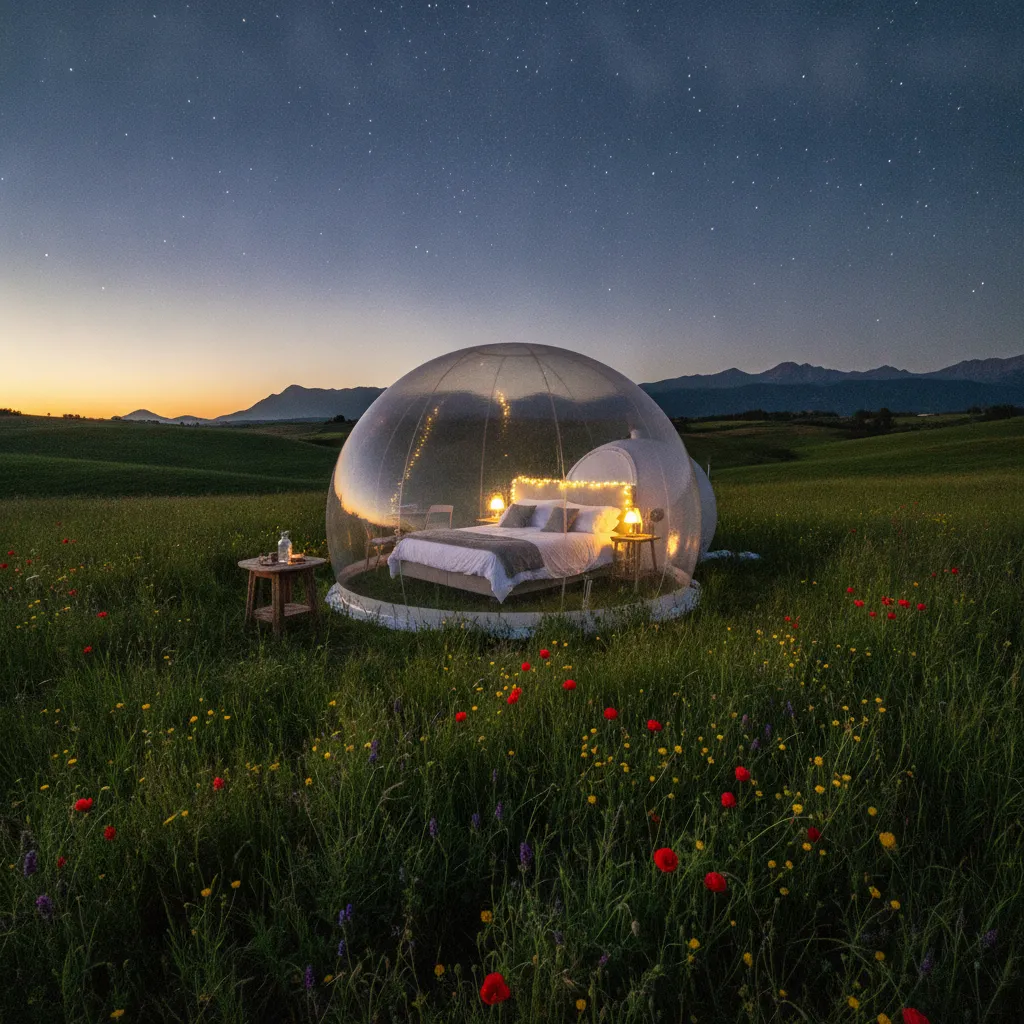
Transparent bubble rooms are growing in popularity across Italy, driven by their spectacular visual appeal. Whether inflatable or lightweight in structure, they are nonetheless treated as tourist accommodation structures (strutture turistico-ricettive) as soon as they regularly host paying guests. They must comply with:
- The land use designation of the site;
- Landscape protection rules (protected areas, Natura 2000);
- Health and sanitation standards: ventilation, water treatment, waste management;
- Safety requirements: access, evacuation routes, fire-resistant materials.
Based on available technical data, a bubble room installed on a glamping pitch represents an average investment of €15,000 to €35,000 depending on size and fittings, excluding any land development costs.
Treehouses in Italy
Elevated and compact in nature, treehouses are generally treated as open-air tourist structures or agritourism accommodation units. They require a construction permit, compliance with urban planning rules, and specific safety standards: railings, structural integrity, safe access routes, and protection of the supporting trees. Local authorities may impose additional requirements in forested or protected areas.
| Type of structure | Status under Italian law | Construction permit required? | Permitted on agricultural land? |
|---|---|---|---|
| Tiny house | Permanent construction | Yes | Only within agriturismo/agricampeggio framework |
| Yurt | Lightweight removable structure | Depends on duration and use | Agricampeggio only |
| Bubble room / bubble dome | Tourist accommodation structure | Simplified procedure or full permit | Agricampeggio/agriturismo only |
| Treehouse | Open-air tourist structure | Yes | Agriturismo only |
| Wooden house / chalet | Permanent construction | Yes (permesso di costruire) | Very limited, agriturismo framework only |
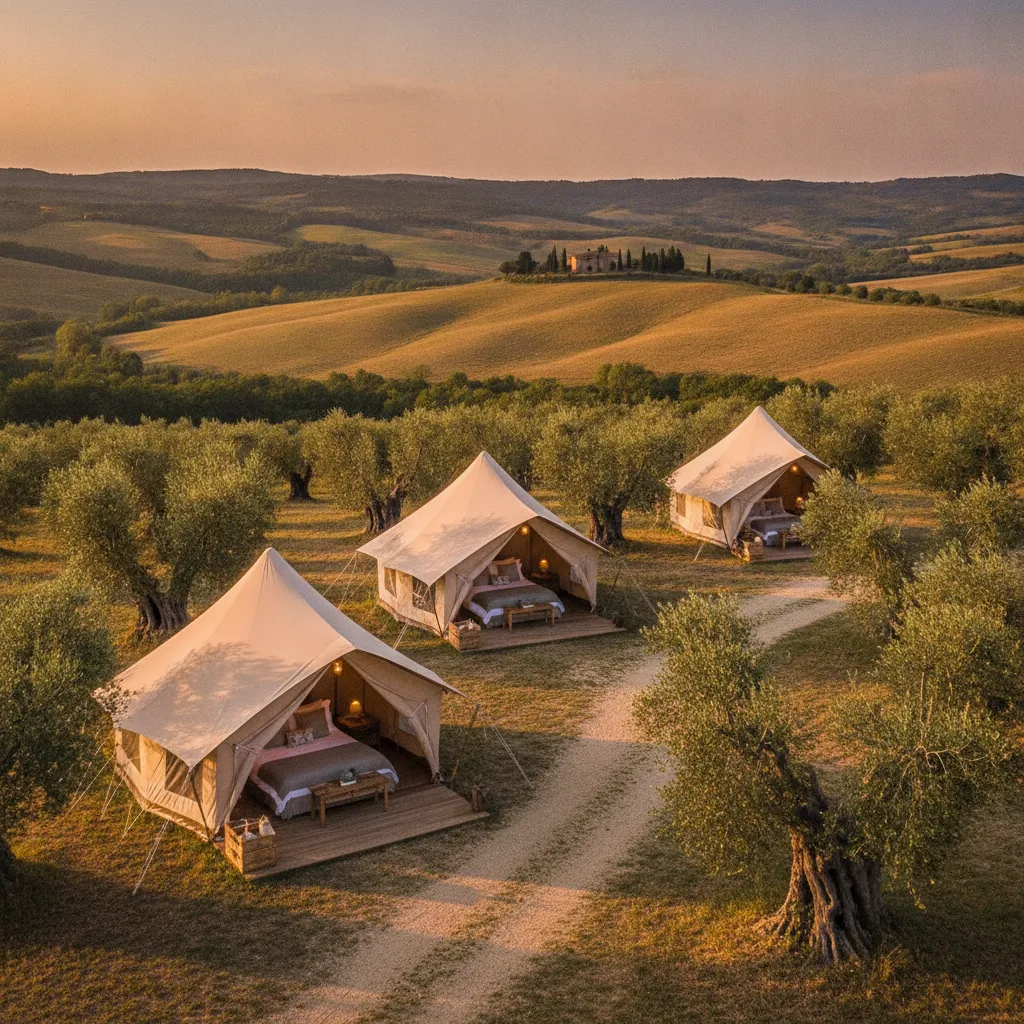
| Equipped glamping tent | Open-air structure | Depends on anchoring and surface area | Regulated agricampeggio |
Opening a glamping site in Italy: the agritourism/agricampeggio model
Glamping in Italy is one of the fastest-growing segments of experiential tourism: according to industry data, demand for this type of accommodation grew by over 30% between 2019 and 2024, driven largely by source markets such as France, Germany, and the Netherlands. Regions with exceptional natural landscapes — Tuscany, Umbria, Puglia, Veneto, and Trentino — account for the majority of supply.
To open a glamping site in Italy on agricultural land, the most accessible legal framework is that of the agricampeggio/agriturismo. This status allows a working farm to operate a complementary tourism activity — provided that:
- Farming remains the primary activity (in terms of income or working time, depending on the region);
- The tourist accommodation is ancillary to the farming operation;
- The land and the farm are officially registered with the regional authorities as an agriturismo establishment.
Caps vary by region. As a general indication:
| Region | Max. number of tents/pitches | Max. number of guests | Max. installation period |
|---|---|---|---|
| Tuscany | ~6 to 10 tents | ~30 people | Seasonal limits apply |
| Umbria | ~6 pitches | ~25 people | Removable structures only |
| Lazio | Varies by municipality | ~30 people max. | Municipal regulations apply |
| Piedmont | ~10 pitches | ~30 people | Up to 180 days per year |
Outside the agriturismo/agricampeggio framework, it is possible to open a conventional glamping site on land with a tourist or camping use designation. This model offers greater flexibility (larger capacity, no farming obligation) but requires that the land already holds such a designation, or that a change of use procedure has been successfully completed.
Required permits: a multi-step process
One of the most common misconceptions among international project developers is the belief that there is a single "glamping permit" to obtain. In reality, opening a unique accommodation in Italy requires a set of permits that must be obtained in sequence.
Step 1: urban planning verification and construction permit
First and foremost, you must verify the designated use of the land and obtain the appropriate construction permit:
- Permesso di costruire (full building permit) for fixed structures or those of significant size;
- SCIA edilizia (certified declaration of works) for certain lightweight structures;
- Landscape authorisation if the land falls within a protected area (Natura 2000, classified landscape zone, etc.).
Step 2: regional tourist qualification and authorisation
Once the structures have been approved, you must obtain the regional tourist qualification: registration as a struttura ricettiva all'aria aperta (campsite/glamping) or as an agriturismo/agricampeggio. Each region has its own classification criteria (minimum pitch size, sanitary facilities, services offered).
Step 3: filing the SCIA
The SCIA (Segnalazione Certificata di Inizio Attività) is submitted to the municipality's business desk (SUAP — Sportello Unico Attività Produttive). It is a certified declaration confirming that:
- All construction permits have been granted and the works completed;
- The activity complies with urban planning, health, and safety requirements;
- The declared accommodation capacity is in line with the permits obtained.
Important: the SCIA is not a building permit. It is filed after all other authorisations have been secured, and serves to formally initiate the economic activity. Without a valid SCIA, operating the accommodation is illegal — even if the structures are physically compliant.
Step 4: additional obligations
- Health clearance from the ASL (local health authority);
- Fire safety compliance where required;
- Obligation to report tourist arrivals and departures to regional and national authorities (ISTAT);
- Compliance with tax regulations: VAT, tourist tax, income tax on rental earnings.
For more detail on the tax aspects of your investment, see our guide on the Italy tax framework and fiscal residency.
Which permit applies to each type of unique accommodation?
This is the most practical question — and the most frequently misunderstood. Under Italian law, the permit required does not depend on the form of the structure (wheels, canvas, inflatable) but on two combined criteria: its actual permanence and its intended use. As soon as a structure stably accommodates tourists, it is treated as a building, regardless of how lightweight it may appear. There is a genuine "hierarchy" of planning permits (titoli edilizi), from lightest to most demanding:
- Edilizia libera (Art. 6 of DPR 380/2001): no permit required, but a simple notification to the municipality is needed. Reserved for structures that are genuinely temporary, removable, and actually taken down. Since the "Salva Casa" decree (DL 69/2024), the maximum installation period has been extended to 180 days (including assembly and dismantling). Note: temporariness is determined by actual use, not by form — a removable structure used continuously throughout an entire season no longer qualifies.
- CILA (Comunicazione Inizio Lavori Asseverata): for minor works or alterations that do not create new permanent volume.
- SCIA edilizia (Segnalazione Certificata di Inizio Attività): for lightweight structures with a stable character that do not qualify as heavy construction.
- Permesso di costruire (full building permit): mandatory for any permanent structure or one intended for stable accommodation, including those on wheels or without concrete foundations.
These planning permits are cumulative — they do not replace one another — and must be combined with a landscape authorisation (if the land is subject to a vincolo), the regional tourist qualification (agriturismo/agricampeggio or struttura ricettiva all'aria aperta), and the SCIA for business activity filed with the SUAP. The table below summarises, for each accommodation type, the planning permit required based on the intended use.
| Type of structure | Planning permit required | "Temporary structure" exception (≤ 180 days) | Additional tourist authorisation |
|---|---|---|---|
| Tiny house (stable residential/tourist accommodation) | Permesso di costruire — even on wheels and without foundations | No: stable tourist use excludes edilizia libera | Agriturismo / agricampeggio on agricultural land |
| Yurt | SCIA edilizia or permesso di costruire if installation is permanent (full season, utility connections) | Yes, if genuinely dismantled and removed: edilizia libera with notification to the municipality | Agricampeggio linked to an active farming operation |
| Bubble room / transparent bubble dome | SCIA edilizia if lightweight seasonal structure; permesso di costruire if permanently anchored and connected to utilities | Possible if seasonal, removable, and actually taken down | Agriturismo / agricampeggio or struttura ricettiva all'aria aperta |
| Treehouse | Permesso di costruire (fixed load-bearing elevated structure) | No | Agriturismo / struttura ricettiva all'aria aperta |
| Wooden house / chalet | Permesso di costruire | No | Agriturismo (heavily regulated on agricultural land) |
| Equipped glamping tent / lodge tent | CILA or SCIA edilizia if lightweight removable platform; permesso di costruire if fixed floor and permanent utility connections | Yes for genuinely removable seasonal tents | Regulated agricampeggio / struttura ricettiva all'aria aperta |
One issue comes up in nearly every case I handle: the lightest permit category (edilizia libera) is also the most legally fragile. It only holds if the structure is genuinely temporary and taken down within the permitted timeframe. An inspection finding a stable installation will reclassify the structure as an unauthorised construction — resulting in a fine and a remediation order. For a project operated throughout the season, it is therefore advisable to plan from the outset for a SCIA edilizia or permesso di costruire, and to have the classification validated by a local surveyor or architect before making any commitment. Since exact permit types and thresholds are set at regional and municipal level, the information above is provided as a general guide and does not substitute for verification with the relevant local authority.
Buying land for glamping: what to check before signing
In our experience, many international buyers fall in love with a plot of land during a trip to Umbria or Tuscany, quickly negotiate the price — often between €2 and €8 per square metre for agricultural land depending on the region and size — and only discover the regulatory constraints after signing. Here is the checklist I always recommend.
- Land use designation: is the land classified as agricultural, tourist, or mixed use? Is a realistic change of use genuinely possible?
- Agriturismo/agricampeggio compatibility: if the land is agricultural, is there an active farming operation that can serve as the legal basis for the activity? What is the minimum land area required by the region?
- Landscape and environmental constraints: is the land within a Natura 2000 area, a landscape protection zone, a flood zone, or a high-seismic-risk area? These constraints can significantly delay or block the permitting process.
- Access and utilities: is there year-round road access? Can the site be connected to mains water, electricity, and sewage? Utility connections can cost between €5,000 and €30,000 depending on the distance to existing infrastructure.
- Feasibility of construction permits: consult the municipality or a local professional (surveyor, architect) in advance to assess the feasibility and likely cost of the required permits.
- Realistic timelines: in Italy, obtaining a building permit can take 3 to 18 months depending on the municipality and the complexity of the project.
Our dedicated guide to buying land in Italy walks you through every step of the transaction, from document checks to signing with the notary.
Best regions in Italy for a glamping or unique accommodation project
Certain Italian regions have developed more favourable regulatory frameworks and benefit from strong tourist demand, making them particularly attractive for investors. Among the most suitable:
- Tuscany: Italy's historic leader in agritourism, with a mature regulatory framework and strong international demand. Agricultural land prices are higher (€3 to €15/m²).
- Umbria: well-preserved landscapes, accessible agriturismo regulations, more competitive land prices. See also buying a house in Umbria.
- Puglia: rapidly growing tourist market, masseria estates and olive grove valleys, regional regulations still evolving.
- Trentino-Alto Adige: premium destination, highly structured regulatory environment, ideal for nature and mountain glamping.
- Veneto and Friuli: well-established agritourism sector, solid tourist demand, good access to Central and Eastern European markets.
FAQ — Unique accommodation in Italy: regulations and permits
Can you install a tiny house on agricultural land in Italy?
Not freely. Under Italian law, a tiny house used for residential purposes or tourist accommodation is considered a permanent construction, even without foundations. It requires a building permit (permesso di costruire) and the land must be compatible with the intended use. On agricultural land, installation is only permitted within the framework of a recognised agrituristica or agricampeggio activity, subject to the limits set by the relevant region. A tiny house installed without authorisation is considered illegal and can result in fines and a demolition order.
Can you put a yurt on agricultural land in Italy?
A yurt is classified as a lightweight removable structure, but its stable use for tourist accommodation subjects it to the rules governing open-air accommodation structures or the agricampeggio framework. On agricultural land, a yurt is only permitted within an agricampeggio/agriturismo operation linked to an active farming business, with limits on the number of pitches, the number of guests, and sometimes the duration of installation (for example, up to 180 days per year in some regions). Without this framework and the corresponding authorisations, a yurt installed on a permanent basis on agricultural land is considered non-compliant with regulations.
What permits are needed to open a glamping site in Italy?
There is no single permit for glamping in Italy. Opening a glamping site requires a set of permits obtained in sequence: first, a construction permit (full building permit or simplified procedure depending on the structures), a landscape authorisation if the site is in a protected area, then a regional tourist qualification as a struttura ricettiva all'aria aperta or agriturismo/agricampeggio. Finally, a SCIA (Segnalazione Certificata di Inizio Attività) must be filed with the municipality's business desk (SUAP) to formally initiate the activity. Health clearance from the ASL and, where applicable, fire safety inspections also form part of the overall application.
How do you open a glamping site on agricultural land in Italy?
To open a glamping site on agricultural land, you must first operate within the legal framework of agriturismo or agricampeggio. This involves: having a recognised active farming operation, verifying the urban planning compatibility of the land, obtaining construction permits for all structures (tents, tiny houses, bubble domes, sanitary facilities), complying with regional limits on the number of pitches and accommodation capacity, and then filing the SCIA with the municipality. Farming must remain the primary activity of the operation. It is strongly advisable to engage a local surveyor or architect and a specialist lawyer from the due diligence stage.
Are bubble rooms (transparent bubble domes) permitted in Italy?
Yes, bubble rooms and transparent bubble domes are permitted in Italy, but they are subject to the same rules as any tourist accommodation. Although lightweight or inflatable, they are treated as tourist accommodation structures as soon as they regularly host paying guests. They must comply with the land use designation of the site, local landscape protection rules, health and sanitation standards (ventilation, water treatment), and safety requirements (fire-resistant materials, evacuation routes). On agricultural land, they may only be installed within a recognised agriturismo or agricampeggio framework. The average investment for a fully equipped bubble dome is between €15,000 and €35,000.
What is the SCIA and when must it be filed?
The SCIA (Segnalazione Certificata di Inizio Attività) is a certified declaration of commencement of activity, filed with the municipality's business desk (SUAP). It confirms that works have been completed in accordance with the permits granted, that the activity meets all urban planning, health, and safety requirements, and that the accommodation capacity is as authorised. For a glamping site or agriturismo accommodation, the SCIA is essential in order to operate legally. It is filed after the building permit and all other technical authorisations have been obtained — it is not a building permit itself, but the formal step that initiates the economic activity.