Building a Swimming Pool in Italy: Permits, Rules and Taxes
Permits, authorisations, land registry, IMU: everything you need to know to build a swimming pool in Italy legally.

You've just acquired a beautiful Italian property and you're dreaming of a pool in your garden? Or perhaps you're considering buying a house with a pool and want to make sure everything is in order? Building a pool in Italy is entirely achievable — but it requires navigating a precise regulatory framework that combines planning law, municipal permits, and tax obligations. As a specialist advisory firm for real estate and relocation in Italy, we support property owners on these matters every week: this guide explains everything step by step, with the practical information you need to move forward with confidence.
Aller en Italie
Relocation experts · since 2020
4.9
How many steps separate you from Italy?
A tailored offer based on your needs — in 3 min, no commitment
Tell us about your project
Profile, area, buying or renting
We select your services
From 50+ services in English
Receive your quote
Clear, detailed, personalized
*Indicative and customizable quote, no contractual commitment.
Free · 3 min · in English · no commitment
Create my offerIn-ground or above-ground pool: two very different regulatory frameworks
The first question to ask when planning to build a pool in Italy is: what type of pool? Under Italian law, the nature of the pool directly determines your administrative obligations.
The in-ground pool: a permanent structure
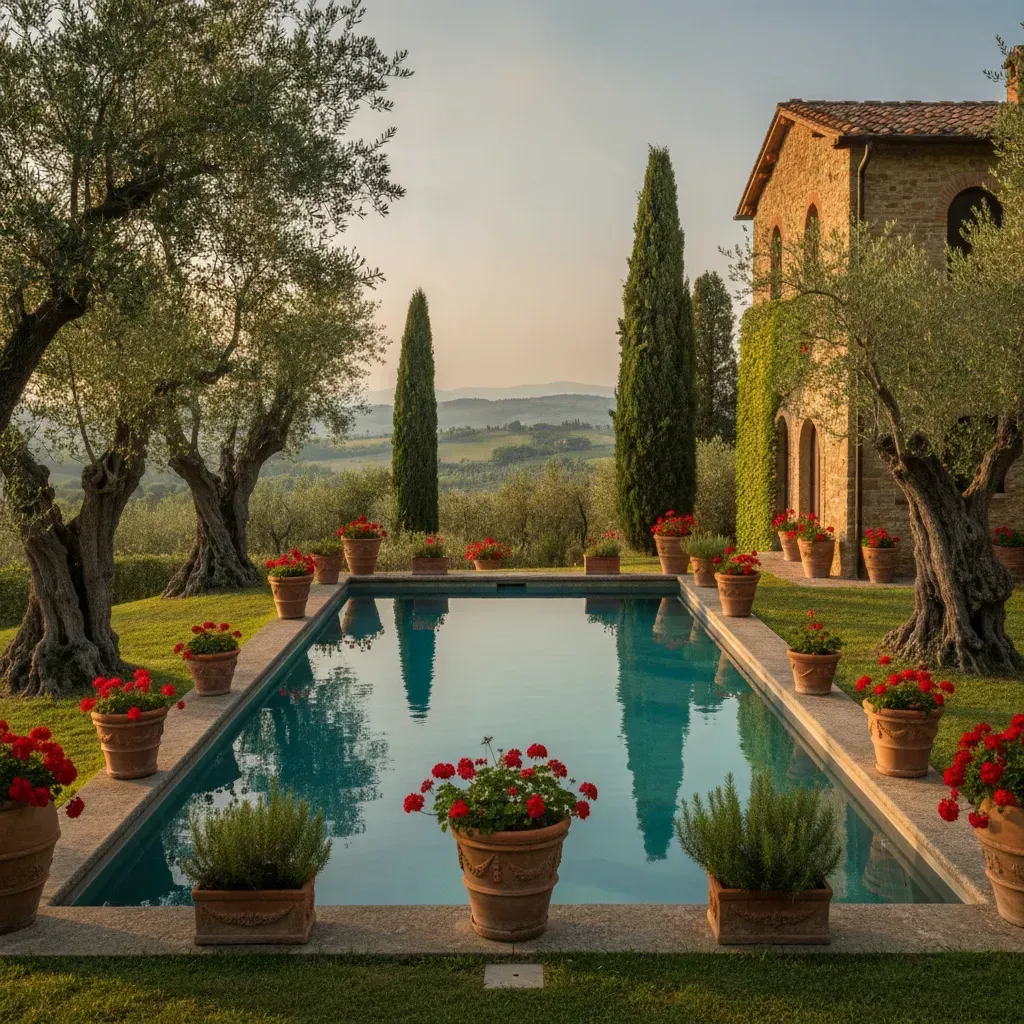
In Italy, an in-ground pool (piscina interrata) is legally treated as a nuova costruzione (new construction) or a pertinenza (ancillary structure) of the main dwelling. It permanently alters the land and creates a fixed structure. As such, it is governed by the DPR 380/2001 (Testo Unico dell'Edilizia), the reference legislation for construction law in Italy.
The Italian Council of State's case law is clear: an in-ground pool constitutes a building structure that requires, in the vast majority of cases, a Permesso di Costruire (building permit). In particular, as soon as the pool generates a volume exceeding 20% of the main building's volume — which is often the case — Article 3 of DPR 380/2001 classifies it as a new construction intervention.
In our experience working with international property buyers, some are surprised by this level of rigour. But rest assured: the process is well-defined, and a qualified professional (architect, engineer, or surveyor) — whom we help you identify and coordinate — will guide you through it effectively.
The above-ground pool: flexibility with conditions
A temporary above-ground pool (piscina fuori terra) — such as a tubular or self-supporting pool placed directly on the ground, easily dismantled and used only seasonally — generally falls under edilizia libera. In practice, this means no permit is required: no Permesso di Costruire, no SCIA, no notification to the local authority.
However, caution is warranted: as soon as an above-ground pool becomes permanent, rests on a concrete slab, has fixed technical installations (buried filtration, permanent lighting, a masonry equipment room), or remains in place year after year, the municipality may treat it as a building ancillary structure and require a SCIA (Segnalazione Certificata di Inizio Attività) or even a Permesso di Costruire. Some court rulings go so far as to hold that any pool, regardless of its configuration, requires municipal authorisation.
| Pool type | Permit required | Land registry declaration | IMU impact |
|---|---|---|---|
| In-ground (standard) | Permesso di Costruire | Mandatory (within 30 days of completion) | Yes — increase in rendita catastale |
| Semi-in-ground / fixed above-ground | SCIA or Permesso di Costruire | Likely | Yes if registered |
| Seasonal removable above-ground | None (edilizia libera) | Not required | No |
THEY TALK ABOUT US
Maisons & Jardins · Le Figaro · Challenges
« Built on solid hands-on experience and an in-depth knowledge of Italian procedures. »
Jessica Colpin, co-founder — Maisons & Jardins France, Jan.–Feb. 2026
The permit for building a pool in Italy: how does it work?
For the vast majority of in-ground pool projects, the main step is obtaining the Permesso di Costruire. Here is how the process works in practice.
Step 1 — Essential preliminary checks
Before engaging a pool contractor, you must first consult the Piano Regolatore Generale (PRG) and the building regulations (regolamento edilizio) of your municipality. These documents define:
- The zoning classification of your land (residential, agricultural, protected area, etc.)
- The remaining development capacity (indice di constructibilità)
- Minimum setback distances from property boundaries
- Any existing easements
- Whether a vincolo paesaggistico (landscape protection constraint) applies
This last point is crucial. If your property lies within a landscape-protected area — which is common in Tuscany, Umbria, around the lakes, or in coastal zones — you will need to obtain an autorizzazione paesaggistica in addition to the Permesso di Costruire. If this applies to you, we also recommend reading our guide on buying a house on Lake Garda, which covers the landscape constraints of these sought-after areas in detail.
Step 2 — Engaging a qualified professional
In Italy, only a qualified professional — an architect (architetto), engineer (ingegnere), or surveyor (geometra) — can sign and submit a building permit application. This professional will be your main point of contact and will prepare:
- The site plan and layout plan
- Cross-sections and technical drawings of the pool
- The volumetric calculation (in particular to verify whether the 20% threshold relative to the main building is exceeded)
- The water management and filtration system design
- The safety compliance report
Step 3 — Submission to the Sportello Unico per l'Edilizia (SUE)
The complete application is submitted to the Sportello Unico per l'Edilizia (SUE) of your municipality. You will also need to pay:
- Municipal processing fees
- Oneri di urbanizzazione (development contributions)
- The contributo sul costo di costruzione (construction cost contribution)
Processing times for a Permesso di Costruire vary by municipality — generally allow 60 to 90 days, and sometimes longer in high-demand areas. For a SCIA, works can begin as soon as the application is submitted (under the professional's responsibility), but the municipality has 30 days to raise any objections.
Special case: a pool on agricultural land
Building a pool on agricultural land in Italy is subject to particularly strict rules. In general, agricultural zones (zone E in the PRG) prohibit the construction of pools for purely residential use. Exceptions exist — notably for agriturismi (farm guesthouses) and tourist accommodation — but each case must be assessed against the specific local regulations. A qualified professional is absolutely essential in this situation.
Map of areas subject to vincolo paesaggistico in Italy — regions shown in light green (Tuscany, Umbria, lake areas, coastal zones) require a specific landscape authorisation in addition to the building permit for any in-ground pool.Aller en Italie
French expatriation expert · since 2020
4.9
73 verified reviews
1,500+ expats supported
50+ services with French-speaking professionals
20 regions covered
Local consultants based in Italy
Free appointment · 15 min · in French · no commitment
Book an appointmentLand registry declaration and tax implications: what every owner needs to know
Once the pool is built, your obligations do not end at the completion of works. Pools and the land registry in Italy are inseparable when it comes to permanent structures.
The accatastamento: mandatory within 30 days
For any in-ground or fixed pool, you are legally required to register it with the Catasto Edilizio Urbano (urban property register) within 30 days of the completion of works. This process, known as accatastamento, is carried out using the official DOCFA software of the Agenzia delle Entrate, and must be completed by a qualified technician.
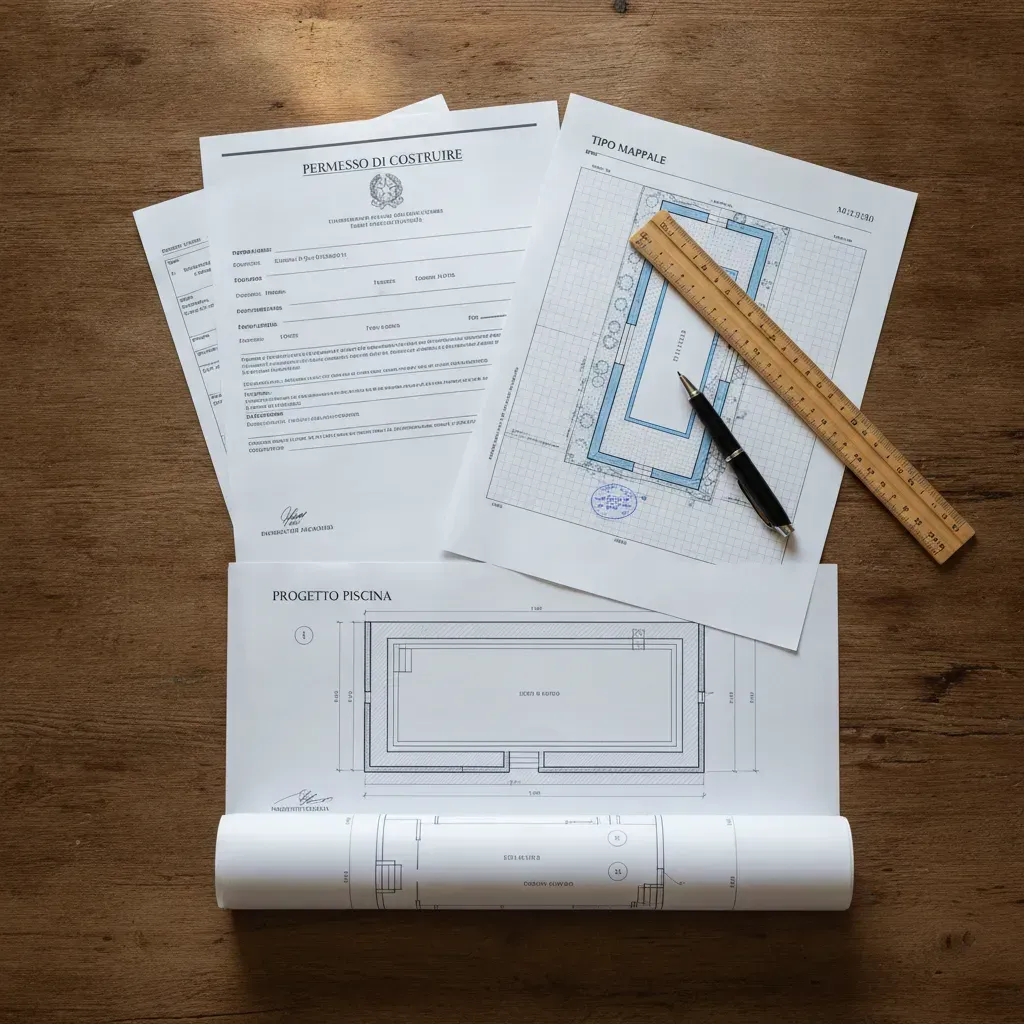
In practice, the pool is shown on the cadastral plan (tipo mappale) with a dotted outline, and registered as a pertinenza esclusiva (exclusive ancillary unit) of the residential property. Its surface area is recorded, which modifies the rendita catastale (cadastral rental value) of the property.
Pools and IMU in Italy: how much will your tax bill increase?
Pools and IMU in Italy are directly linked through the rendita catastale. IMU (Imposta Municipale Propria) is calculated on the basis of the rendita catastale multiplied by statutory coefficients. An in-ground pool increases this rendita, and therefore the annual IMU you will be required to pay.
In some cases, the presence of a pool — particularly a large one combined with other prestige features — may contribute to the property being classified as an immobile di lusso (luxury property), with a more burdensome tax regime. To fully understand Italian property taxation, we recommend consulting our comprehensive guide on IMU and property taxes in Italy.
| Pool type | Accatastamento | Deadline | Impact on rendita catastale | IMU impact |
|---|---|---|---|---|
| In-ground or semi-in-ground | Mandatory | 30 days after completion of works | Increase | Yes |
| Fixed above-ground with permanent installations | Likely | 30 days after completion of works | Partial increase | Yes if registered |
| Temporary removable above-ground | Not required | — | None | No |
What are the risks of an undeclared pool?
Failing to declare an in-ground pool is a serious mistake to avoid at all costs. The consequences can include:
- Administrative penalties for failure to complete the accatastamento
- A mandatory regularisation at the owner's expense (or the buyer's, if the issue comes to light after the sale)
- Retroactive payment of IMU for prior years, with penalties and interest
- Complications at resale: any serious buyer — and their notary — will systematically verify planning and cadastral compliance
We have assisted several families who discovered, when purchasing a house with a pool in Italy, that the pool had never been registered with the land registry. In these cases, we negotiated a price reduction to cover the regularisation costs, and the final deed had to be delayed by several weeks. It's far better to know about this before making an offer!
Buying a house with a pool in Italy: the essential checks
If you are buying a property that already has a pool, your due diligence covers two areas: administrative compliance (is the pool properly authorised?) and its actual technical condition (what will it cost you going forward?). Here is the checklist of points we systematically verify for our clients before any signing.
Administrative and land registry checks
- Planning title: ask to see the Permesso di Costruire or SCIA relating to the pool
- Landscape authorisation: if the property is in a protected area, verify that the autorizzazione paesaggistica was duly obtained
- Building compliance: does the pool as built correspond exactly to the approved plans? Any unauthorised modifications?
- Accatastamento: is the pool correctly registered in the land registry as a pertinenza?
- Updated cadastral plan: request the visura catastale and the current tipo mappale
- IMU: what is the current IMU amount? Does it reflect a rendita catastale that includes the pool?
Technical checks: what to look at in practice
A pool that "looks to be in good condition" during a summer visit can conceal costly repairs. We recommend examining the following, ideally with a pool technician:
- Structure and waterproofing: age and condition of the liner or shell, presence of cracks, concrete spalling, infiltration stains. A liner needs replacing every 10 to 15 years (budget €3,000 to €8,000 for a standard pool)
- Equipment room: condition of the filtration pump, filter (sand or cartridge), salt electrolysis or treatment system, and pipework
- Electrical compliance: earthing, dedicated RCD circuit breaker, low-voltage lighting — a safety point too often overlooked in older installations
- Safety equipment: fencing, alarm, cover, or roller shutter. Italy does not impose safety legislation as strict as some other countries for private pools, but these features remain essential — and become mandatory for tourist rental use (see below)
- Any heating system (heat pump, heat exchanger) and its operational condition
- Maintenance records and service certificate, if the seller can provide them
Finally, ask the seller for a realistic estimate of actual annual running costs (chemicals, electricity, technician): this is the item buyers most frequently underestimate, and we detail it in the next section. And if your plan is to offer the pool to guests in a B&B or holiday rental, check at the point of purchase that it can be brought into compliance for collective use.
Always have these elements verified by an independent geometra or architect before signing the preliminary contract. For more on the documents to request when buying property in Italy, see our guide on the documents to check before buying a house in Italy.
Cost of building a pool in Italy: what to expect
The cost of building a pool in Italy depends on many factors: pool type (shotcrete, polyester shell, steel), dimensions, features (heating, cover, LED lighting, roller shutter), site complexity, and region. Here are some indicative figures:
| Pool type | Typical dimensions | Estimated cost |
|---|---|---|
| Standard in-ground concrete pool | 8×4 m | €25,000 – €50,000 |
| In-ground polyester shell pool | 8×4 m | €20,000 – €35,000 |
| In-ground pool with premium features | 10×5 m | €50,000 – €100,000 |
| Fixed above-ground pool (steel) | 7×3.5 m | €5,000 – €15,000 |
| Seasonal tubular pool | Variable | €300 – €2,000 |
In addition to construction costs, you should budget for:
- Professional fees (permit application, project management): generally between €1,500 and €5,000 depending on complexity
- Municipal fees and construction contributions: vary by municipality and pool size, typically between €1,000 and €5,000
- Accatastamento costs (DOCFA procedure): approximately €500 to €1,500 in technical fees
- Annual IMU increase: a few hundred euros per year depending on location and cadastral value
Annual pool running costs in Italy: what to budget
Building or buying a pool is only the first step: it is the ongoing maintenance that weighs on your budget year after year. Many property owners discover too late just how significant this expense can be. Here, in complete transparency, is what you should expect for a standard in-ground pool (8×4 m) in Italy.
| Maintenance item | Details | Estimated annual cost |
|---|---|---|
| Treatment products | Chlorine or salt, pH corrector, algaecide, flocculant | €300 – €600 |
| Electricity (filtration) | Filtration pump running throughout the swimming season | €200 – €600 |
| Water (top-up and refilling) | Compensating for evaporation and partial draining | €100 – €300 |
| Opening / winterisation | Spring start-up and autumn closure by a technician | €300 – €800 |
| Maintenance contract | Regular technician visits, equipment checks (optional) | €500 – €1,500 |
| Heating (if heat pump) | Depending on season length and region | + €300 – €1,500 |
In practice, budget approximately €1,000 to €3,000 per year for a standard in-ground pool, and considerably more if the pool is large, heated, or fully managed by a service provider. On top of this, factor in periodic replacements: liner (every 10 to 15 years), pump (every 8 to 12 years), sand filter, robotic cleaner — occasional but sometimes significant expenses that it is wise to set money aside for.
Good to know: in Italy, water and electricity bills vary considerably from region to region, and the warmer climate in the south extends the swimming season (and therefore the filtration and treatment period). The same pool will cost more to run in Sicily than in Lombardy. We always factor in this operating budget in our financial assessments, particularly for rental investment projects.
Pool at a B&B or holiday rental: lifeguard requirements and health obligations
This is a point many owners discover too late, and one that can turn a commercial asset into a source of complications. As soon as your pool is made available to paying guests — B&B, agriturismo, seasonal rental such as an Airbnb with a pool "for guests' use" — it changes legal status. It is no longer a pool ad uso privato (private family use) but a pool ad uso collettivo (collective use), and falls under a much more demanding health and safety regime.
The framework: the Accordo Stato-Regioni of 16 January 2003
The reference text is the Accordo Stato-Regioni of 16 January 2003, which sets the hygiene and safety rules applicable to pools for collective use. One essential point to understand: this text establishes a national baseline, but its practical implementation is delegated to each region (Tuscany, Liguria, Puglia, Sicily, etc.), which adopts its own regional law (legge regionale) and regulations. The specific obligations — including whether a lifeguard is required — therefore vary from region to region, making local verification indispensable.
Is a lifeguard (assistente ai bagnanti) required for a B&B pool?
This is the question we are asked most often. The general rule is as follows: the presence of an assistente ai bagnanti (lifeguard, holder of a brevetto issued by FIN — Federazione Italiana Nuoto — or the Società Nazionale di Salvamento) may be required for pools in collective use, depending on the region, the pool surface area, and the visitor profile.
In practice:
- Large facilities and significant pools (hotels, campsites, holiday villages): a lifeguard is generally mandatory during pool opening hours.
- Small establishments (B&Bs, agriturismi, small rentals): several regional laws provide for exemptions or reduced requirements for small pools reserved exclusively for guests, provided that an internal set of rules is displayed, unsupervised swimming is prohibited, and certain surface area or depth thresholds are not exceeded. Other regions maintain the obligation regardless of context.
There is therefore no single answer that applies everywhere in Italy: it all depends on your region and the characteristics of the pool. This is precisely the type of verification we carry out in advance for clients developing an accommodation project.
Other health and safety obligations
Beyond the lifeguard question, operating a pool for collective use entails a range of obligations that we help you put in place:
- A responsabile della piscina: a designated person responsible for the technical and health management of the pool.
- Water quality monitoring: regular analyses (chlorine, pH, microbiological parameters) carried out at set intervals and recorded.
- A control register (registro): mandatory traceability of readings and treatments.
- Signage (cartellonistica): posting of pool depth, rules, safety instructions, and prohibited activities.
- Water treatment and renewal in accordance with regional standards.
- Public liability insurance appropriate for welcoming guests.
- Notification to the ASL (Azienda Sanitaria Locale), often as part of the SCIA for tourist activity.
Failure to comply with these obligations exposes you to administrative penalties, closure of the pool, and above all serious liability in the event of an accident. Our recommendation is clear: before listing "pool" in your B&B or rental advertisement, have your compliance validated with the municipality and the ASL in your region. We support clients through this process from start to finish.
Aucun produit
Can you build a pool without a permit in Italy?
The honest answer is: only for temporary, easily dismantled above-ground pools. A tubular or self-supporting pool, erected in spring and taken down in autumn, with no fixed installations on the ground, falls under edilizia libera. No permit, no SCIA, no land registry declaration.
However, any pool designed to remain in place permanently — even above ground — must be verified with your municipality. Certain court rulings hold that beyond a certain degree of permanence, even an above-ground pool requires authorisation. The prudent approach: if you have any doubt whatsoever, consult the SUE of your municipality or seek advice from a local geometra.
A typical scenario we encounter: a couple buys a villa in Tuscany and installs a 7×3.5 m steel above-ground pool on a concrete slab. Even though it is technically an above-ground pool, the permanent slab and fixed filtration installations mean the municipality can require a SCIA. It is always better to anticipate than to regularise!
FAQ — Building a pool in Italy
Is a building permit always required for a pool in Italy?
For an in-ground pool, yes: the Permesso di Costruire is generally mandatory, as the pool is treated as a permanent new construction under DPR 380/2001. For a temporary, easily dismantled above-ground pool, no permit is required (edilizia libera). Fixed or semi-in-ground above-ground pools may require a SCIA or a Permesso di Costruire, depending on the municipality and the size of the installation.
Does a pool need to be declared to the land registry in Italy?
Yes, any in-ground or fixed pool must be registered with the Catasto Edilizio Urbano within 30 days of the completion of works, via the DOCFA procedure carried out by a qualified technician. The pool is registered as a pertinenza (ancillary structure) of the main dwelling. Temporary, removable above-ground pools are not subject to this requirement.
Does a pool increase property taxes in Italy?
Yes, a registered in-ground or fixed pool increases the rendita catastale of your property, which results in a higher annual IMU (municipal property tax) bill. In some cases, if the pool is large and combined with other prestige features, the property may be reclassified as an immobile di lusso (luxury property), subject to an even heavier tax regime. Temporary, unregistered above-ground pools have no impact on IMU.
How much does it cost to maintain a pool in Italy each year?
For a standard in-ground pool (approximately 8×4 m), budget around €1,000 to €3,000 per year. This covers treatment products, filtration electricity, top-up water, opening and winterisation, and optionally a maintenance contract with a technician. Add heating costs if the pool is heated, as well as periodic replacements (liner every 10 to 15 years, pump every 8 to 12 years). Actual costs depend on pool size, region, and length of the swimming season.
Is a lifeguard required for a B&B pool in Italy?
It depends on your region and the size of the pool. As soon as a pool is made available to paying guests (B&B, agriturismo, holiday rental), it becomes a pool "for collective use" subject to the Accordo Stato-Regioni of 16 January 2003, implemented through each regional law. Large facilities generally need a qualified lifeguard (assistente ai bagnanti) on duty during pool hours. For small B&Bs, several regions allow exemptions for small pools reserved exclusively for guests, provided that internal rules are displayed and health standards are met. It is essential to verify the regulations in your specific region and to notify the local ASL.
What size pool can be built without a permit in Italy?
There is no fixed size threshold that allows an in-ground pool to be built without a permit in Italy. A few court rulings have admitted pools of less than 12.5 m² as a pertinenza not requiring a Permesso di Costruire, but these cases are very specific. In practice, the general rule is that any in-ground pool, regardless of size, requires a Permesso di Costruire. Only temporary, removable above-ground pools are exempt from any authorisation requirement.
Can a pool be built on agricultural land in Italy?
Building a pool for residential use on agricultural land (zone E in the PRG) is generally prohibited or subject to very strict conditions in Italy. Exceptions may exist for approved tourist structures (agriturismi) or professional uses, but each situation must be assessed against the specific local municipal regulations. Consulting a qualified professional and the SUE of your municipality is essential before pursuing such a project.
How do I know if my plot is suitable for a pool in Italy?
To find out whether your land is suitable for a pool (idoneo alla costruzione di una piscina), you need to consult the Piano Regolatore Generale (PRG) and the building regulations of your municipality, and verify the absence of vincoli paesaggistici, hydrogeological constraints, or other restrictions. A local geometra or architect can carry out a feasibility study within a few days. They will also check setback distances from property boundaries, the remaining development capacity, and available utilities.
What are the risks if a pool is not declared in Italy?
An in-ground pool that has not been registered with the land registry exposes its owner to administrative penalties, a mandatory regularisation at the owner's expense, retroactive payment of IMU for prior years with penalties and interest, and serious complications when selling the property. Any serious buyer and their notary will systematically verify planning and cadastral compliance before signing the final deed of sale.