Buying a house on Lake Garda: complete guide to investing with confidence
Investing in a house on Lake Garda requires a solid understanding of the Italian real estate market and its local procedures, so you can buy with confidence and under the best possible conditions.

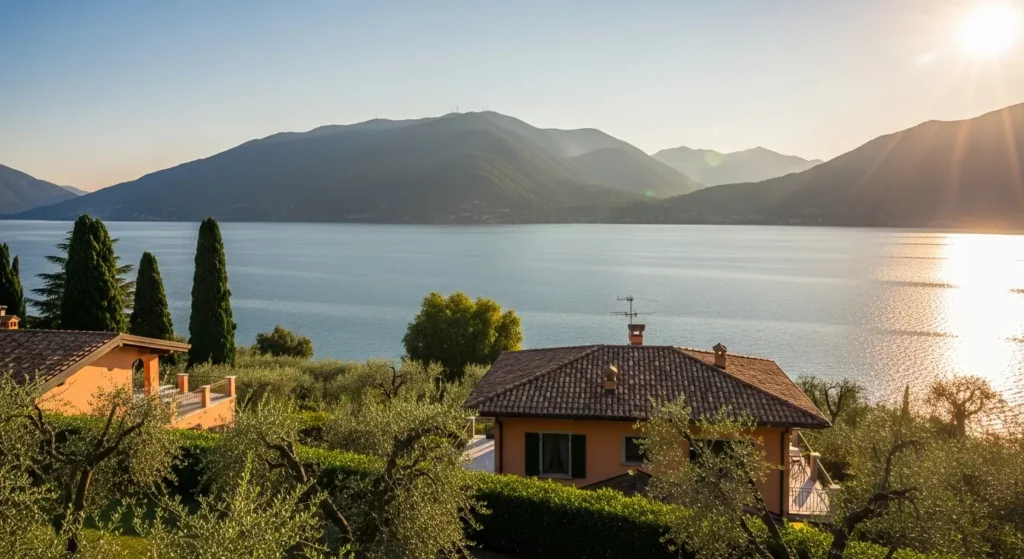
Lake Garda is attracting a growing number of international buyers drawn to its remarkable setting between mountains and turquoise waters. Buying property around Lake Garda, however, requires getting to grips with a distinctive real estate market and Italy-specific procedures.
This territory spans three regions (Lombardy, Veneto, and Trentino), with significant price variations depending on the area and the characteristics of each property. Navigating this market can feel complex when approaching it from outside Italy.
In this guide, we give you the tools to understand the local property market, the steps involved in a secure purchase in Italy, and the key points to watch for in this highly sought-after region. You will find price benchmarks by area, administrative procedures, applicable taxes, and the trade-offs to consider for a successful investment.
Aller en Italie
Relocation experts · since 2020
4.9
How many steps separate you from Italy?
A tailored offer based on your needs — in 3 min, no commitment
Tell us about your project
Profile, area, buying or renting
We select your services
From 50+ services in English
Receive your quote
Clear, detailed, personalized
*Indicative and customizable quote, no contractual commitment.
Free · 3 min · in English · no commitment
Create my offerBuying a house at Lake Garda: understanding the areas (Veneto, Lombardy, Trentino)
Lake Garda sits at the junction of three Italian regions, each with its own administrative and property market characteristics. This geography directly influences both the market and the buying process.
The lake's shoreline is divided mainly among:
- The eastern and south-eastern shore, part of the Province of Verona (Veneto region)
- The western shore, belonging to Lombardy
- The northern section, falling under Trentino-Alto Adige
This administrative division has practical implications for buyers: land registry services, planning regulations, and even some local taxes vary depending on the municipality and region where your future home is located.
Buying a house at Lake Garda: price benchmarks around Verona and regional comparison
In the area linked to Verona and in close proximity to the lake, the average price per square metre stands at around €2,808 (January 2026). This level is rising at approximately 5.9% per year.
These figures place the area above the Veneto regional average of around €2,176/m², which is itself growing at a slightly faster rate of approximately 6.9% annually.
Buying a house at Lake Garda: why the gap between central and peripheral areas matters
One of the defining characteristics of the Lake Garda property market is the significant price difference between central locations and the surrounding areas, even within the same province.
Central zones can show average prices reaching €4,105/m², while peripheral areas remain between €1,840 and €2,160/m².
Several factors explain these differences:
- Lake views (direct, partial, or none)
- Proximity and access to the waterfront
- Parking availability (critical during peak season)
- Exposure to seasonal tourist noise
- Availability of local amenities and shops
For a well-informed purchase at Lake Garda, it is essential to factor in these local characteristics, which have a strong influence on the final price.
THEY TALK ABOUT US
Maisons & Jardins · Le Figaro · Challenges
« Built on solid hands-on experience and an in-depth knowledge of Italian procedures. »
Jessica Colpin, co-founder — Maisons & Jardins France, Jan.–Feb. 2026
Lake Garda property: buying a primary or secondary residence — what are the practical differences?
Buying property at Lake Garda involves different considerations depending on whether it will be your primary or secondary residence. These differences have a direct impact on your project and its day-to-day management.
For a primary residence, you will need to establish your tax residency in Italy. This involves opening an Italian bank account and registering your address with the local authorities. The tax treatment is more favourable than for a secondary residence, particularly regarding the property tax (IMU).
For a secondary residence, you keep your tax residency in your home country, but you will need to manage the property remotely. Running costs are generally higher and the tax treatment less advantageous.
Lake Garda property: steps for buying in Italy (offer, preliminary contract, notary)
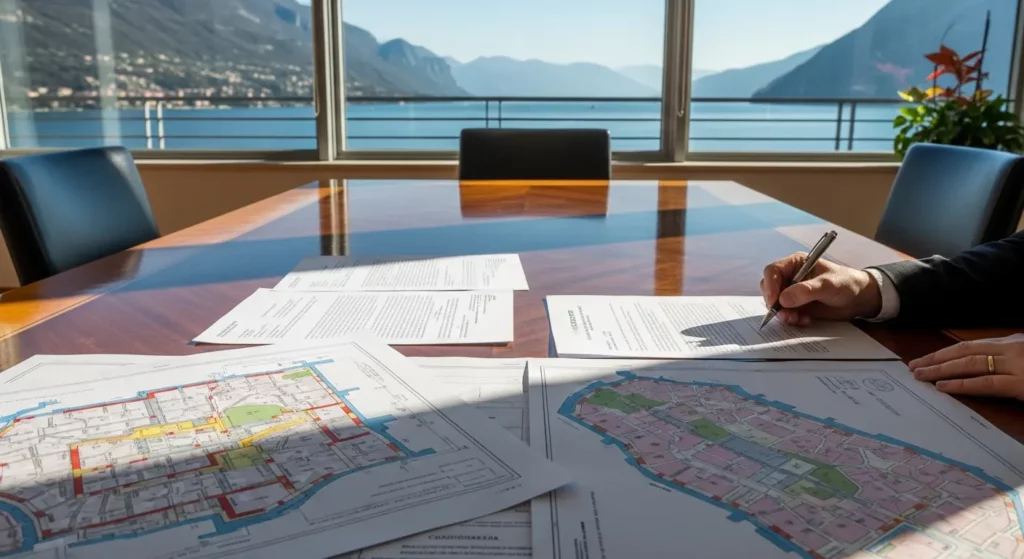
The property purchase process at Lake Garda follows Italian rules, with a few specifics worth knowing.
The first step involves carrying out essential checks before making any offer: consulting the land registry, verifying ownership titles, checking planning compliance, and reviewing any outstanding charges or mortgages.
Next comes the proposta d'acquisto (purchase offer), typically accompanied by a deposit (caparra confirmatoria) that commits the buyer. Unlike in many other countries, this commitment is made very early in the process and generally represents 10 to 20% of the purchase price.
The preliminary contract (compromesso or contratto preliminare) sets out all the conditions of the sale and may include suspensive conditions, although these are less common in Italy than elsewhere. It is a legally binding document that commits both parties.
The final deed (rogito or atto notarile) is signed before an Italian notary (notaio), who verifies the legality of the transaction and officially registers the transfer of ownership. The time between the preliminary contract and the final deed typically ranges from one to three months.
Lake Garda property: additional costs and taxes to budget for when buying
Purchasing property at Lake Garda comes with fees and taxes specific to the Italian system, generally representing 10 to 15% of the purchase price.
Registration taxes:
- Purchase from a private individual (primary residence): 2% of the price + €50 mortgage tax + €50 cadastral tax
- Purchase from a private individual (secondary residence): 9% of the price + €50 mortgage tax + €50 cadastral tax
- Purchase from a developer: VAT at 4% (primary residence) or 10% (secondary residence) + €200 mortgage tax + €200 cadastral tax
Notary fees: Calculated on a progressive scale based on the property value, generally between €1,500 and €3,000 for an average-value property. Budget for additional costs (€300–500) if you need translations or an interpreter at the signing.
Estate agent fees: Generally between 3 and 5% of the sale price, often shared between seller and buyer. Do not forget to include the cost of technical surveys (mandatory energy performance certificate) and any necessary compliance work.
After the purchase, you will need to budget for annual recurring costs:
- IMU (Imposta Municipale Unica): property tax varying by municipality and type of residence; exempt for primary residences except luxury properties
- TARI (waste disposal tax): approximately €100–300/year depending on floor area
- Service charges: highly variable depending on facilities (pool, concierge, maintenance), ranging from €500 to €2,000/year
Lake Garda property: financing and mortgages for non-residents
Obtaining a mortgage in Italy as a non-resident is possible but more restrictive than in many other countries:
- Italian banks typically lend up to 50–60% of the purchase price for non-residents (compared to 80% for residents)
- Minimum personal contribution required: 40–50%
- Interest rates slightly higher than for residents (approximately +0.5 to 1%)
- Documents required: proof of income for the last 3 years, tax assessments, bank statements
- Processing time: 2 to 3 months on average
Many international buyers prefer to arrange financing in their home country to secure better terms.
Aller en Italie
French expatriation expert · since 2020
4.9
73 verified reviews
1,500+ expats supported
50+ services with French-speaking professionals
20 regions covered
Local consultants based in Italy
Free appointment · 15 min · in French · no commitment
Book an appointmentVilla in Lombardy at Lake Garda: planning rules and restrictions near the waterfront
Buying a villa in Lombardy, particularly at Lake Garda, requires close attention to local planning regulations. These rules are often stricter near the shoreline to protect the exceptional landscape that makes the lake so renowned.
Properties near the waterfront are subject to specific constraints. You will need to check landscape protection zones, which can significantly limit your options for modifying or developing the property. These restrictions typically cover:
- Maximum building height
- Permitted construction materials
- Maximum footprint coverage
- Minimum distances from the shoreline (generally 150 metres)
- Preservation of lake views
- Permitted façade colours (often limited to traditional tones)
Before buying a villa in Lombardy in the Lake Garda area, always request the planning destination certificate (Certificato di Destinazione Urbanistica). This official document specifies the constraints applicable to the plot and will be required by your notary.
Villa in Lombardy at Lake Garda: extensions, pools, energy renovation — what to check
For owners wishing to develop their villa, several points deserve particular attention:
Regarding extensions: Check the building density index (indice di edificabilità), which determines the maximum buildable area on your land. In some sought-after areas of Lake Garda, this index can be very restrictive or even zero, preventing any extension.
For swimming pool construction: Generally possible but requires specific authorisation (permesso di costruire or SCIA). Allow for administrative lead times of up to 3 to 6 months depending on the municipality. Some protected zones prohibit pools entirely.
For energy renovation, Italy now requires compliance with energy performance standards (APE – Attestato di Prestazione Energetica), which can be demanding for older buildings. Before buying a villa in Lombardy that requires renovation work, have the following checked:
- Compliance of electrical and heating installations (mandatory compliance certificate)
- Whether solar panels can be installed (often restricted in protected areas)
- The condition of insulation and scope for upgrading
- The property's current energy rating (from A4 to G)
- Available tax incentives for renovation works (Superbonus, Ecobonus)
A partially renovated property can conceal costly surprises. Take the time to examine the technical file thoroughly and do not hesitate to call on a local expert (geometra or architect) to accurately assess the extent of work required.
Villa in Lombardy at Lake Garda: common mistakes to avoid
Certain mistakes come up repeatedly when buying a villa at Lake Garda:
- Overlooking right-of-way easements: Many properties have access rights for reaching the lake that limit your use of the land
- Underestimating maintenance costs: A large property with garden and pool can cost €5,000–10,000/year to maintain
- Failing to check road access: Some older villas have narrow driveways unsuitable for modern vehicles
- Not transferring utility contracts: Water, electricity, and gas connections must be transferred to your name promptly
- Ignoring tourist tax obligations: If you rent out your property, you must collect and remit the tourist tax
Investing at Lake Garda: key points for your property project
Buying a property at Lake Garda is a significant commitment that goes well beyond a simple transaction. As we have seen, this market shows substantial price differences between areas, with an upward trend in recent years (annual growth of 5.9% to 6.9%). The foundation of a successful purchase lies in a thorough understanding of Italian procedures, planning constraints, and the additional costs that come with your investment.
To invest at Lake Garda with confidence, prioritise location quality, the administrative compliance of the property, and an accurate assessment of the total cost (including 10–15% in additional fees) rather than focusing solely on the asking price. Also budget for annual recurring charges and set aside a maintenance reserve fund.
Before committing, build a comprehensive checklist covering: land registry checks, planning compliance, assessment of required works, calculation of total costs, financing confirmation, and consultation with an Italian notary. Explore our other guides on buying property in Italy to deepen your preparation and secure your project.
No products found
Lake Garda FAQ: prices, demand, and comparisons
Lake Garda: are prices higher than the Veneto average?
Yes, certain areas close to Verona show average prices above the Veneto regional average. The Verona area and its proximity to the lake yield average prices of around €2,808/m², compared with the Veneto average of approximately €2,176/m².
Lake Garda: why are there such large price differences between areas?
The differences are mainly driven by location (central vs. peripheral), with gaps that can be as much as double. For example, prices in central areas can reach around €4,105/m², compared with €1,840–2,160/m² in peripheral zones. Lake views, direct water access, and parking availability also have a strong influence on prices.
Lake Garda: has the market been trending upward in recent years?
Yes, recent data shows annual growth of approximately 5.9% in the Verona area and 6.9% at the Veneto regional level. Demand is rising for both purchases and rentals, which is helping to sustain this upward trend.
Lake Garda: what specific checks should you carry out before buying near the water?
Check planning compliance carefully and look for any landscape protection designations that may restrict works near the shoreline. Also verify that the property is free of mortgages, review any easements granting lake access that could affect your use of the land, and request the planning destination certificate (CDU).
Lake Garda: what is the difference between buying as a primary or secondary residence?
The main differences relate to taxation: registration tax is 2% for a primary residence versus 9% for a secondary residence. IMU (property tax) is exempt for a primary residence (except luxury properties) but applies to a secondary residence. A secondary residence also involves remote management, potentially higher service charges, and more complex banking procedures.
Lake Garda: how much should you budget for total purchase costs?
Budget between 10 and 15% of the purchase price in additional costs: registration taxes (2–9%), notary fees (1–2%), agent fees (3–5%), surveys, and any translations required. For example, on a property priced at €300,000, expect between €30,000 and €45,000 in additional costs depending on your situation (primary or secondary residence).
Lake Garda: how long does the purchase process typically take?
The full process generally takes 3 to 6 months: preliminary checks (2–4 weeks), signing the preliminary contract (2–3 weeks after offer acceptance), then the period up to the notarial deed (1–3 months). If you need a bank loan, add a further 2–3 months for the application process.